Itihas Diwakar - October 2019
Table of Contents
- Editorial
- Personality
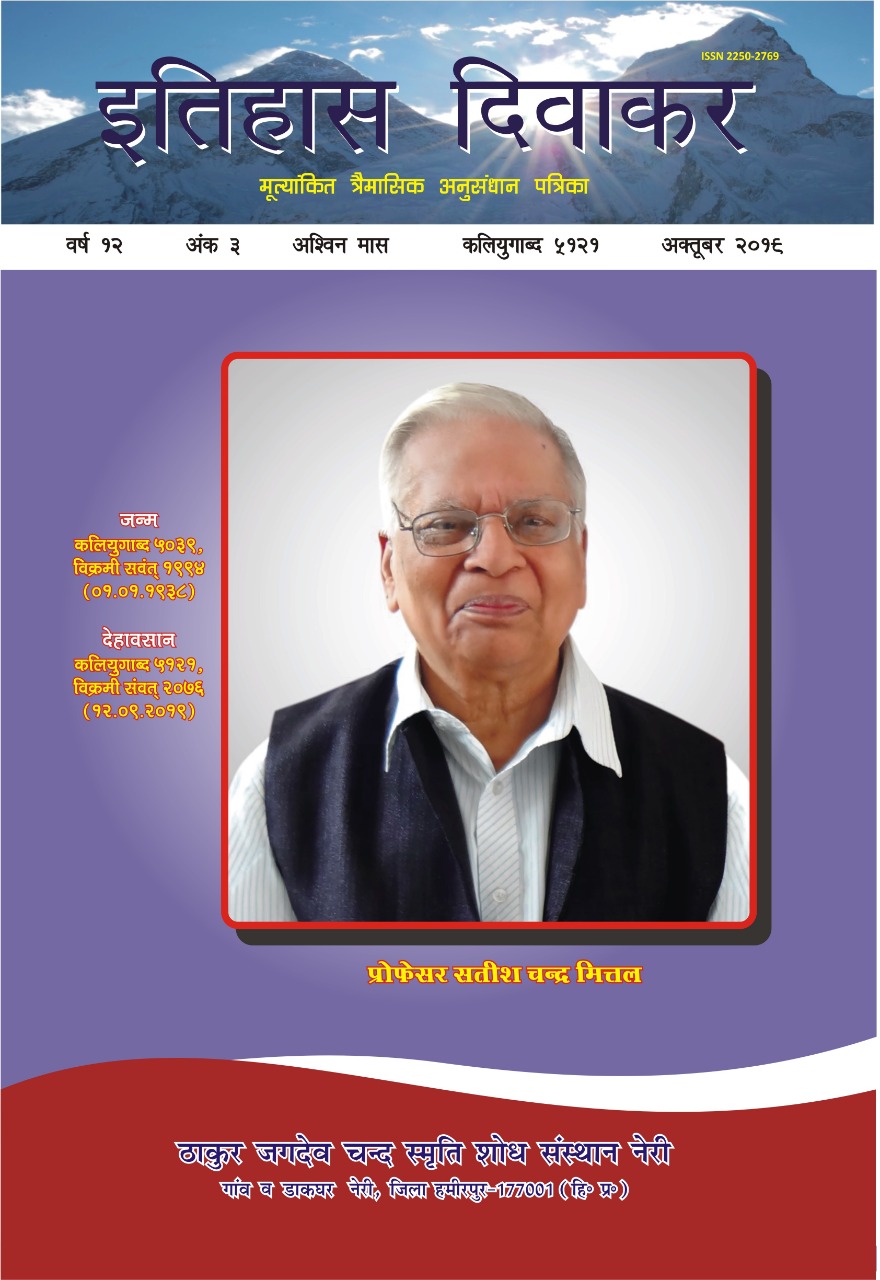
- Nationalist Historian – Prof. Satish Mittal (Chetram Garg)
- Review
- Indian Land Survey in the Colonial Period (Lucky Sharma)
- Contemporary Depiction in the Poetry of the First Guru of Dashguru Tradition, Shri Nanak Dev Ji (Dr. Kuldeep Chand Agnihotri)
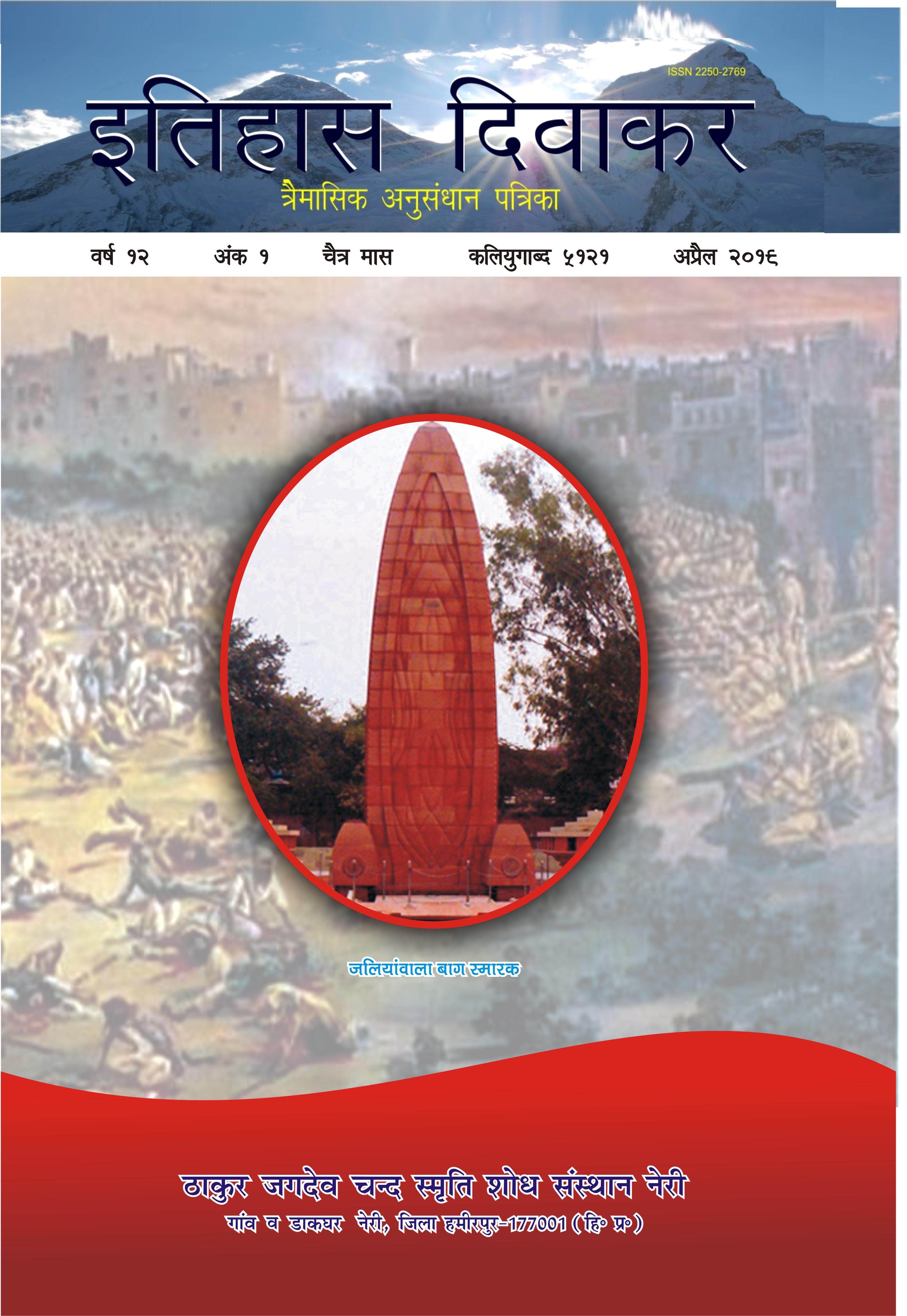
- Jallianwala Bagh Massacre: The Sacrificial Tradition (Dr. Prashant Gaurav)
- Gandhi in the Perspective of Cultural Nationalism (Dr. Jaiprakash Singh)
- Contribution of Kasauli in the Great Revolution of 1857 (Dr. Om Prakash Sharma)
- Time Analysis in Shrimad Bhagavat Purana (Dr. Om Dutt Saroch)
- A Continuously Struggling Warrior – Pandit Jaikrishna Sharma (Bhumi Dutt Sharma)
- The Path of Aim
- Activities (Pyar Chand Parmar)
Editorial
For the Nation, Not for Me
The sudden demise of the renowned historian Prof. Satish Mittal is an irreparable loss for nationalist thinkers and historians. From his childhood, Mittal ji was associated with the Rashtriya Swayamsevak Sangh, the influence of which is directly reflected in his writing and studies. He was a founding member of the Akhil Bharatiya Itihas Sankalan Yojana Samiti and, while holding various national responsibilities, remained its national president from 2012 until now. Prof. Mittal refuted the false theories fabricated by British imperialist powers with his powerful writing based on true evidence. He also criticized those so-called historians who, despite being scholars of so-called history, were only nurturing European ideas. In this issue, his interview and memoir with the director of the research institute, Chetram Garg, is also included. We respectfully dedicate this issue at the feet of such a great man.
The central government's historic decision on the Kashmir issue and the bold decision on triple talaq were at the center of this quarter's political landscape. This effort reflects the results of having a strong government at the center. The Chandrayaan-2 mission is a major milestone in India's space journey. The courage and hard work of the scientists in this direction paves the way for the nation's progress. Last month, a two-day symposium on the 'Jallianwala Bagh Massacre' was organized under the joint auspices of the research institute and Himachal Pradesh University, Shimla.
This issue is dedicated to the readers, focusing on aspects of Guru Nanak Dev Ji's 550th Prakash Utsav, Gandhi Ji's 150th birth anniversary, the Jallianwala Bagh massacre, and other related topics. Suggestions and encouragement are welcome. With best wishes for Diwali.
Nationalist Historian - Prof. Satish Mittal
Chetram Garg
Prof. Satish Mittal was born on January 1, 1938 (Kaliyugabd 5039, Vikrami Samvat 1994) in the Kanghla town of Muzaffarnagar district, Uttar Pradesh. He completed his M.A. in History from Agra University, M.A. in Political Science from Panjab University, and obtained his Ph.D. from Kurukshetra University, Haryana, for his research thesis on "Freedom movement in Punjab 1905-1929". He taught at R.K.S.D. College, Kaithal for a few years, after which he served the nation for three and a half decades as a professor in the History Department of Kurukshetra University. On September 12, 2016, he was the chief speaker at a ceremony in Gorakhpur temple organized on the 115th birth anniversary of Brahmalin Mahant Digvijaynath. After the program, he passed away in Gorakhpur at 5:30 PM due to a sudden cardiac arrest. This is an irreparable loss in the field of nationalist history writing.
Prof. Satish Mittal was an epitome of human compassion, faith, and history. In the field of history, he especially exposed the false theories fabricated during the British imperial period in India and brought the true evidence of Indian history before society. Prof. Mittal was a very cheerful, hardworking, and simple-natured person. He became a swayamsevak of the Rashtriya Swayamsevak Sangh in his childhood.
Indian Land Survey in the Colonial Period
Lucky Sharma
Historians generally agree that colonialism in India emerged after the Battle of Plassey. European companies were initially attracted to the natural resources of the East and expanded their territories accordingly. After devastating various provincial powers and the hollow Mughal empire, the British emerged as the strongest among the various European powers. Wellesley, the victor of Srirangapatnam, first felt the need for a land survey to facilitate tax collection, travel, and territorial expansion.
The British power was aware that for the establishment of a strong and stable system of governance and for regular and balanced tax collection, land measurement was an essential process. In this effort, the British East India Company primarily initiated three types of land surveys: Revenue Survey, Topographical Survey, and Trigonometrical Survey. All three types of surveys were started for various purposes at about the same time (1799-1802 AD).