Editorial
Memorable Historical Moments
The Ardh Kumbh of Prayagraj has left its indelible mark on the pages of history. This grand confluence of arrangements, the flood of faith, and awareness of its own traditions and beliefs attracted everyone from the Prime Minister of the country to the common man, witnessed by the world's media. The praise for Uttar Pradesh's Chief Minister Yogi Adityanath was on the lips of every Kumbh pilgrim. And why not? Along with being the Chief Minister, he left no stone unturned in making the arrangements for the confluence of Hindu faith attractive and convenient, providing tangible proof of being a Yogi.
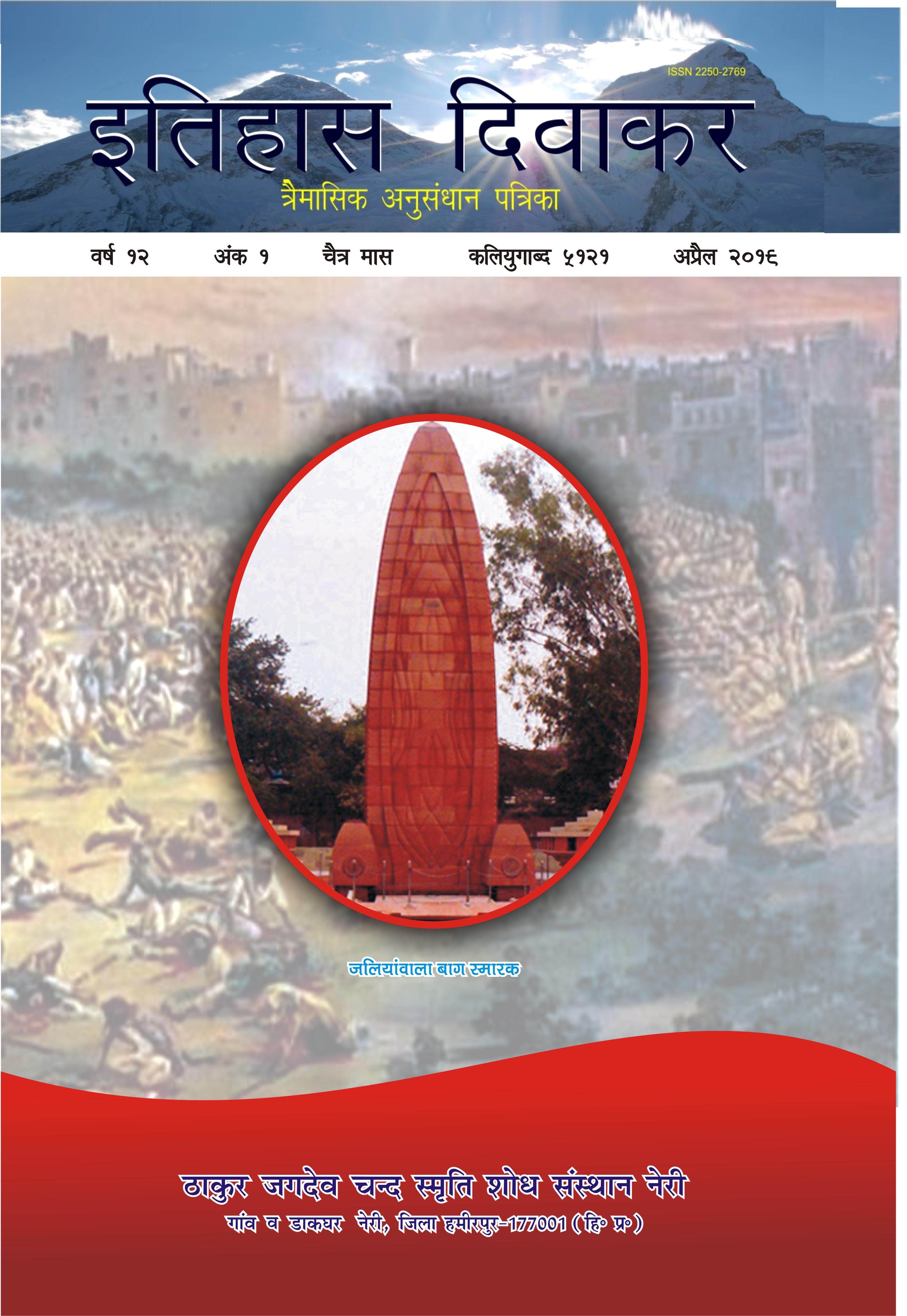
The pages of history are not just a record of our past memories. They also keep in mind the challenges and opportunities to come. This year, there are some historical events whose remembrance is necessary for every Indian - the hundredth year of the Jallianwala Bagh massacre, the 150th birth anniversary of Mahatma Gandhi, and the birth centenary of Padma Shri Vishnu Shridhar Wakankar are significant. The living memory of facing and resisting the atrocities of imperialist powers is the shower of bullets on the unarmed public by General Dyer on the day of Vaisakhi. The black deeds of the imperialist powers are a stain on humanity and civilization. Dr. Kuldeep Chand Agnihotri's article describes that scene. In this issue, the life story of the famous archaeologist and artist Padmashri Vishnu Shridhar Wakankar is an inspiration for all.
Navsamvat - Classical Perspective and Folk Tradition
Dr. Om Dutt Saroch
In Indian culture and tradition, the Vikrami Samvat is used in a practical sense. Although many calendars like Shaka Samvat, Kali Samvat, Srishti Samvat, Nanakshahi, and Krishna Samvat are in vogue, religious, cultural, and traditional activities in North India are conducted based on the Vikrami Samvat. The Government of India also gives importance to the Shaka Samvat for official purposes. It is a special fact that whenever the new year (Samvatsar) has begun in India, it has always been associated with the Indian Srishti Samvat.
The new Vikrami Samvat begins from Chaitra Shukla Pratipada. According to Indian classical belief, on this day Brahma started the work of creation, and Emperor Maharaj Vikramaditya of Ujjain liberated the land of India from foreign invaders and started the new Vikrami Samvat on this very day. The Vikrami Samvat 2076 is starting from Chaitra Shukla Pratipada (sunrise-pervading) on Saturday, April 6, 2019. According to the sequential succession of the cycle of sixty Samvats, each Samvat has a name. The Samvat 2076 is the forty-sixth Samvat named 'Paridhavi' of the Samvat cycle.
The Jallianwala Bagh Massacre and Its Aftermath
Prof. Kuldeep Chand Agnihotri
To understand the background of the massacre that the British government committed in Amritsar, Punjab, on April 13, 1919, it is necessary to understand the political background of that time. Indians had made their first organized attempt to drive the British out of the country in 1857, which is called the first war of independence in history. This struggle took place a full hundred years after the British had established their control. Due to the defeat in the first war of independence in 1857, a new enthusiasm was building up among Indians to end slavery.
On the other hand, there were also Indians who did not recognize Her Majesty at all. They believed that the British government in India was not established by the authority of any act or constitution. This government was established purely on the basis of force, which is also called brute force in political science. That is, this government was established on the basis of the gun. Therefore, force should be used to uproot it. To continue struggling for partial participation in power through acts passed by the British Parliament is not only to indirectly recognize the British government in India but also to deliberately get caught in their web. These Indians were called revolutionaries in the eyes of the common people, but in the vocabulary of the British government, they were called anarchists.
Archaeological Study of the Martand Sun Temple of Kashmir
Dr. Satish Ganju, Banita Rani
We get to see many ancient grand temples in Kashmir. Among them, the 'Martand Sun Temple' holds special importance from an archaeological perspective. It is located in Kashmir's Anantnag, on the way to Pahalgam, a short distance away at a place called 'Mattan'. The Sun Temple is world-famous for its grandeur and can also be called the 'Cyclops of Kashmir'. It holds a special place in the early Indian architecture, sculpture, and carving arts of India. Some scholars have tried to find a mixture of the elegance of Egyptian and Greek architecture in India's famous Sun Temple.
Architecture
The architecture of the Martand Temple showcases Kashmiri Hindu art. Blue limestone was used in the construction of this temple. In ancient Hindu temples and royal palaces, a mixture of limestone and urad dal (black gram) was used for its strength and shine. The archaeological department still uses this mixture for the conservation of ancient monuments.