Itihas Divakar - October 2018
Editorial: From Practice to Behavior
The Rashtriya Swayamsevak Sangh (RSS) is the world's largest non-political organization. Its foundation is cultural nationalism. It emphasizes character building. The pervasiveness of this idea is present in some form throughout the entire world. It does not consider anyone its enemy. To those who consider it their enemy, it extends an open invitation: "Come! See the workings of the Sangh. If there is something wrong, tell us." The eternal thought of India, "Sarve Bhavantu Sukhinah" (May all be happy), is the effort taught in the Sangh's shakha system. This is a matter of turning practice into behavior. The publicity department of the RSS's Delhi province organized a program for enlightened citizens on the topic 'Future of India' at Vigyan Bhavan, Delhi, from September 17-19, 2018. In it, the honorable Sarsanghchalak Mohan Rao Bhagwat ji answered questions posed by enlightened citizens on the Sangh's ideology and related subjects. A part of his address on September 18 is being published in this issue. It is in his style of address. No changes have been made.
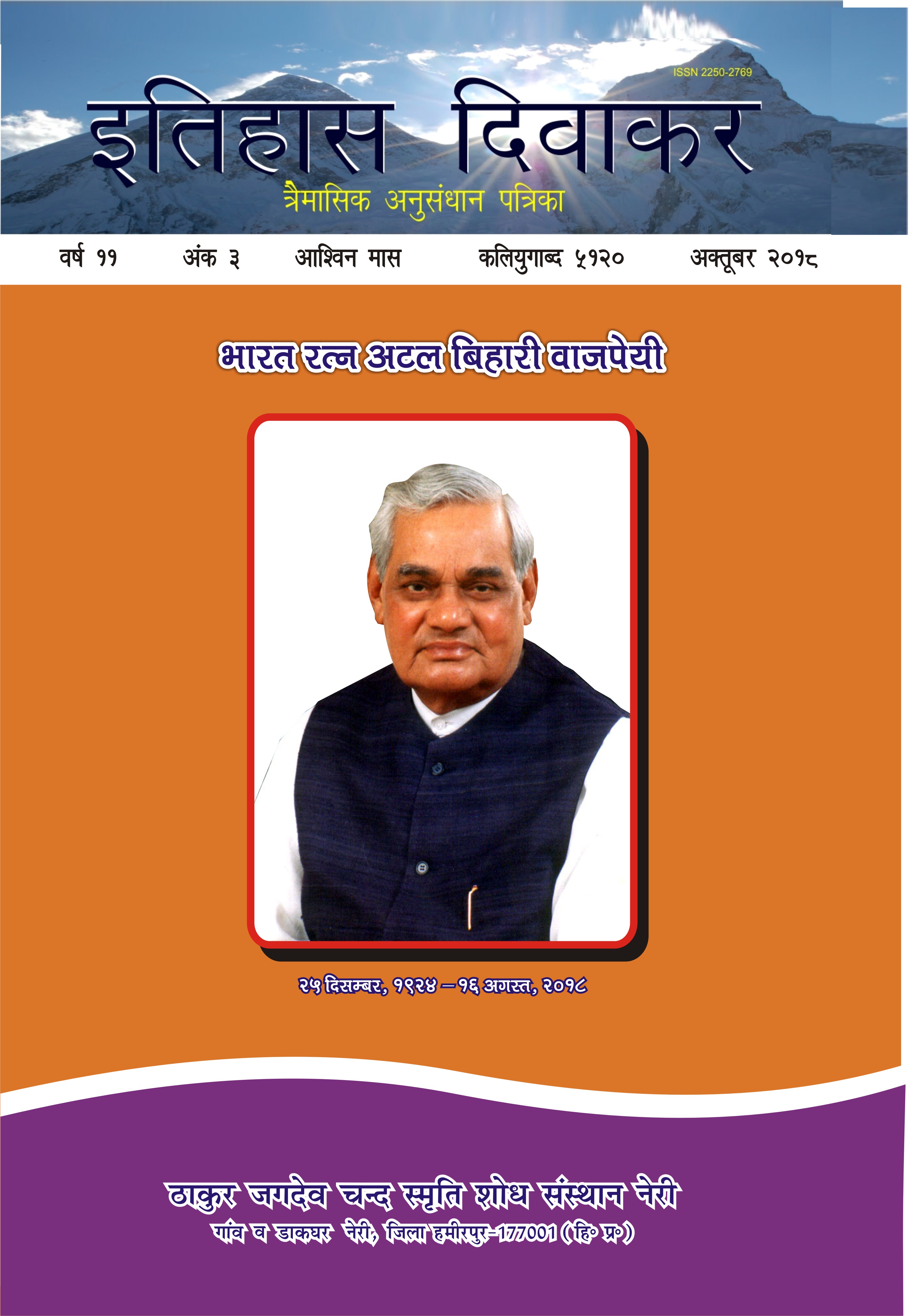
The demise of India's former Prime Minister, Shri Atal Bihari Vajpayee, is an irreparable loss. Vajpayee ji was an institution in himself. His personality was immense. Nurtured in the ideology of the Rashtriya Swayamsevak Sangh, he was the first Prime Minister whose image and personality connected everyone. The Itihas Divakar family prays for peace for the departed soul of such a great personality.
This year, the monsoon in India came in a fierce form. More than half of Kerala was submerged in water. Snowfall in Himachal Pradesh in September will be considered an प्रकोप of nature. These natural disasters have caused immense damage to life, property, livestock, and crops. It is also important for the government, while making development plans, to focus not just on material comforts but also on the problems arising from excessive interference with nature. The research paper presented by Dr. Bhag Chand Chauhan is one that opens new dimensions. Best wishes to all for the upcoming series of festivals - Dussehra, Diwali, Bhai Dooj, etc.
Discourse: India is a Cultural Nation
Dr. Mohan Rao Bhagwat
Honorable Sanghchalaks present on the stage. All respected dignitaries, mothers, and sisters. The work of the Sangh is the work of character building; after individuals are built, they create an atmosphere in society. They try to bring about a change in the conduct of society, and this is a completely self-reliant and collectively run work, a work of free will. Coming and going is free of charge, and there can be no question of coercion because there is nothing in hand to coerce with, only our friendship. As the work grows, the Swayamsevaks have been taught that the Sangh will do only one thing: character building, but the Swayamsevak will do whatever is necessary in the interest of society. As strength grows, the Swayamsevaks needed to run the Sangh are not left idle. Whatever they understand in society, they take up some work accordingly. If someone else is doing it, they join them with discipline.
Review: The Historicity of Manu and Manali: A Scientific Observation
Dr. Bhag Chand Chauhan
The surprising correspondence between Indian time-reckoning and modern scientific time-reckoning, as presented by Prof. Carl Sagan in his book 'Cosmos', is indicative of the amazing wisdom, intellect, and mental excellence of the Indian sages. The mantra-seeing sage, in a state of deep meditation, composes the Vedic mantras through a divine vision from the Supreme Being. The interesting thing is that the profound mysteries of these Vedic mantras have been presented in detail in various philosophical texts, Puranas, Smritis, and many other scriptures by numerous sages across different time periods, according to public interest and capacity. Among the four Vedas, the Rigveda is today indisputably considered the oldest available written text in the entire world. There are several hymns in the Rigveda about the creation of the universe, in which hymns like Hiranyagarbha, Nasadiya, and Purusha Sukta express the truth of the creation of the cosmos.
Atal Ji's Life Journey
Dr. Indra Singh Thakur
Atal Ji was born in the Brahma Muhurta in the Shinde locality of Gwalior in Kaliyugabd 5026, Vikrami Samvat 1981 (May 25, 1924). His school certificate states his birth was two years later, in 1926. Pt. Krishna Bihari had four sons: Avadh Bihari, Sada Bihari, Prem Bihari, Atal Bihari, and three daughters: Bimla, Kamla, and Urmila. The family was full and complete. The purely Indian atmosphere of the family began to be ingrained in Atal Ji from his childhood. This is why even today, Atal Bihari Vajpayee is the emperor of the hearts of the Indian people. The ocean of immense faith for him in the public mind continues to surge. Even after his passing, his popularity graph has always been rising. Atal Ji remained a lifelong bachelor. Whenever his parents discussed marriage, he would flatly refuse. He had dedicated his life to the service of Mother India.
Atal Ji's Connection with the Sangh and National Thought
Rishi Kumar
Atal Bihari Vajpayee's image has been that of a skilled politician, a visionary, and a timeless poet. His personality was universal and all-encompassing. Politics is the most difficult field of social life, demanding ceaseless dedication. To emerge untainted and spotless after remaining in such a crucible for 60 consecutive years is no less than a miracle. His strong nationalism, resolve, patriotism, pride in language, leadership ability, and despite all these great qualities, his ability to remain humble, was all possible due to his Sangh shakha training and his identity as a Swayamsevak.