Itihas Divakar - October 2016
Editorial
The Eternal Culture of Om Shanti (Peace)
The sentiment of 'Sarve Bhavantu Sukhinah' (May all be happy), inspired by the sages, is naturally pervasive in the Indian psyche. The eternal tradition of 'Om Shanti' is inherent in this nature of the national consciousness. All our traditional rituals are completed with a peace invocation (Shanti Path). In the Yajurveda, the mantra of the Shanti Path expresses the desire for the goal of peace everywhere:
Dyauḥ śāntirantarikṣaṁ śāntiḥ pṛthvī śāntirāpaḥ śāntiroṣadhayaḥ śāntiḥ | Vanaspatyaḥ śāntirviśve devāḥ śāntirbrahma śāntiḥ sarvaṁ śāntiḥ śāntireva śāntiḥ sā mā śāntiredhi ||
May there be peace in the celestial realm, peace in the sky, peace on earth, peace in the waters, peace in the herbs, peace in the plants, peace among all the gods, peace in Brahman, may everything be peaceful, may peace itself be peace, and may that peace come to me.
In India, blessed with the eternal culture of peace, the power of valor has never been neglected. When demonic forces like Subahu, Tadka, Maricha try to disturb the peace, it becomes necessary to use power to establish it. On the night of September 28-29, 2016, corresponding to Ashwin Krishna Trayodashi, Kaliyugabda 5118, the Indian army conducted an undeniably brave and unimaginable operation on terrorist camps in Pakistan-occupied Kashmir, which was widely praised by the Indian government and army. The principle of 'shathe shathyam samacharet' (treat the wicked with wickedness) gives this appropriate action great historical significance. This action follows the teaching of the Srimad Bhagavad Gita that it is not a sin to fight while performing one's duty on the path of action: 'tato yuddhāyayujyasva naivaṁ pāpamavāpsyasi ||'
This fulfillment of duty, performed with national devotion, wisdom, and promptness, is the best path to establishing national security and peace.
Om Shanti! Shanti! Shanti!
Review
Spiritual Life - The Goal of Humanity
Swami Ranganathananda
Never in the history of humankind has there been a more urgent need to explain the goal of human existence than there is today. This is not merely a question of intellectual curiosity, but a question that spontaneously arises in the hearts of all men and women, ordinary and extraordinary, Eastern and Western, in the modern age. In the light of its religious heritage, for thousands of years, humanity has considered spirituality to be the goal of human life. However, due to the intellectual and social revolution initiated by Western European nations, the strength of that religious heritage has weakened in recent centuries. Therefore, it is necessary to review the nature of that revolution and, in its light, to redefine the goal of human existence. The entire world has felt the severe impact of the powerful mechanistic civilization that emerged in Western Europe in the seventeenth century due to the critical and experimental methods of modern science....
Ancient India: The Cradle of Knowledge & Information
Dr. B. C. Chauhan
Since the time immemorial India has been a phenomenal source of fascination and a great material concept, knowledge and information resources to the planet. Takshashila University (in Pakistan now) was a great centre of learning where more than 10,500 students from all over the world used to study about 64 subjects. The other great Indian Universities viz. Nalanda, Vikramashila, Vallabhi and Odantapuri were the ancient light houses of knowledge and learning centres for the scholars of the whole world. To see the knowledge and educational developments in ancient India a need arises to go through the socio-economic, political and cultural history of the wonderland. In this work some light is being shed on the historical facts which divulge India as the origin of most of the scientific discoveries and inventions that have been credited by the western people. The inferences have been supported by the facts, findings and quotes of the historians and scholars. Contribution of the ancient Indians towards the broadening of the horizon of human consciousness is very great and quite legitimately the Indians must proud of it.
Agriculture Perspective
Crops of Kullu
Maulu Ram Thakur
Just as the Kullu district of Himachal Pradesh is geographically isolated from other parts of the country, it also has some distinctiveness in terms of agricultural production. Like other parts of the country, Kullu is also an agricultural region. In fact, it should be said that Kullu is completely dependent on agriculture. Yes, it can certainly be said that cash crops are grown here in greater abundance than other crops. Kullu is blessed with various natural gifts. While on one hand there is commendable wheat production, on the other hand, crops like potatoes, garlic, and fruits like apples are also abundant....
Personality
The Glorious Commander of Garhwal, Madho Singh Bhandari
Dr. Sushil Kumar Kotnala
Madho Singh Bhandari was one of the three main commanders of Mahipat Shah (reign 1626-1646), the 46th Parmar dynasty king of the Garhwal kingdom, along with Rikhol Lodi and Banwari Das. Madho Singh Bhandari is a renowned great warrior in Garhwal. The credit for transforming the flat but barren land of Maletha into irrigated agricultural land goes to Madho Singh Bhandari. Only coarse grains were produced in the fields of Maletha. His wife Udina complained to him about this. On this, the brave Madho Singh Bhandari, with the cooperation of the people of Maletha village, built a canal from the Chandrabhaga river flowing in the north of the land to the flat land of Maletha....
Path of the Goal
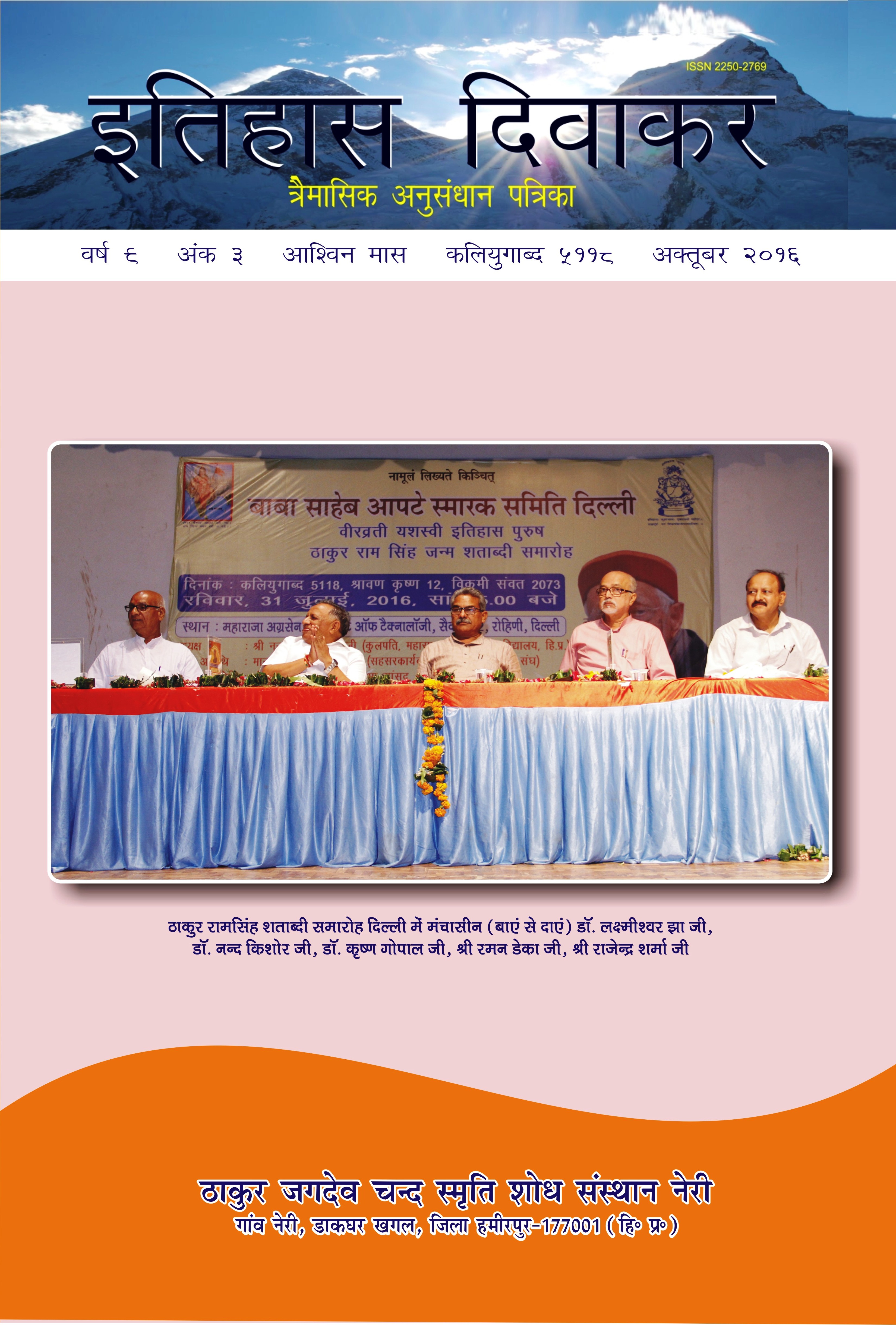
Thakur Ramsingh Centenary Celebration
Chetram Garg
Under the Thakur Ramsingh Centenary Celebrations, a grand event was organized in the auditorium of Agrasen Technical Institute, Rohini Sector 18, on the evening of July 31, 2016 (Shravan Krishna 12-13, Kaliyugabda 5118, Vikrami Samvat 2073) at 5 PM. The chief guest of the program was the Honorable Krishna Gopal Ji, Sah-Sarkaryavah of the Rashtriya Swayamsevak Sangh. Lok Sabha MP from Assam, Raman Deka Ji, was the special guest on this occasion. The program was presided over by Dr. Nand Kishore Ji, Director of Agrasen Institute....