Editorial
The Great Hero of Cultural Consciousness
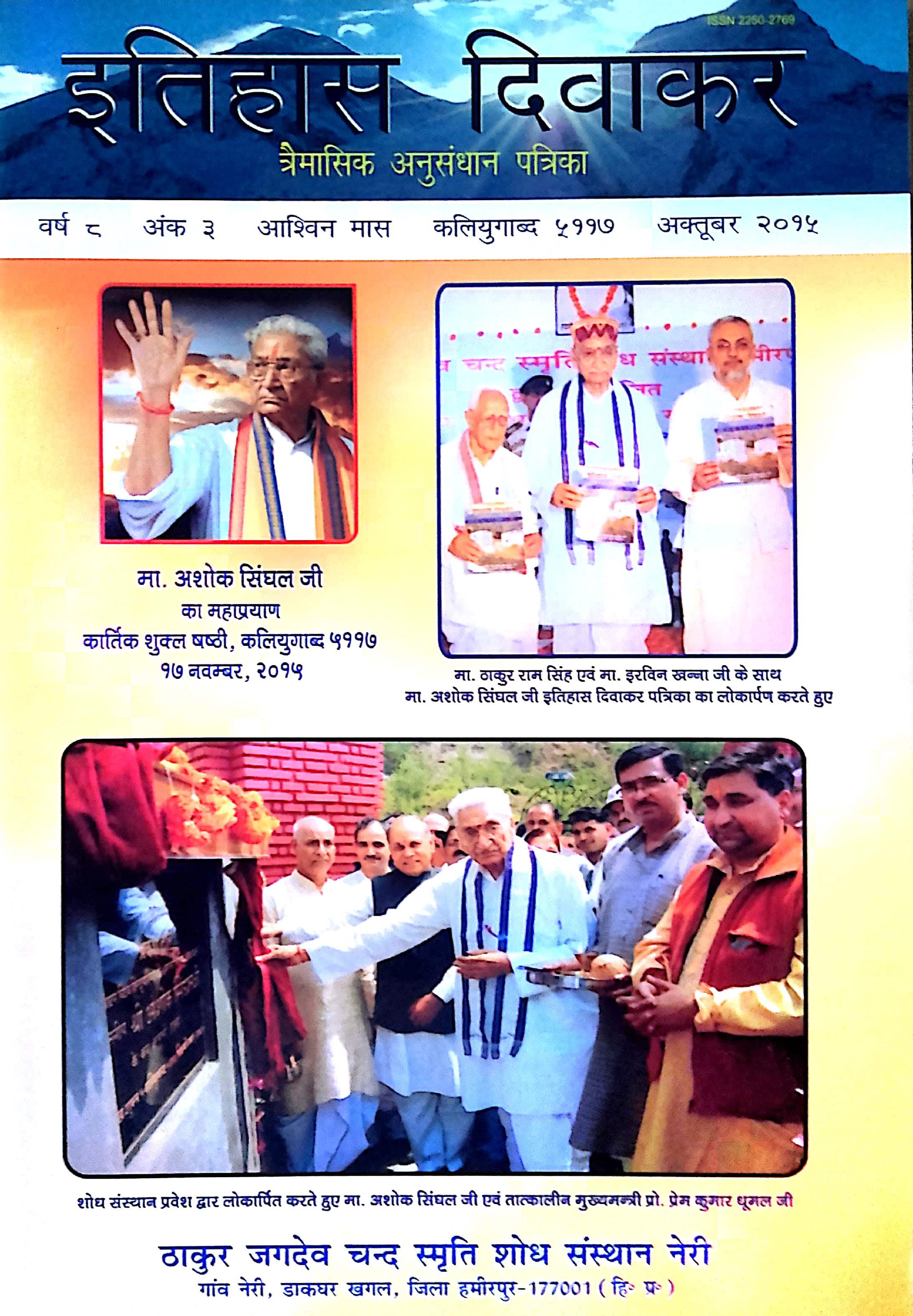
Shri Ashok Singhal ji, the great hero of cultural consciousness, imbued with the ideal eternal life values of the Indian nation, left his mortal body and merged with the divine on Kartik Maas, Shukla Paksha, Shashthi Tithi, Kaliyugabda 5117, corresponding to November 17, 2015. Shri Singhal ji was born on Ashwin Maas, Krishna Paksha's Panchami Tithi, Kaliyugabda 5028, on September 27, 1926, at the home of his father, Shri Mahavir Singhal, in Agra city, Uttar Pradesh.
Throughout his life, Shri Singhal ji remained dedicated with immense courage, patience, and seriousness to the cause of awakening the pride of the Hindu society, which is the sustainer of India's eternal flow and global welfare. He gave a unique prestige and expansion to the Vishwa Hindu Parishad. Singhal ji brought the Ram Janmabhoomi movement to a significant conclusion and, for the construction of a grand Ram Mandir, he embraced the vow of Hanuman, 'Ram Kaju Kinhe Binu Mohi Kahan Vishram' (No rest for me until the work of Ram is done), and remained a lifelong warrior.
A three-day national seminar on the theme 'Srishti Rachna Vichar in Lok Parampara' (The Idea of Creation in Folk Traditions) was organized at the Research Institute in Neri on Vaishakh Shukla 5, 7, 8, Kaliyugabda 5110, corresponding to May 10, 11, 12, 2008. In the inaugural ceremony of this seminar, the revered Singhal ji graced the occasion as the chief guest. On this occasion, the grand entrance gate of the research institute campus was inaugurated by his hands. Subsequently, on the event stage, the inaugural issue of the 'Itihas Divakar' magazine was released by him, and in his address on the occasion of the seminar, he said that the world's great scientific researchers, as they advance in their research work, are getting closer to Indian thought. There is a need to strengthen this. The kind of research institute that has opened here, it is through the efforts of such research institutes that we will be able to understand our history. The important links of our history are safe with the common people in the form of folklore. People engaged in collecting material related to folk life are doing important work for history. Society will take inspiration from these works, and India will emerge as a powerful nation.
The mighty endeavor and supreme guidance of the great hero of cultural consciousness, the revered Singhal ji, is a priceless inspiration for moving forward on the right path.
Inspiration for Crores: Ashok Singhal Ji
Dr. Pravin Togadia
When Ashok Singhal ji placed his hand on my shoulder and said, 'We will all build a grand Ram Mandir together, we will all resurrect the Hindu nation together,' I was 36 years old. In 1992, I went to Ayodhya from Gujarat with the youth of the Vishwa Hindu Parishad. Ashok ji had strength in his hands, and confidence was reflected in his eyes. He was 66 years old then. Many years before that, at the age of 10, I had joined the Rashtriya Swayamsevak Sangh. Not just me, Ashok ji inspired lakhs of youths and made them dedicated to the service of Mother India and Hindus.
That a grand temple of Lord Shri Ram should be built in Ayodhya at the very birthplace of Ram ji was not just his dream; it was his indomitable faith, the unwavering commitment of his life. Day and night, Ashok ji worked for it. The pracharaks and swayamsevaks of the Sangh learn organizational skills, and work, movements, service—all of these involve planning and discipline, which are an indivisible part of such a personality. Ashok ji was also like that. Not just today, but even then, when TV, internet, and social media were not prevalent, it used to happen that about people doing great work, news that was narrow, based on incomplete information, or under government pressure, would be published—less positive and more distorted—to tarnish their image. Ashok ji was never affected by any of this. Besides the Ram Mandir, Ashok ji did many great things for this country.
Ashok ji developed the unique concept of 'Dharma Sansad' (Religious Parliament). It was not an easy task to unite the saints and sages from home and abroad under one powerful banner for the welfare of the nation and the Hindu nation. Ashok ji established the Dharma Sansad. Its scope and importance grew to such an extent that a single word, a single resolution from the Dharma Sansad on various issues began to take the form of an authoritative direction. Ashok ji once told me, 'In England, the Prime Minister, and in America, the President, take their oath in the name of 'God', and at that time, their Paris's Father is present on the stage or near the podium with them. Yet, in the world, these countries are called 'secular'. Will there ever be a time in our country when our Dharma will decide the direction of this country's politics, and when the country's leaders take their oath, the heads of our Dharma will be with them, giving blessings with the same respect? It will happen!' This indomitable hope of his was a source of inspiration for him and the Hindus of this country. When the government announced the project to break the Ram Setu in Rameswaram, Ashok ji was shocked that anyone could even make such a wicked plan! Under the guidance of the Sangh, when the Vishwa Hindu Parishad launched a nationwide movement to save Ram Setu.
Karmayogi Mahamanav (The Great Karmayogi)
Champat Rai
Swami Satyamitranand Ji had said that Ashok ji should have been called a Mahatma at the age of 60 itself. In India, there are all kinds of worship practices and philosophical paths, but Ashok Singhal ji was the person who brought the saints, mahatmas, and religious leaders of all paths together on one platform to solve the problems of the country and society. Everyone knows that whatever he resolved, he would do. This doesn't mean he was stubborn. He was a man of resolve, he was also obedient and very patient. To keep waiting for the attainment of his goal, never forgetting the goal—this was his specialty. Along with this, he had a great sense of compassion and mercy, with no distinction between big and small. His security PSO, the driver, the servant who served him—if there was any joy or sorrow in their homes, he would make his own plans without telling anyone and go. It didn't matter to him whether someone invited him or not. He just needed to know that a program was happening, a very important program, and he would arrive without being called. The thought of honor or dishonor could not touch him. I feel that he kept his deity in front of him in his room. He kept a picture of his guru and the most revered Shri Guruji. He used to say these two are my only gurus. Perhaps he received direct inspiration from there. That's why his decisions were decisions taken from the heart, from the soul. At first glance, it would seem, how will this happen, what is he saying, but what he said would come to pass. In the end, everyone would say he was right. Even in the Rashtriya Swayamsevak Sangh, when he only had the work of the shakha, he would speak and think about all the problems of the country. Living in the Vishwa Hindu Parishad, we clearly experienced that his thinking was global. He had a remarkable talent for listening to every problem, studying it, discussing it, and finding a solution, which perhaps God had given him by birth. Very few people would know that when it was discovered in Kanpur that cows were being taken by train, he took the workers, broke the locks, freed the cows, and set off on his journey from there, and no one could catch him. The Jhandewalan temple in Delhi was in the hands of anarchic elements; respecting the sentiments of the devotees, he beat them up and drove them away from there. Today that temple is pure and prestigious, in front of everyone, but his personal greed was never in that temple. The Vedas should be revived; he planted the seed of the tradition of memorizing Vedic texts in North India, and today it has sprouted. The stain of slavery should be removed from the nation's forehead; he ignited a longing in the mind of every child. In 1526, we were humiliated; he awakened a strong feeling in the masses to rectify that.