Itihas Divakar - October 2014
Table of Contents
Review
- Trends in Modern Indian History Writing (In the context of the Indian National Movement) - Dr. Satish Chandra Mittal
- Congress and Sangh: The Journey from Swaraj to Complete Independence - Krishnanand Sagar
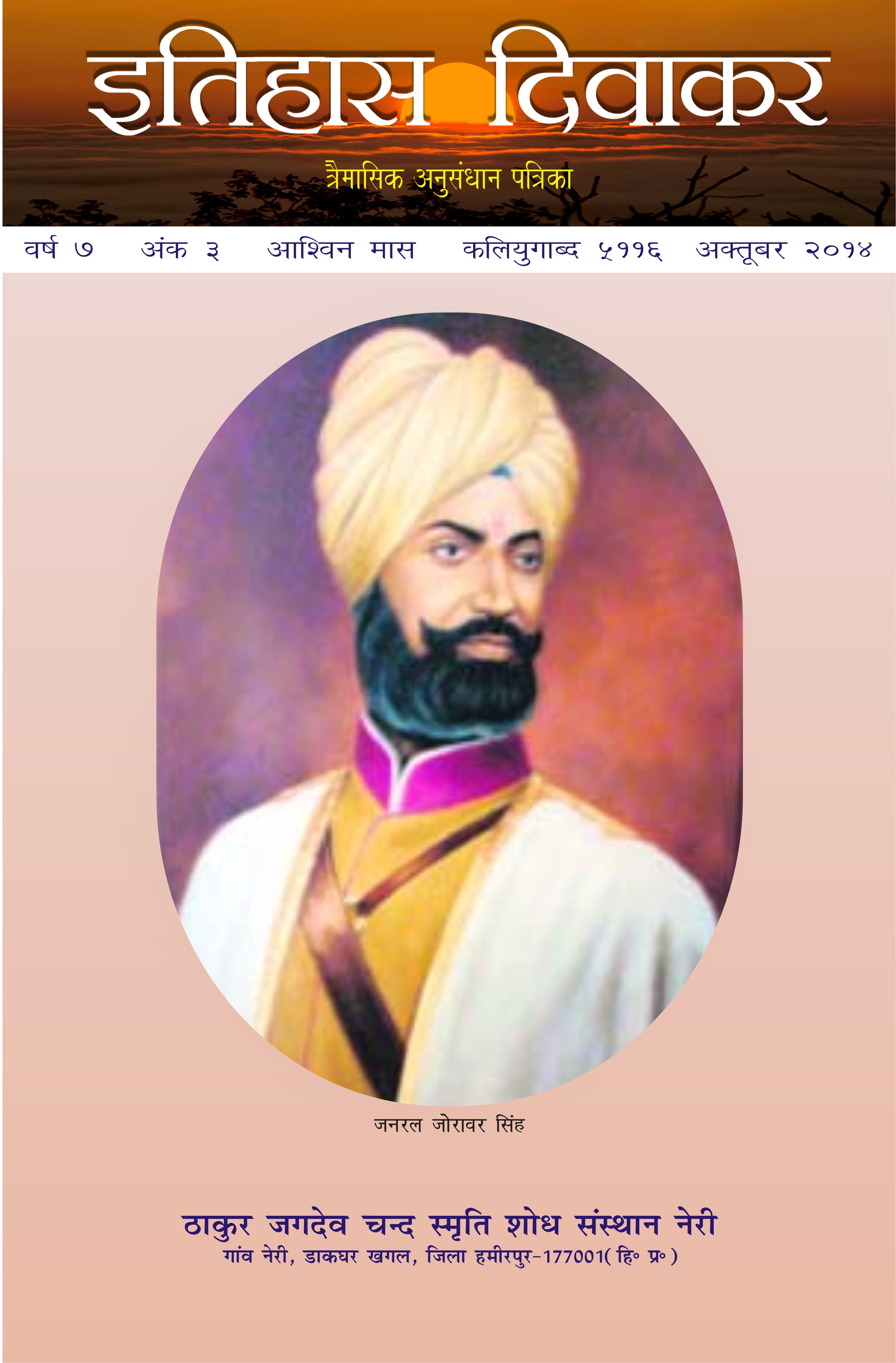
- The Brave and Mighty Warrior: General Zorawar Singh - Rakesh Kumar Sharma
Agriculture Section
- Agricultural Professional Vocabulary of Kullu - 2 - Molu Ram Thakur
Creation Narratives
- Creation Theory in the Folk Tradition of Haryana - Ram Sharan Yuyutsu
- Creation in the Ishwar Geet - Vidya Sagar Negi
- Creation in the Ghure of Lahaul - Dr. Surat Thakur
Editorial
May Your Glory Remain Immortal, Mother
The Indian army possesses a deep-rooted culture of patriotism, as profound as the ocean, and an elevated spirit that touches the sky when facing crises. The nation can never repay the debt it owes to its soldiers and to the farmers who protect lives by producing food through tireless labor. Expressing gratitude towards them, in 1965 AD (Kaliyugabd 5067), the second Prime Minister of independent India, the late Shri Lal Bahadur Shastri, gave the national slogan - Jai Jawan! Jai Kisan! Former Prime Minister Shri Atal Bihari Vajpayee expanded this national slogan by highlighting the unique role of science in human society and national life, saying - Jai Jawan! Jai Kisan!! Jai Vigyan!!!
The security of any country is ensured by its soldiers. From this perspective, the bravery and reliability of the soldiers of the Indian army are paramount. Recently, during the devastating floods in Jammu and Kashmir in September, the courage and systematic manner in which the Indian army provided safety to lakhs of flood-affected people has awakened a sense of reverence for their valor in everyone's hearts - Jai Jawan!
In 1841 AD (Kaliyugabd 4943), a symbol of India's valor, General Zorawar Singh, the commander of Raja Gulab Singh of the Jammu principality, led the Dogra army to hoist their victory flag in Ladakh, making Ladakh a part of Maharaja Gulab Singh's kingdom, which is why it is a part of India today.
After the victory in Ladakh, he advanced towards Kailash Mansarovar. In the fierce battle of Taklakot To-yu, General Zorawar Singh was martyred at the hands of the Tibetan army. Later, the Tibetan army built a stupa in his memory at To-yu, which is known as 'Singh Chorten'. This act of building a memorial by the enemy is a unique example in world history, testifying to the incredible and charismatic valor of General Zorawar Singh. This historical monument of General Zorawar Singh will forever ignite the spirit of patriotism in the national consciousness - May your glory remain immortal, Mother. Whether we live for four days or not.
Trends in Modern Indian History Writing
First, a brief clarification of the concepts of history is necessary. What is history? In today's context, 'History' is not the story of a man or a woman (His-story or Her-story), as was believed in the past. It is not a saga of leaders, kings, or heroes. Nor does history mean an event that occurred in the past. Rather, what is important today is why and how this event happened. It is not merely knowledge of 'Tawarikh' or dates. There is no 'finality' in history. Changes are necessary based on the latest facts.
British Imperialist Historians
Generally, in Europe, the 17th century is considered the age of scholars, the 18th century the age of enlightenment and reason, and the 19th century the age of history. In the 19th century, European scholars focused on the concept of history, its nature, method of study, and its principles. British imperialist historians interpreted Indian history in a way that always maintained a sense of European superiority. James Mill (1773-1836) was the first British historian to promote colonial and imperialist tendencies.
Marxist Historians
The thinking of Marxist historians is based on the ideas of Marx in the context of history. Generally, it is considered a response to the administrative history provided by the British. Marx's ideas can be easily understood from his 23 articles. Generally, it is considered a response to the administrative history provided by the British. The ideas of Marx, which he wrote during 1853-1857, described a dual purpose of British rule in India: one destructive and the other creative.
Nationalist Historians
Due to the complexity of Indian nationalism, the Indian national movement is seen flowing in many streams. Thus, there is a lack of uniformity in its nature, but many elements are common. Generally, India's nationalist writers expose anti-imperialism and many inconsistencies and myths. They have sharply criticized British colonialism and imperialism on social, economic, and political grounds. Dadabhai Naoroji, R.C. Dutt, Major Basu, and Lokmanya Tilak can be called the forerunners of Indian historiography.
Congress and Sangh: The Journey from Swaraj to Complete Independence
It is well-known that the Congress was founded in 1885 by Mr. A.O. Hume to keep British rule in India unchallenged. Mr. Hume was one of the few British officials during the 1857 revolution who managed to escape the clutches of the revolutionaries by blackening his face or dressing as a woman. He had witnessed the storm of Indian anger firsthand.
Swaraj, meaning Self-Governing British Dominion
In the Kashi Congress of 1906, the word 'Swaraj' was first used by Dadabhai Naoroji. Lokmanya Tilak had declared with a bang - 'Swaraj is my birthright'. Although the goal of the Congress was declared as Swaraj in the 1906 Congress session, the definition of this Swaraj and 'Swarajya' was given in the form of a system of governance that is 'in a self-governing British dominion'. This meant that India would remain a part of the British Empire, while the governance here would be in the hands of Indians.
Pure Independence
Dr. Hedgewar and those who shared his views did not accept at all that India should remain a colony of England. They envisioned a completely independent India, free from any foreign power. Dr. Hedgewar named it 'Vishuddha Swatantrya' (Pure Independence).
The Brave and Mighty Warrior: General Zorawar Singh
There is no example in world military history where the enemy side has built a memorial in memory of the commander of a defeated army. Such an example is found only in the military history of India, where the Tibetans, impressed by the immense courage, valor, and bravery of the great general Zorawar Singh, built a memorial in his memory at a place called To-yu, which is called the 'Chorten of the Lion'. General Zorawar Singh will always be remembered for his historical contribution to securing India's northern borders. A devout and loyal servant, a skilled administrator, brave, valiant, and a great warrior, General Zorawar Singh was very far-sighted.