Editorial
Dr. Bhimrao Ambedkar's Historical Perspective
On April 2, 2018, some political figures called for a 'Bharat Bandh' (nationwide strike). During this, 10 people lost their lives, hundreds were injured, crores worth of property was damaged, and the hardships faced by the common person were separate. Some people, in the name of Babasaheb Ambedkar, are trying to create discord in the country under their divisive policies to advance their petty politics. They first need to understand Babasaheb's thoughts.
Babasaheb Ambedkar's life is a unique example of efforts made to unite Indian society. He said that India's unity has remained intact due to its cultural heritage, something not seen in other nations of the world. At the same time, he held the upper castes of society responsible for social evils like untouchability prevalent in Indian society. He deeply analyzed society and compelled the Indian leadership to think that the Hindu society would only benefit from the elimination of this caste-based disparity.
Babasaheb was a great historian. Babasaheb stated that the Aryans are the original inhabitants of India and did not come from outside. European linguists and historians fabricated the false theory that Aryans came from outside India with the intention of establishing their permanent dominance over India. This was their calculated move, which was blindly followed by the so-called historians of India. The result was that even the students of independent India were deprived of reading their true history. In this issue, Dr. Kuldeep Chand Agnihotri's article exposes all these conspiracies.
The Western Aryan Theory and Ambedkar's Opinion
Dr. Kuldeep Chand Agnihotri
Before discussing the Western Aryan theory, it would be better to understand what this theory is. In the mid-nineteenth century, this topic was highly debated among scholars worldwide. Broadly, the conclusion of this Western-born theory was that the people of Europe and India are originally Aryans and belong to the same race. The reason for this was the evidence found in linguistic research that European and Indian languages have the same origin. In 1767, a French Jesuit priest, Gaston-Laurent Coeurdoux, who had spent a significant part of his life in Hindustan, had identified the similarity between Sanskrit and European languages. A few years later, in 1786, Sir William Jones (1746-1794) also prepared a proto-language based on the similarity of Indian and European languages. William Jones was the first person to consider Aryans as a race. Based on the evidence of common linguistic origin, he speculated that the Aryans had migrated to India from Europe millennia ago. According to this theory, the British tried to establish that the Aryans came to India as invaders from outside, defeated the original inhabitants, and took control of the country. They enslaved the original inhabitants and gave them the status of Shudras. They killed the Dravidians and pushed them to the south. The remains of the Indus Valley Civilization found in places like Mohenjo-Daro and Harappa were also described by European scholars as the remnants of a civilization destroyed by the Aryan invasion.
Maharishi Vedvyas: The Originator of the Guru Tradition
Dr. Om Dutt Saroch
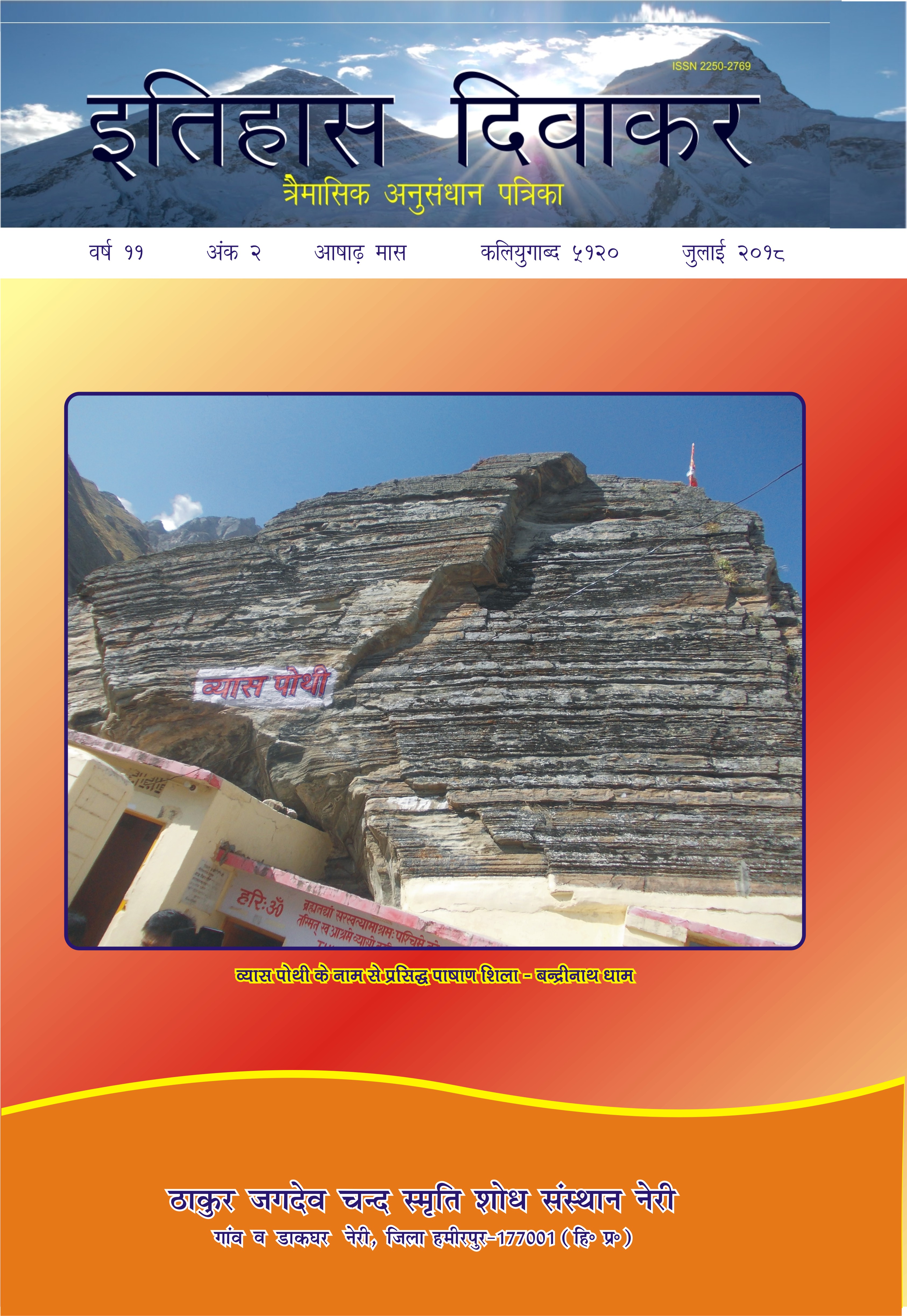
Maharishi Ved Vyasa has a significant contribution to the development and dissemination of Vedic and Puranic knowledge traditions and enriching the Guru-Shishya tradition. By compiling the four Samhitas of the Vedas and composing eighteen Puranas and an epic like the Mahabharata, Maharishi Vyasa presented an inexhaustible source of knowledge for the welfare of mankind.
The Advent of Vyasa: According to Puranic belief, in every Manvantara, at the end of the Dvapara Yuga of each Chatur-yuga, Lord Vishnu incarnates as Vyasa for the revival of the Vedas. Following this tradition, in the Dvapara Yuga of the twenty-eighth Chatur-yuga of the current Vaivasvata Manvantara, Vadarayana, the son of Parashara, appeared as an incarnation of Vishnu. The word Vyasa is not a name but indicative of a tradition. In Sanskrit, Vyasa means to expand. His name became famous as Vyasa because he expanded the Vedas into four Samhitas and various branches, and disseminated knowledge through the Puranas.