Itihas Divakar
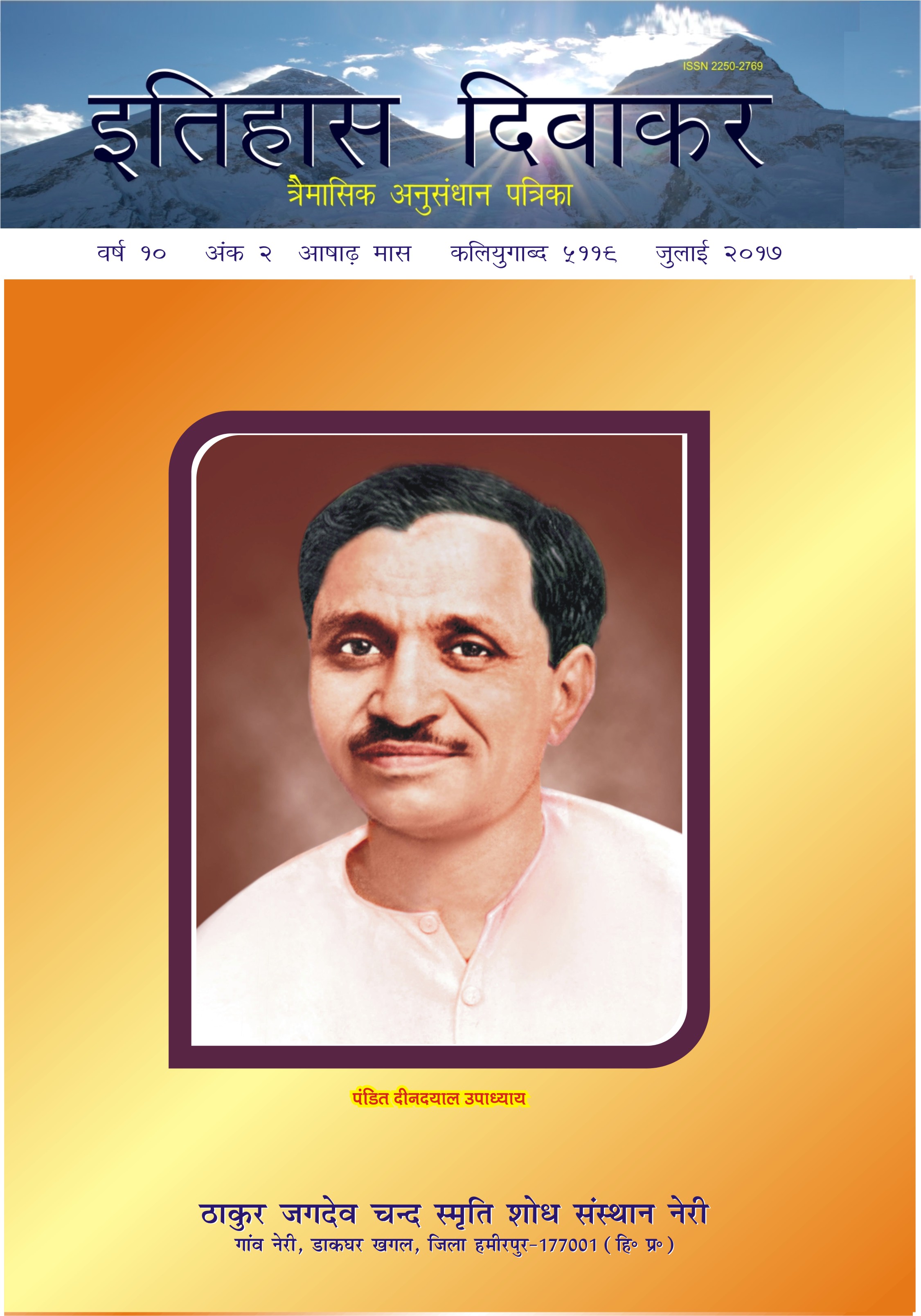
Quarterly Research Journal, Year 10 Issue 2, Ashadh Maas, Kaliyugabd 5119, July 2017
Table of Contents
- Editorial
- Centenary Commemoration
Sage of Indian Thought: Pandit Deendayal Upadhyay - Chetram Garg - Review
Contribution of Hindi Litterateurs in the Popularization of History in the Colonial Period - Dr. Rakesh Kumar Dubey - Jammu Kashmir and the Neglect of Maharaja Hari Singh - Dr. Kuldeep Chand Agnihotri
- Rishi Tradition
The Great Humanity of Maharshi Vasishtha - Shri Mukundray V. Parasharya - Place Report
Governance System of Pangi Valley - Hira Lal Thakur - Folklore
Chano-Bano in Himachal Folk Tale - Krishna Chand Mahadeviya - Path of Purpose
Dialogue on Historiography - Prof. Rakesh Kumar Sharma
Editorial: Upadhyay Ji's Integral Humanism
Pandit Deendayal Upadhyay, the proponent of Integral Humanism for human welfare and nation-building, was born a hundred years ago on the Trayodashi Tithi of the Krishna Paksha of Ashwin month in Kaliyugabd 5018 and Vikram Samvat 1973, i.e., September 25, 1916. He passed away at the age of 52 on Magh Shukla 12, Kaliyugabd 5069, Vikram Samvat 2024 (February 11, 1968). The period from the last Ashwin month to the upcoming Ashwin month is the birth centenary year of Deendayal Upadhyay. His life, forged through many difficult circumstances, was an ideal one with extraordinary wisdom. In 1937, he came in contact with the Rashtriya Swayamsevak Sangh and thereafter dedicated his entire life to the service of the nation. In 1951, on the advice of the then Sarsanghchalak Madhavrao Sadashivrao Golwalkar, he joined the Bharatiya Jana Sangh. After the martyrdom of Dr. Shyama Prasad Mukherjee on June 23, 1953, he took on the major responsibility of defining the policies of the Jana Sangh. In the Gwalior session of 1964, he presented the concept of Integral Humanism, which the Jana Sangh adopted as its core principle. His steadfast ideal was labor, dedication, purity in the field of work, and faith in spiritual values for the aspiration of national prosperity. The ancient sage's thought 'Sarvam Khalvidam Brahma' (all that is visible are different forms of the eternal entity Brahma) and 'Atmavata Sarvabhutani' (like us, so are all others) was given the name of Integral Humanism in a new social context by Pandit Deendayal Upadhyay. Upadhyay ji said - let us work with a sense of pride for our past, a realistic assessment of the present, and aspirations for the future. This work itself is Integral Humanism, and this work, through the realization of oneness with creation, will be capable of transforming 'man into Narayana'. Pandit Deendayal Upadhyay's Integral Humanism is the light of India's 'Chitti' or consciousness, which encompasses not just India but the welfare of the world with the spirit of 'Vasudhaiva Kutumbakam'.
Centenary Commemoration: Sage of Indian Thought: Pandit Deendayal Upadhyay
Chetram Garg
Pandit Deendayal Upadhyay, a sage of the Indian Sanatana thought stream, was born on Ashwin Trayodashi, Vikram Samvat 1973 (September 25, 1916) in Nagla Chandrabhan village, 25 kilometers from Mathura district, to father Bhagwati Prasad and mother Rampyari. The village is now famous as Deendayal Dham. But Deendayal ji's entire childhood was spent in his maternal grandparents' home in Rajasthan. He lost his father at the tender age of three. At the age of six, his mother also passed away. His maternal grandparents, who became his guardians in childhood, also departed by the time he was ten. His maternal uncle and aunt, who were his caretakers, also passed away in his sixteenth year. His younger brother Shiv Dayal, whom he loved dearly, also left his elder brother alone to follow other family members. Deendayal ji had not yet crossed 18 springs of his life. In the fierce flames of such sorrows, the practice of service was deeply ingrained in Pandit ji's nature...
In his intellectual sessions, Pandit ji used to emphasize his national identity and that it is necessary for us to think seriously about our national identity. He believed that without national pride, 'freedom' has no meaning. The root cause of the problems India is facing today is the neglect of its national identity. The nature of a nation is classically addressed by the word 'Chiti'. A nation is a living entity. Some of its elements are visible, like land and human community. But some elements remain invisible, just as the soul exists in the body but is not seen. The body becomes dead without the soul. Similarly, the soul of a nation is its identity (Asmita). The nation remains alive with its identity and becomes like a dead body without it. The word 'Bharat' itself is the expression that awakens self-respect within us. The basis of our nationality is Bharat Mata. Therefore, the form of the nation is determined by the collective basic nature of this one people. This is 'Chiti'. From this, consciousness remains in the nation.
Review: Contribution of Hindi Litterateurs in the Popularization of History in the Colonial Period
Dr. Rakesh Kumar Dubey
History has an unparalleled contribution to nation-building. In the colonial period, history was considered the main component of literature, and literature is the sole determinant of a society's vitality and lifelessness, its civilization and barbarism. If the capacity and vitality of races are visible anywhere, it is in their literature. Hindi litterateurs did the important work of popularizing this main component of literature, history, and propagating its importance because the power hidden in literature is not found even in cannons, swords, and bombs. The progress of literature is essential for national advancement, which Rai Deviprasad 'Purna' highlighted: 'There is darkness where there is no sun. That country is dead where there is no literature.' When literature is so important, its main component, history, will certainly be of great importance because history plays a big role in bringing about public awakening among the masses.
Jammu Kashmir and the Neglect of Maharaja Hari Singh
Prof. Kuldeep Chand Agnihotri
Jammu and Kashmir had been practically partitioned. The strategically and security-wise important areas were under the occupation of the Pakistani army. The Indian army was at war. London knew very well that the British head of the Indian army would not remain in that position for long, nor would Lord Mountbatten remain the Governor-General of India after the new constitution came into force. Note that from August 15, 1947, to December 31, 1947, the Commander-in-Chief of the Indian Army was General Sir McGregor Macdonald Lockhart, and from January 1, 1948, to January 15, 1949, it was General Sir Francis Robert Roy Bucher. Both these Englishmen were naturally protecting Britain's interests. Even after these three left, if the war between India and Pakistan continued, there was a possibility that India would reclaim the areas of Jammu and Kashmir captured by Pakistan. Preventing this possibility by any means was the top priority of British policy. Therefore, Lord Mountbatten's entire strategy was that India should take the issue of Pakistani aggression in Jammu and Kashmir to the United Nations Security Council as a complaint.