Itihas Divakar - July 2015
Editorial
The Illustrious Light in the Sanskrit Language
Sanskrit is the richest language in the world, embodying the illustrious light of India's sage tradition and serving as an imperishable repository of knowledge for the welfare of global society. The literature composed in Sanskrit touches the highest peaks of spirituality and provides a comprehensive discussion of knowledge and science. In honor of this glorious linguistic heritage of India, Sanskrit Day is organized at the national level every year on the auspicious day of Raksha Bandhan on the Shravani Purnima. This year, Sanskrit Day falls on August 26, 2015. The greatness of the all-encompassing, knowledge-filled Sanskrit language has been praised not only by the great men of India but also by many foreign scholars who have acknowledged its global significance. Indian wisdom considers Sanskrit as the very foundation of culture, stating: 'Culture is rooted in Sanskrit.' When Lord Macaulay decided to close the Sanskrit College in Calcutta in an attempt to uproot Indian cultural values, the principal of the college, a Sanskrit scholar and foreign academician H.H. Wilson, disagreed. He articulated the importance of Sanskrit through a verse, stating that as long as India exists, as long as the Himalayas and Vindhya mountains stand, and as long as the Ganga and Godavari rivers flow, Sanskrit will remain here. Many Western scholars and Indian scholars influenced by them take more interest in finding faults with the greatness of Sanskrit. Generally, communist thinkers are placed in this category, but it is not entirely true. Scholars who have studied Sanskrit literature with an open mind, regardless of their ideology, have appreciated the achievements of Sanskrit luminaries. One such distinguished scholar of communist ideology is Dr. Ramvilas Sharma. He found the philosophy of communism within Sanskrit literature and, by documenting its achievements, elevated national pride. In honor of Dr. Ramvilas Sharma's profound Indian thought, this issue includes his research-based article on 'Indian People and Agricultural System' under the section of Agricultural Philosophy.
Scrutiny
Sanjivani Vidya
Baba Saheb Apte
The Sanjivani Vidya (the science of revival) is mentioned repeatedly in Puranic texts. Shukracharya, the preceptor of the demons (Rakshasas), possessed this knowledge. Whenever demons were killed in the war between gods and demons, their guru would revive them with the power of his Sanjivani Vidya. This knowledge was unknown to the gods. To acquire it, Kacha, the son of the gods' preceptor Brihaspati, went to Shukracharya. The story of how he stayed there and achieved his goal without falling into the trap of love with Shukracharya's daughter, Devayani, is beautifully and extensively described in the Mahabharata. But as for the complete description of the Sanjivani Vidya, for which Kacha gained such transcendent fame, not even a fragment of it is available in the Puranas or any other text. Has this knowledge, like many other sciences, been lost forever?
The Nature of Sanjivani
Several strange speculations about the nature of this Sanjivani Vidya have emerged these days. Some say it must be a substance like a medicinal herb. Others say it is a mantra, a view clearly based on the description in the Mahabharata. Some argue that Sanjivani was a name for a specific system of governance that Shukracharya had initiated among the demons. And some argue that Sanjivani is a process combining medicine, mantra, and electrical application. However, it seems impossible that Sanjivani was an herb or a plant part. Because the first time, Kacha's body was cut into pieces and fed to hyenas; the second time, his dead body was burnt, and its ashes were thrown into the sea; and the third time, those ashes were mixed with wine and given to Shukracharya himself to drink.
Life and Death
To properly understand the nature of Sanjivani Vidya, it is first necessary to understand the prevailing perception of life and death at that time. The idea of 'a body nourished by consuming food, meaning a state of being alive' and 'death upon the destruction of the body' was not prevalent in those days. Insulting venerable individuals was considered equivalent to their death.
The Reality of Avatarism in Indian Culture
Dr. Prashant Gaurav
The word 'avatar' is derived from the root 'tṛ' with the prefix 'ava' and the 'ghañ' suffix. According to a specific rule of Panini, the word 'avatar' means the act of descending from a high place or the place of descent itself. In addition to this general meaning, it has a specific meaning: a powerful god or deity assuming a human or non-human form and descending from a higher world to a lower one. In the Puranas, the word 'avirbhava' (manifestation) is also used in this sense. The fulfillment of an 'avatar' is considered in two conditions: first, assuming a new form, and second, taking a new birth. The concept of avatars has its roots in the Rigveda. In its fifth mandala, the unity of Agni is established with Varuna, Mitra, and Aryaman. Later, the identity of a deity was established with a non-deity form. This trend had emerged by the time of the Brahmanical texts, in which Matsya (fish), Kurma (tortoise), Varaha (boar), and Nrisimha (man-lion) are described as transformations of Prajapati, and Vamana (dwarf) as a transformation of Vishnu. This is why the Puranas, along with summarizing these transformations of Prajapati described in the Brahmanas, also discuss other avatars. In the Mahabharata, Kurma, Matsya, Varaha, Narsimha, Vamana, Parashurama, Rama, Krishna, and Kalki are considered avatars of Vishnu.
Science in Ancient Indian Scriptures: Bhumi Sukt (Atharv Ved) and Heat inside Earth
Dr. Bhag Chand Chauhan
It is corroborated by the researchers that up to the 15th century, Europe was in the Dark Age. Historians call this period as the Dark Age because there was no knowledge like mathematics, science, medicine etc...in Europe. Long back, there was enlightenment for short period in a limited part of Europe, i.e. in Greece from 6th century BC for a few centuries by import of knowledge from India through Arabs. This period is called the first awakening of Europe and the reappearance of knowledge in the 16th century is called the Renaissance. India was the phenomenal source of concept knowledge, information and technology. The vast ocean of scriptures, like Bhagvad Gita, Mahabharat, Ramayan and Upanishads, greatly evidences an unimaginable expansion of human consciousness. The Vedic culture, developed by the Aryans, flourished in the fertile banks of the Indus and Sarswati rivers. The ancient scriptures describe the magnificent work of these scholars. Starting from the state of nothingness to creation and evolution of the entire universe, including stars, solar system, planets, earth and life have been well accorded in these books.
Divine Personality
Hail, Tulsidas!
Dr. Paritosh Bailgo
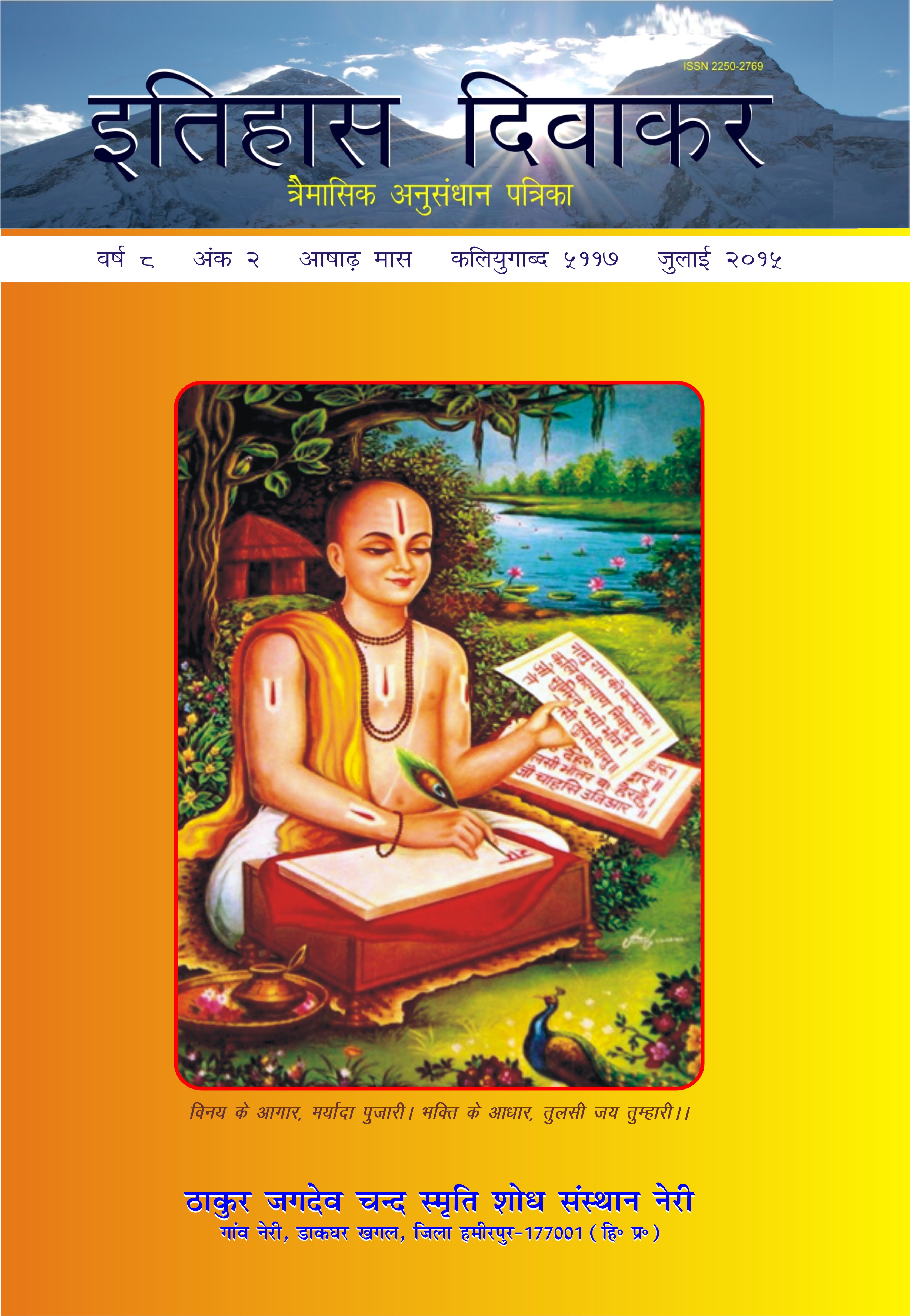
On the sacred land of Bharatvarsha, near Prayag, in the Chitrakoot division, in a village named Rajpura, the crest-jewel of devotees, Goswami Tulsidas, was born in Vikram Samvat 1554, on the seventh day of the bright fortnight of the month of Shravan. His life was dedicated to the feet of Lord Shri Ram, and he gifted the Hindu society an unprecedented gem of a book, the Ramcharitmanas, which is not limited to Hindu society but has become a treasure for the entire world. The fame that Ramcharitmanas has received in Indian literature is unparalleled. The literary scholar Vishnu Kant Shastri expressed his sentiments towards Goswami Tulsidas, saying: 'O storehouse of humility, guardian of decorum! O foundation of devotion, hail, Tulsidas!' Tulsidas is considered the Sumeru (peak mountain) of the Bhaktamal (garland of devotees). His Ramcharitmanas is the Sumeru of the Hindi poetic garland. It is a unique epic that wonderfully synthesizes history, Puranas, scriptures, narrative poetry, biographical poetry, and folk poetry on the foundation of devotion.
Agricultural Philosophy
Ancient People and Agricultural System
Dr. Ramvilas Sharma
It is firmly believed by many scholars that the Rigvedic Aryans led a nomadic life. They began to live in villages here and there, but their main occupation was animal husbandry. For those who believe that the Aryans came from outside and destroyed a developed civilization here, it is natural to think that the invading Aryans were living a barbaric life. In his book 'Rigvedic Arya', Rahul Sankrityayan wrote: 'After destroying Mohenjo-daro, Harappa, and many such cities, the pastoral Aryan people divided the conquered land of the Saptasindhu among themselves and turned it into pasture land.' In the Rigveda, there is a gambler - he gambles, repents, and gambles again. The poet says to him: 'Krishi krishasva' (Do farming). He does not tell him to graze cows, nor to plunder, but to farm. It should be assumed that farming was a common occupation, which is why he said this to the gambler.
The Remainder
A Great Karmayogi
Shrigurupad Bhaumik
The honorable Thakur Ramsingh ji was a great karmayogi (a person dedicated to selfless action), a skilled organizer, resolute, self-controlled, and possessed of immense inner strength. All these descriptions were not just embellishments for him but were true to the letter. Sangh work in Assam began in 1948, a few days before the ban on the Sangh. After the ban was lifted, Honorable Ramsingh ji was sent to Assam with the responsibility of a prant pracharak (provincial organizer). In the then-Assam, from the perspective of Sangh work, the territories of all seven states of the North-East were included. It was due to the victorious mindset and rigorous hard work of Thakur Ramsingh ji in the extremely adverse circumstances of that time that the prestige of Sangh work could be established in the North-East. With the help of his attractive personality and erudition, Honorable Thakur Ramsingh ji was successful in establishing contact with many educationists, linguists, historians, and virtuous individuals of this region and was able to make them active in Sangh work and various other fields.