Editorial: Children of Mother India
The Prithvi Sukta of the Atharvaveda states, 'Mata Bhumih Putro'ham Prithivyah,' meaning this land is our mother and I am the son of this earth. This Vedic knowledge, expressed for the entire world by our sages, connects us to our sacred land, India, with the supreme relationship of a mother. However, in the modern consumerist flow, a segment of the national consciousness has strayed from this relationship. Such a segment considers the land of India as mere land, and their faith in the motherland has faded. This lack of faith is giving rise to demonic tendencies within the nation in the form of terrorism, Naxalism, etc. The land of India is our mother, and we are all children of Mother India. If this concept is firmly established in the national consciousness, anti-national forces will be eradicated, and the nation's power will become strong and capable. Imbued with this spirit of nationalism, let us bring to fruition this message of Swami Vivekananda in mind, word, and deed – Let us not be ashamed of our ancestors, but feel proud. When a man is ashamed to acknowledge his ancestors, understand that his destruction is near. India's decline did not happen because the rules and conduct of our forefathers were bad, but because those rules and conducts were not allowed to reach their logical conclusion. The more we study the past, the brighter India's future will be.
Vivekanandamritam: The Chicago World Parliament of Religions and Swami Vivekananda
To understand the role of Swami Vivekananda and his global impact at the 1893 World Parliament of Religions held in Columbus Hall, Chicago, it is essential to know his resolve, personality, and the influence of his ideas. The basis of Swami Vivekananda's success was his belief that "the Parliament of Religions is being organized for this purpose." He envisioned going abroad to present Indian spirituality and the Hindu way of life to the world. The Parliament was motivated by Christian pride, aiming to establish the superiority of Christianity. Swami Vivekananda sensed this. He did not go with the support of any king or financier but with the donations collected by his disciples. He went as a representative of the entire Hindu society and set out on his journey after receiving blessings from Ma Sharada. On September 11, 1893, he delivered his famous speech at the Parliament, which created history. His address, 'Sisters and Brothers of America,' had a magical effect on the audience. In his speeches, he expressed ideological liberalism, religious tolerance, and the broad Hindu perspective on life, conveying the message that all religions lead to the same God, just as rivers flow into the sea. He said that cooperation, harmony, and peace are the way forward, not conflict and discord. Even today, the world sees a path to global peace in his ideas.
Vedic Saraswati in Himachal Pradesh: Its Origin from the Himalaya as Deduced from Scientific Signatures Implanted on Landforms
Introduction
In the ancient river systems of Bharat, only three rivers emerge instantaneously in Hindu ethos: Ganga, Yamuna, and Saraswati. Nevertheless, Saraswati is celebrated and known all over the country. In Vedic geography, there is a mention of Sapta Sindhu, i.e., seven rivers, in which Saraswati holds an important description. Most of these rivers exist today, except for Saraswati, which has disappeared. Recent scientific studies have provided irrefutable data proving that Saraswati did exist in Bharat as described in ancient scriptures.
Perennial Source of Vedic Saraswati
A mighty river like the Vedic Saraswati must have had a perennial source, likely a glacier in the Himalaya. The term Vedic Saraswati is used to designate the mighty river that once existed in northwest Bharat. It was described in the Rigveda as a supreme, swift, and violent river. Over time, it became extinct.
Conclusions
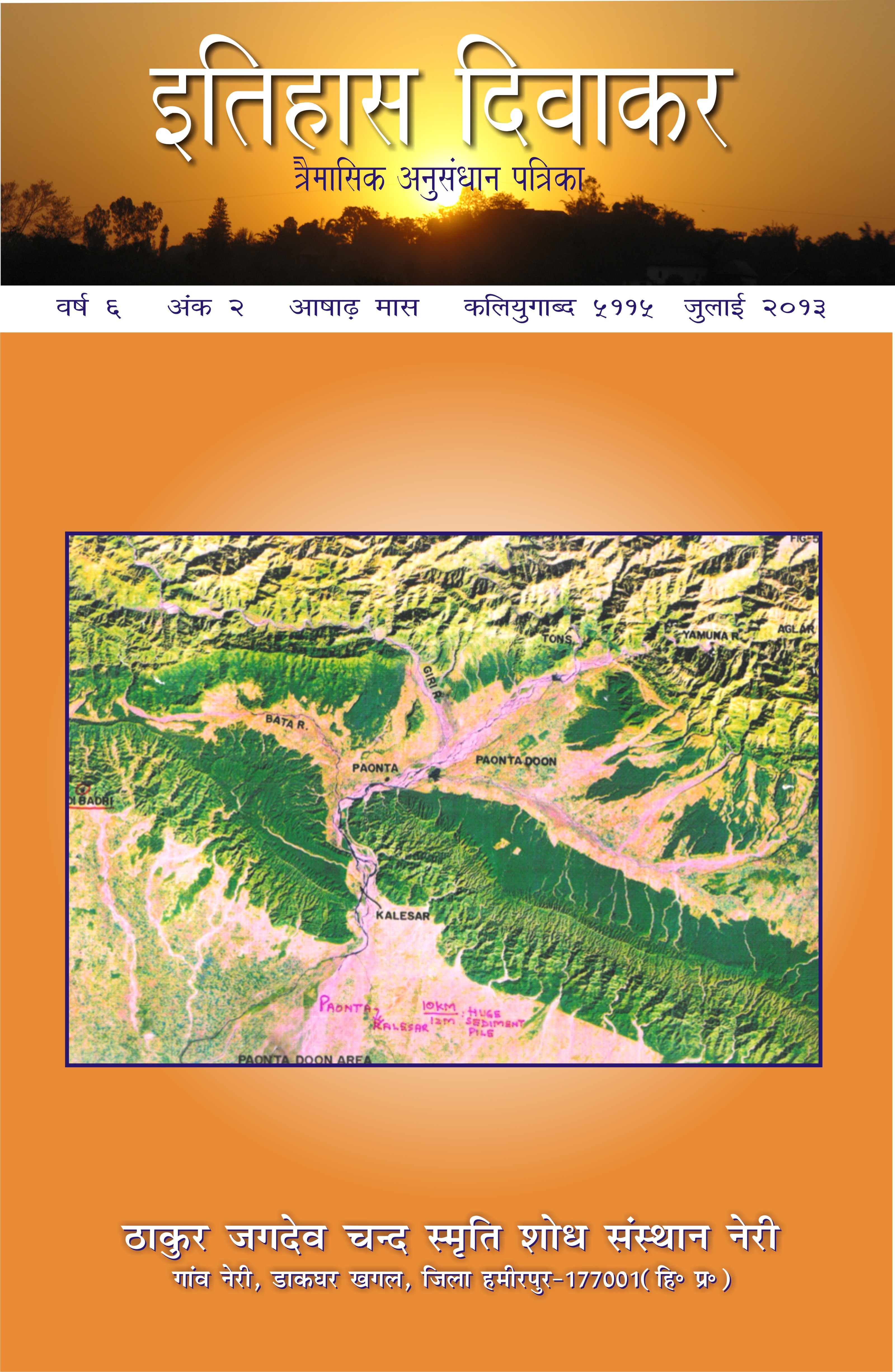
The terraces at Sudanwala, Bata, Garibnath, Markanda, and Adi Badri provide irrefutable scientific evidence to suggest that a gigantic river was flowing in an almost WNW direction in the past. The present-day Tons or Tamasa River was, in fact, the Vedic Saraswati in its upper reaches, fed by a large glacier. It traversed through Himachal Pradesh, entering the Paonta valley and later the plains near Adi Badri. Tectonic activity led to its eventual disappearance, converting a perennial river into a seasonal one.
Dev Vritt: Deity Mahasu in Mandi District
Himachal Pradesh holds a significant place in Indian divine culture. In the Nihri tehsil of Mandi district, there is a famous temple of Dev Mahasu, although this deity is primarily worshipped in Shimla and Sirmaur. His original place is considered to be Hanol (Uttarakhand). In Mandi, there are three temples and chariots of Mahasu. According to a common belief, the deity first appeared in the Mahasudhar forest of Sarech village. The story goes that a cow would offer its milk daily on a stone. When a cowherd struck the stone with an axe in anger, a divine voice announced, "I am Dev Mahasu." After this, he was established as the main deity in the Sirmaur region. This article also describes the deity's wives, sons, and his various forms. The worship methods, associated fairs, and the role of the 'gur' (medium) are also described in detail.
Krantiveer: Great Martyr Rajkumar Pratap Singh of India's First War of Independence
Rajkumar Pratap Singh of Kullu was also a martyr in the first war of independence of India, who was hanged on August 3, 1857, in Dharamshala. After the childless death of Vikram Singh, the son of Raja Pritam Singh of Kullu, his brother Kishan Singh became the king. After Kishan Singh's death, his wife went to Kangra with her young son Pratap Singh. Pratap Singh grew up under the protection of Maharaja Ranjit Singh and fought against the British on behalf of the Sikhs in 1846. The British had placed an illegitimate descendant on the throne of Kullu, which Pratap Singh opposed. During the revolution of 1857, he traveled through Kullu disguised as a sadhu and planned an armed rebellion. He wrote letters to the local Negis and Kardars to fight against the British. This plan was exposed, and he was captured along with his companions. He was tried in Dharamshala and hanged.
Rashtrabhasha: Maharishi Dayanand's Upliftment of the National Language
The name of Maharishi Dayanand Saraswati is prominent in the Indian renaissance of the nineteenth century. He was a great social reformer, a commentator on the Vedas, and a strong proponent of Hindi as the national language. His mother tongue was Gujarati, and he was a profound scholar of Sanskrit, but he adopted Hindi for the propagation of his Vedic principles. At the request of Keshab Chandra Sen and Ishwar Chandra Vidyasagar, he made Hindi the medium of his lectures and writings after 1873. He also wrote his famous book 'Satyarth Prakash' in Hindi. Maharishi Dayanand called Hindi 'Aryabhasha' and considered it mandatory for all countrymen to learn it. He dreamed that from the Himalayas to the ocean, only Aryabhasha Hindi in the Devanagari script would be used. His efforts greatly strengthened the position of Hindi as the national language.
Srishti Akhyan: The Creation Myth in the Bhil Society of Gujarat
The Bhil tribals, who live in the Aravalli hill regions of Gujarat, have a rich cultural tradition. This article describes a creation myth prevalent in their society. According to this myth, in the beginning, there was neither earth nor sky, only water everywhere. God existed in the form of an insect in the water. An egg was formed in the water, from which the 'Jalukar' God emerged. He had no place to live, so Manasa Devi appeared as a fish, and a lotus flower bloomed from her navel, on which God resided. God thought of creating the earth, the seeds of which were in the mouth of the serpent Vasuki. Amiya Devi emerged from the nectar that came from God's mouth. On God's command, Amiya Devi took the form of a tortoise and brought the seeds of the earth from the netherworld. A bread was made from these seeds and spread on the water, which formed the earth. The myth also describes the origin of Shiva, Kailashpuri, and mankind. This myth is an important part of the Bhils' oral tradition and is narrated during their religious rituals.