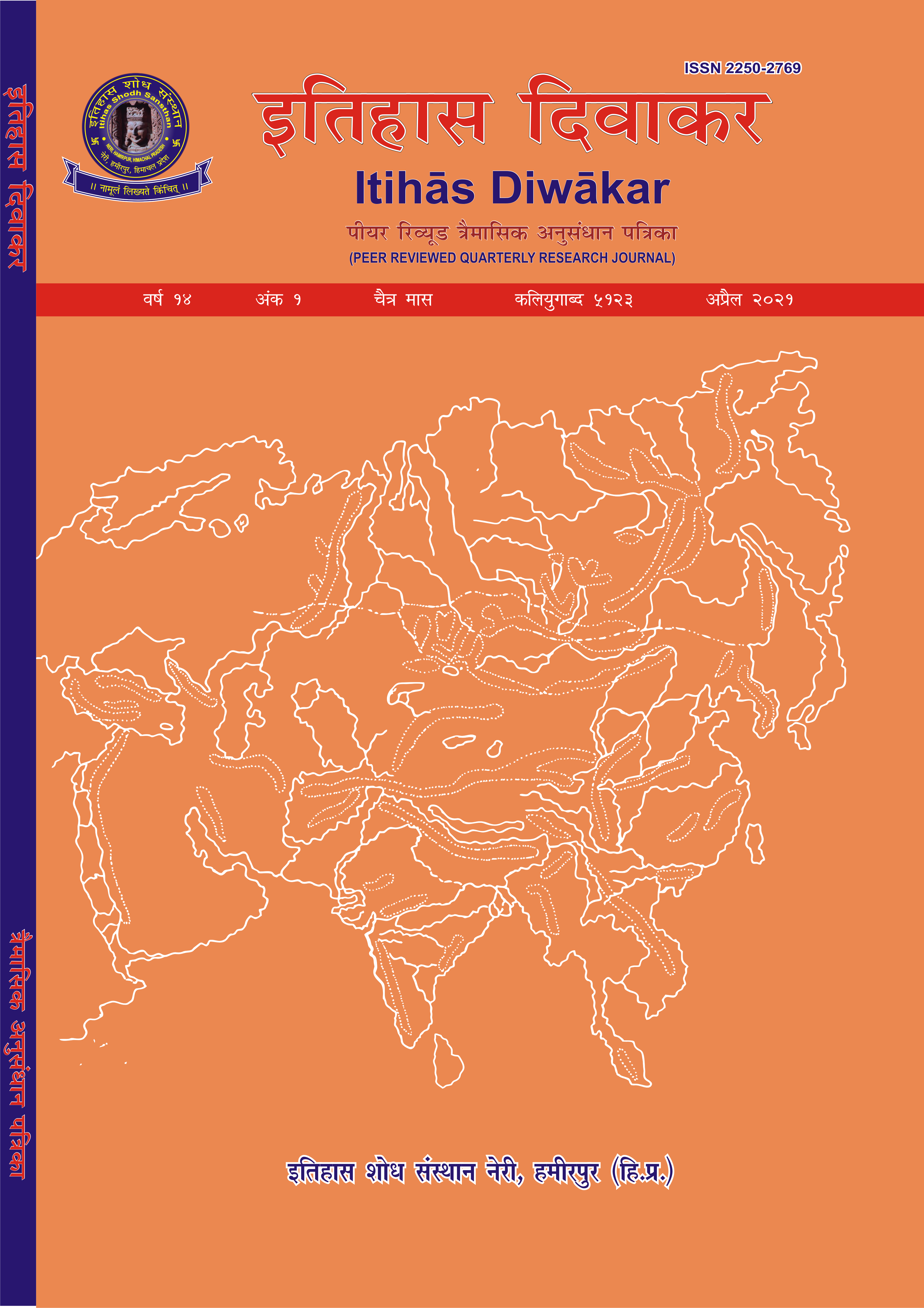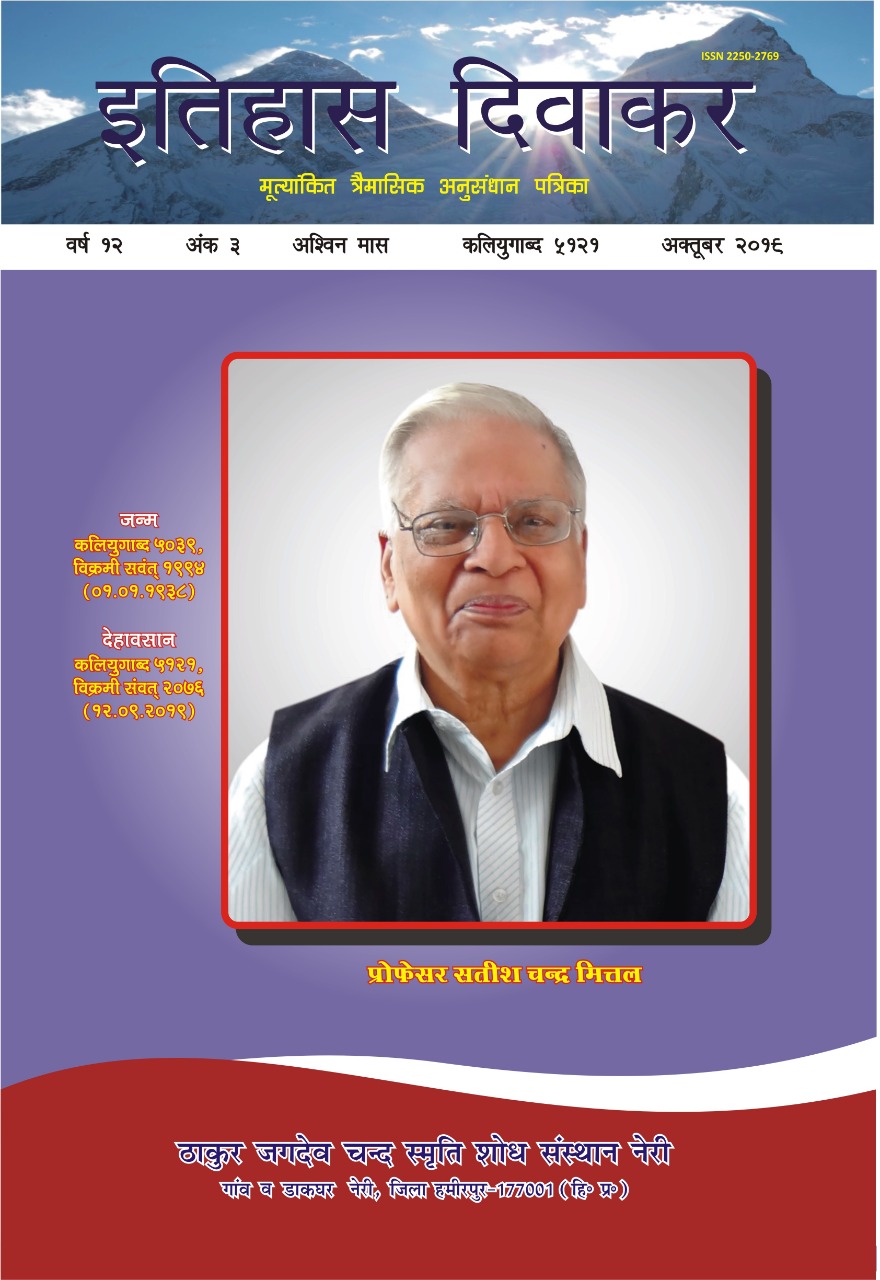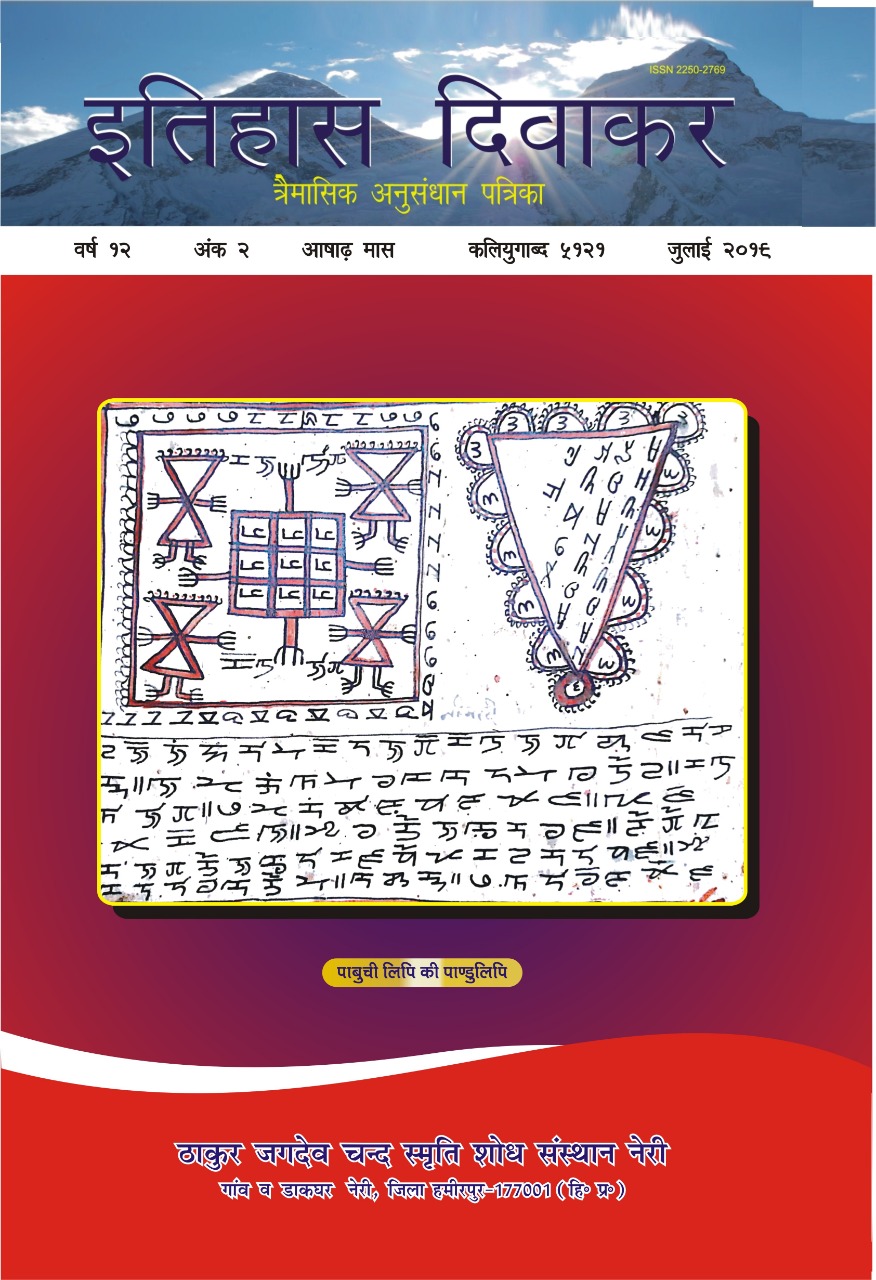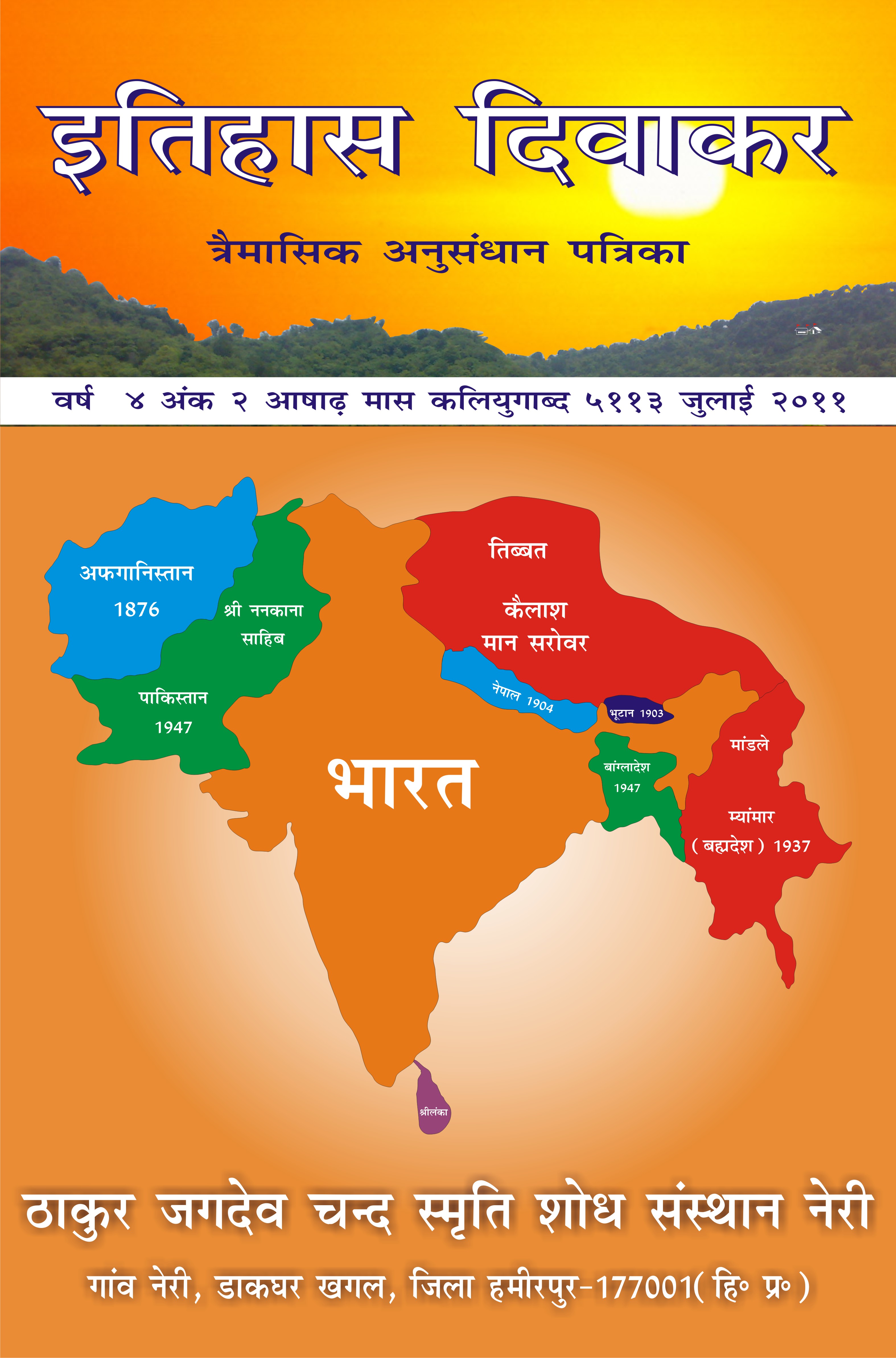
Itihas Diwakar: July 2011
Editorial: Sanskrit Day and Hindi Day
In India, Sanskrit Day is organized every year on the day of Shravani Purnima Raksha Bandhan. This event reminds the national consciousness of the glorious tradition of the continuously flowing Sanskrit language of the nation. When the former President of India, Dr. A.P.J. Abdul Kalam, visited Greece, at a reception ceremony organized at the Presidential Palace in Athens, the President of Greece, Karolos Papoulias, began his welcome in the Sanskrit language, saying – Rāshtrapatiḥ mahābhāgāḥ svāgatam yavanadeśe. This welcome sentence expressed in Sanskrit is proof of the fact that Sanskrit is the identity of India. It contains the history of a period of more than 197 crore years since the beginning of creation. It holds an imperishable treasure of spirituality, philosophy, public life, and all knowledge and science, which paves the way for the welfare of the entire world.
The 14th of September is celebrated every year in India as Hindi Day. The celebration of this day is becoming a mere formality. The government is not sensitive towards the national language, Hindi. It is not inappropriate to acquire knowledge of the English language, but establishing the dominance of English over the national language, Hindi, is highly deplorable. Even in Hindi-speaking provinces, the Hindi language remains dwarfed in front of English. Firstly, the governments of Hindi-speaking provinces should ensure the use of Hindi in official work with a committed spirit, fulfilling their national duty, only then can a nationwide favorable environment be created for it. Pausha Krishna Ashtami, Kaliyugabd 4963, Vikrami Samvat 1918, corresponding to 25th December 1861, is the 150th birth anniversary year of the great patriot of the Indian nation, Mahamana Madan Mohan Malaviya. In this light, an article related to Mahamana Malaviya is also included in this issue.
Himalayan Region - Threads of Internal Unity
Thakur Ram Singh
The Himalayas, with their most vast and highest peaks of grandeur, divinity, and beauty, are majestically situated in the middle of Jambudvipa with their living and growing existence. It is inseparably linked to the structure of Indian life. Even today, it excites and inspires the poets, writers, singers, dancers, artists, and painters of our country, India. The great poet Kalidas called it Nagadhiraj, meaning the king of mountains.
The mention of the Himalayas comes in the Hiranyagarbha Sukta of the Rigveda, the world's first text. It states that the creator Brahmaji who emerged from the luminous egg is also the master of the Himavant mountain. The Himalayas are also praised in the Prithvi Sukta of the Atharvaveda.
According to modern Western geology, the Himalayas were born from the bottom of the 'Tethys' sea about fifty million years ago. To understand the internal threads of the life of such a vast Himalayan region, it is necessary to review the ancient history and current situation of the countries of this vast landmass. Leaving aside Japan, the Philippines, and Australia, the Himalayas are spread in the form of their various mountain ranges in almost all countries of Southeast Asia. It includes present-day Indonesia (Hindu Asia), Malaya, Burma, Thailand, Cambodia, Laos, Annam, Champa (Vietnam), Tonkin, Cochin, etc. All these countries were formerly part of India. The source of the civilization and culture of all these countries is India itself. All these countries have large Hindu temples with idols of Hindu gods and goddesses that are 70-70 and 80-80 feet high.
The Basic Spirit of the Constitution is Akhand Bharat
Krishnanand Sagar
In the history of India spanning lakhs and crores of years, the term 'Akhand Bharat' (Undivided India) was never used before 1940. Not in the ancient Vedas, nor in the Ramayana of the Treta Yuga, nor in the Mahabharata of the Dvapara Yuga, nor in the Puranas. Wherever it was used, it was the word 'Bharat', not 'Akhand Bharat'. What happened in 1940 that some people of that time felt it necessary to add the word 'Akhand' to the traditional word 'Bharat', and many leaders started using the term 'Akhand Bharat' in their speeches. In reality, the very mention of 'Bharat' brings to our mind the concept of a vast sacred land from the Himalayas to the ocean. This land is surrounded by the sea on three sides, and on the fourth side, the Himalayas spread their two long arms to touch the Indian Ocean in the east and west.
This was extremely painful for the patriots. From this pain, the resolve to keep India undivided arose in the hearts of the people, and the term 'Akhand Bharat' became popular. Kanhaiyalal Maneklal Munshi even formed a formal 'Akhand Bharat Morcha' separate from the Congress in 1940-41 to save the integrity of India. To understand the necessity of an undivided India, we first need to understand the Indian perspective on 'Rashtra' (Nation) and 'Rajya' (State). The state is a very ordinary unit compared to the nation. The nation is a great unit. A nation is not a visible object, yet it is a living entity.
National Icon: Mahamana Madan Mohan Malaviya
Acharya Hazari Prasad Dwivedi
Mahamana Malaviya Ji's name is foremost among the great men who tried to make India free and respected by liberating it from all kinds of slavery. Mahatma Gandhi wrote about him that “his inner life was very, very pure. He was a repository of compassion.” The year 1861 was very auspicious for India. In the same year, the poet Rabindranath Tagore was born. In the same year, Pt. Motilal Nehru was born, and in the same year, Pt. Madan Mohan Malaviya Ji was also born. All three brought glory to Mother India.
Malaviya Ji was born on 25th December 1861, in a respected but poor Brahmin family in Allahabad. His ancestors had moved from Malwa and settled in Allahabad. That is why they were called Malaviya. Malaviya Ji had great respect for Indian culture and civilization in his heart. He felt great pain seeing the youth of the country learning wrong conduct under foreign influence. Banaras Hindu University is considered Malaviya Ji's greatest work. He started his efforts to build it in 1904. After collecting one crore rupees, the foundation stone of the Hindu University was laid by Lord Hardinge on the auspicious day of February 4, 1918, according to scriptural rites.
Hindi Diwas Special: Why Hindi Did Not Become the National Language
Shriprakash
Around 1965, there was a protest against Hindi in the whole of South India. In Tamil Nadu, this protest had crossed all limits. The protest against Hindi was at its peak in the whole of Tamil Nadu with slogans of 'Down-Down with Hindi'. At the same time, a lecture series related to physics was organized by the University of Madras. The fourth Sarsanghchalak of the Rashtriya Swayamsevak Sangh, the venerable Rajju Bhaiya, who was then the Prant Pracharak of Uttar Pradesh, was also invited to speak.
According to Article 343(1) of the Indian Constitution, the official language of the Union shall be Hindi and the script Devanagari. It is said that English is necessary for technical education and science education. This is completely false and a myth. It is a conspiracy by some people for their vested, vile interests, to be carried out with the majority. Today, Russia, China, Japan, Germany, France, all have their own language and culture. These countries have made great progress in the field of science and technology. As their national language, only Hindi should be used, not English.