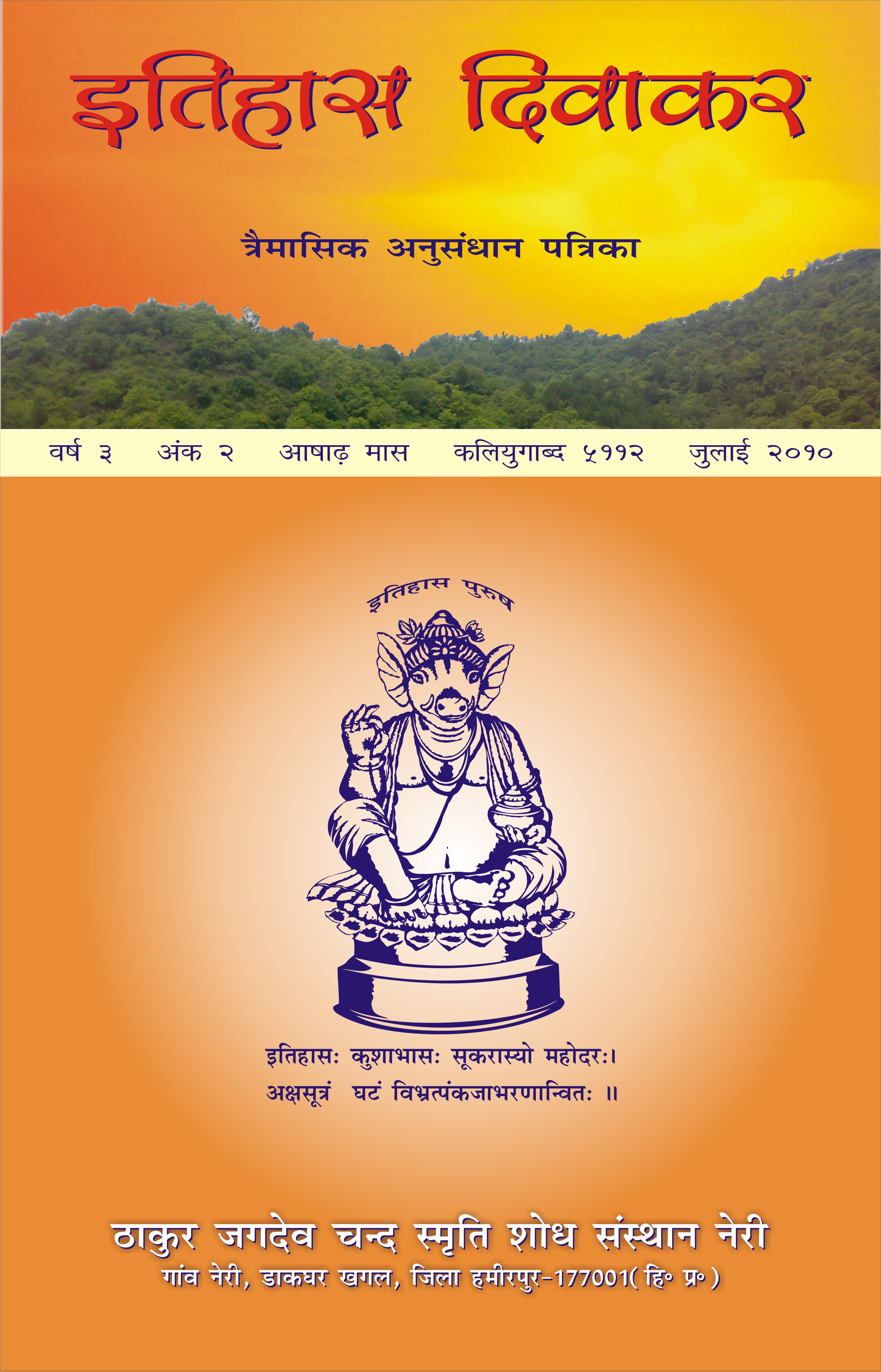
Itihas Diwakar - July 2010
Table of Contents
Editorial
Review Section
- Our Saints and Society - Thakur Ram Singh
- Nation's Protector Maharaja Suhel Dev - Dr. Parshuram Gupta
- The Katoch Dynasty of Trigarta - Dr. S.K. Bansal
World's Energy
- Bhagwati Sati - Krishnanand Sagar
World's Glory
- The Primordial Acharya of Shilpa Shastra, Vishwakarma - Ramsharan Yuyutsu
Survey
- Naga Deities in Himachal Pradesh - Dr. Surat Thakur
Folk Tradition
- Vishnu's Teachings to the Deva Samaj - Deepak Sharma
Activities
Editorial: Satyam Param Dhimahi (Let us meditate on the ultimate truth)
Maharshi Vedvyas, at the beginning of the Bhagavata Purana, in the first verse of the first chapter of the first canto, said, "Satyam Param Dhimahi," meaning, "We meditate on the ultimate truth." This very auspicious wish of the Bhagavata is expected in history. The concept of history as envisioned by the Indian sages is realized only through a factual account written after carefully investigating the ultimate truth. In this concept, it is said that the account of ancient characters and events, along with teachings on Dharma, Artha, Kama, and Moksha, is called history. In the Puranas, history has been propounded with this noble vision of public welfare. Therefore, while completing the story of the Bhagavata Purana, the great sage Shukadeva says to the supremely devout King Parikshit: Kathā imāste kathitā mahīyasāṁ vitāya lokeṣu yaśaḥ pareyuṣām. Vijñānavairāgyavivakṣayā vibho vacovibhūtirna tu pāramārthyam. This means that great and mighty men have lived in this world, who have spread their fame and passed away. This historical account of theirs has been narrated for the attainment of knowledge and detachment. It is not merely a display of eloquence and grandeur of speech. It contains the ultimate meaning and essence of life. The light of 'Satyam Param Dhimahi' is ignited in history not merely through the splendor of words, but through the analysis of the ultimate meaning in life.
Our Saints and Society
In our holy land of India, according to the tradition of Sanatana Dharma, many acharyas and saints have been born from time to time. However, a common perception prevails in society about them that these saints were engrossed in devotion to God, and their sole purpose was self-realization, having nothing to do with society. But this view is completely false. Whenever society faced foreign or internal crises, the saints made every effort to awaken and unite society. They removed the evils and distortions in society and propagated the true form of religion in the common language, reaching every person.
Formation of the Non-Kshatriya Force
The Mahabharata war resulted in a massive massacre and an irreparable loss of knowledge and science. Therefore, after the war, movements for peace emerged in the country in the form of Jainism and Buddhism. Hatred for war was generated. Consequently, both movements considered non-violence as the supreme dharma, in opposition to the Kshatriya dharma. Due to the propagation of their non-violence, the Kshatriya dharma began to decline.
The Rise of Islam in Arabia
In the year 3702 of the Kaliyuga, corresponding to the sixth century AD, Islam emerged in Arabia. Based on military power, it subjugated the entire Middle East, which was a worshipper of Shiva, and transformed its civilization, culture, beliefs, and traditions into an Islamic way of life.
Creation of a New Kshatriya Class
The responsibility for the security of society lay with the Kshatriyas, but many of them had abandoned their duty for other occupations. The decline of the Kshatriyas created a crisis for the country's security. The saints of that time, in consultation with national thinkers, planned the creation of a new Kshatriya class. A survey of the entire country revealed that there were only 36 Kshatriya clans who had not accepted Buddhism. Therefore, the saints organized a national brainstorming session on the holy Mount Abu to create a new Kshatriya class and invited representatives of those 36 princes to it.
Nation's Protector Maharaja Suhel Dev
From 4103 to 4127 Kaliyugabda (1001 AD to 1025 AD), Mahmud of Ghazni invaded India 17 times with the aim of plunder and was finally successful in looting the very wealthy temples of Mathura, Thanesar, Kannauj, and Somnath. His nephew, Sayyid Salar Masud Ghazi, also participated in the battle of Somnath. After the death of Mahmud of Ghazni in 4132 Kaliyugabda (1030 AD), Masud took upon himself the responsibility of expanding Islam in North India. However, in 4136 Kaliyugabda (June 10, 1034 AD), in the battle of Bahraich, he was killed along with his one and a half lakh strong Jihadi army at the hands of the local ruler, Maharaja Suhel Dev. After this defeat of the Islamic army, such terror of the Indian warriors spread throughout the world that for the next 150 years, no invader dared to attack India. Maharaja Suheldev's empire extended from Gorakhpur in the east to Sitapur in the west.
The Katoch Dynasty of Trigarta
The Katoch dynasty of Trigarta has been inscribed in the pages of history since ancient times. Several views come to the fore regarding the origin of this dynasty. One view suggests that this dynasty originated from the Mongol race. In North India, Himachal Pradesh holds a place of honor due to its geographical location, ancient cultural traditions, art, civilization, and historical significance. Trigarta was a prominent republic. This republic was dominated by Rajputs. In the Himalayas, and especially in Trigarta Kangra, the Katoch royal family was the most prominent, endowed with its glorious features and originality.
Bhagwati Sati
Shiva's wife, Sati, was wandering on Mount Kailash. She saw various gods and goddesses riding their vehicles and going somewhere in the sky. Upon asking them, she learned that Prajapati Daksha had organized a grand yajna (sacrificial ritual), and they were all going to participate in it. Daksha Prajapati was Sati's father. Once, he visited Brahma's assembly, and all those present stood up in his honor, but Shiva remained seated. Daksha considered this an act of insolence from his son-in-law and spoke ill of him in the assembly. This was the reason Daksha organized a yajna at his place and invited all the gods but not his own son-in-law, Shiva. Hearing such bitter words about Shiva, it was as if embers rained from Sati's eyes. Saying this, Sati joined her hands, remembered Shiva, and jumped into the yajna fire pit. Her entire body began to burn.
The Primordial Acharya of Shilpa Shastra, Vishwakarma
In the field of ancient craftsmanship of the world, India holds a very glorious position, of which we can be proud. Vishwakarma is considered the first propagator and acharya (master) of craftsmanship. Vishwakarma was the architect and craftsman of the gods, who later became the first architect for the people of the earth. In the very ancient Vedic period, iron, bronze, and stone had progressed together to reach the highest peak of science. Even today, some people are trying to bring back the glimpse of the science of that ancient Vedic period. The discovery of the properties of God-made substances is science, and then making that substance suitable for the purpose for which it can be used is craftsmanship. This is the science and craft of Vishwakarma.
Naga Deities in Himachal Pradesh
According to Hindu belief, the Naga deities have adorned the form of Lord Vishnu's serpent bed (Shesha-shayya), the necklace around Lord Shiva's neck, and a rope during the churning of the ocean. In the Western Himalayas, especially in Himachal Pradesh, these Naga deities are worshipped by many names. They have countless places and temples here. They are equal partners in people's joys and sorrows. Their connection with cool, clean water sources is so strong that the people here believe the sprouting of springs is primarily due to the Naga deities. Throughout Himachal, there are innumerable places and temples of the Naga deities. These temples are usually found amidst groves of deodar trees, in secluded mountainous regions, or near water sources.
Vishnu's Teachings to the Deva Samaj
In the ancient historical village of Nirmand in the Kullu district, a folk tale is prevalent that Moghi was an ardent devotee of Lord Vishnu in the mortal world. Lord Vishnu first gave darshan (divine sight) to the devotee Moghi Chanadi, who was considered of a lower caste by society. Seeing Moghi's faith and devotion, Lord Vishnu would not refuse her words. However, the Deva Samaj (society of gods), falling victim to misconception and caught in the trap of casteism, brings the story to a point where Lord Vishnu is ostracized from their community. But the preserver, Lord Vishnu, deals such a blow to this casteist mentality of the Deva Samaj and teaches them such a lesson that the entire Deva Samaj bows at Vishnu's feet.