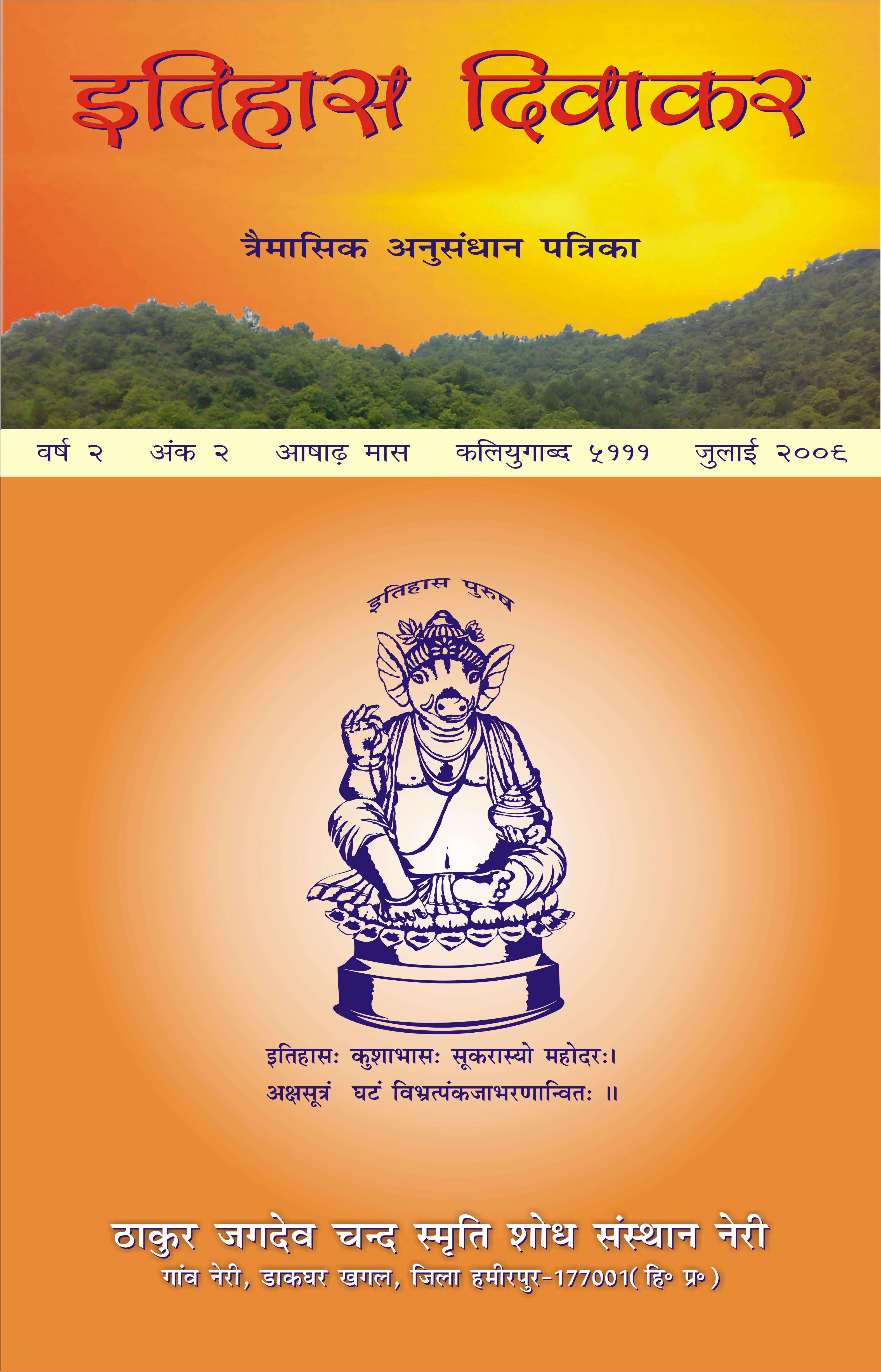
Itihas Diwakar - July 2009
Table of Contents
- Editorial: 100 Years Before the Uttarpara Speech
- Address: History Happens - It Is Not Directed (Author: Hon. Mohan Rao Bhagwat)
- Element of Time: Shveta Varaha Kalpa (Author: Vasudev Poddar)
- Understanding:
- The Reality of Noah's Flood (Author: Th. Nagina Ram Parmar)
- Hindu and Buddhist in the Perspective of History (Author: Dr. Sharda Sinha)
- Hammir Chauhan of Ranthambore (Author: Gokul Chand Goyal)
- Festivals: Shravani Purnima (Author: Chetram Garg)
- Path of the Goal: In the Lap of the Himalayas... (Author: Narendra Sehgal)
- Workshop
Editorial
100 Years Before the Uttarpara Speech
Uttarpara is a town on the banks of the Hooghly river in the province of West Bengal. At this place, Maharshi Aurobindo Ghosh delivered a historic speech on May 30, 1909, in the 5011th year of Kaliyugabd, in which the true, original picture of Bharatvarsha becomes bright. This year marks the completion of 100 years of the Uttarpara speech. Therefore, this year is the centenary year of this speech. Aurobindo Ghosh was a leading figure in the Indian National Congress. Later, he became disillusioned with politics and adopted the path of spiritual practice, becoming world-famous as Maharshi Aurobindo. He made an active contribution to India's freedom struggle even after leaving politics. From his political life itself, he saw India as a powerful, eternal force. ...In the solitude of the prison, God showed me his miracles and I had a direct experience of the true reality of Hindu Dharma. We often talk about Hindu Dharma and Sanatana Dharma, but few of us know what this Dharma is. Other religions primarily give importance to vows, initiations, and beliefs, but Hindu Sanatana Dharma is life itself. It is for giving this Dharma that India is rising. ...It is rising to spread the eternal light throughout the world. The life of India has always been for humanity. It is to be great not for itself, but for humanity. Therefore, when it is said that India will rise, it means that Sanatana Dharma will rise. The existence of India is for Dharma and through Dharma.
Address: History Happens – It is Not Directed
By Mohan Rao Bhagwat
To have faith in one's history is a great quality of human society, but today the vice of faithlessness towards history has grown in us. The recent wave of commercialization has deepened this thinking of ours. The powers that are turning the world into a market have described a subject like history as unnecessary in what they have said and written about human life. They believe that there is no need to read and teach history. ...The history we are reading today is a directed history. Because the powers that wish to force events in a directed manner are dominant today, and our struggle is against them. Our struggle, that is, the struggle of Bharat Varsha, Hindus, and the स्वयंसेवकों of the Sangh, is against them. ...This is the struggle of divine propensity against demonic propensity. It is a continuous struggle. ...We will narrate the history that happened, not the one that was directed. Such a great Mahabharata war happened, and Vyasa ji did not add a single word of his own, whereas he played a major role in the Mahabharata. ...How impartially he has written. He described events as they happened. Not directed, but told as it was. People themselves will decide what the truth is.
Element of Time: Shvetavaraha Kalpa - History and Science
By Vasudev Poddar
The beginning of the Earth's organized bio-environment occurred 1.97 billion years ago, which is famous in Indian Puranic history as the Shvetavaraha-kalpa. Its vast science has been presented through the story of the Varaha avatar. ...In the most ancient historical tradition of the Puranas—the beginning of history happens from here, which is famous as the Shvetavaraha-kalpa, the basis of which is the position and motion of planets and constellations. The word Varaha means Vayu (air). ...The subject of Indian history does not begin from the flow of time of five thousand years, but from the point in time of the creation of 'Hiranyagarbha' - the primordial cosmic egg. The Rishi-sages saw and understood both history and science on the same plane; for them, the origin point of both is one. Thus, history there is itself a science. ...The word 'Itihas' is not a translation of the English word 'History', nor can their meanings be established as mutually related within their semantic boundaries. ...The word 'History' means Inquiry, where there is a predominance of probable meaning, hence 'History' everywhere remains only an inquiry of probability within the limits of its meaning. In contrast, the meaning of the word 'Itihas' is definitive. In this term, the power of three words clarifies its meaning – 'Iti-ha-asa'. 'Iti' means 'thus' and 'in this manner', 'ha' means 'certainly', and 'asa' means 'was'. Thus, the full meaning of the term is 'it certainly was' or 'it certainly happened'.
Understanding: The Reality of Noah's Flood
Noah's flood is mentioned in powerful words in the religious books of Jews, Muslims, and Christians. However, it is not mentioned in the literature of many other countries of the world. ...The reality is that Prophet Noah's flood was not global, but local. And it occurred only in Arabia, Rome, and Greece, which are the birthplaces of the beliefs of Jews, Christians, and Muslims. ...By studying the Puranas, not only is the reality of Noah's flood confirmed, but its scripture becomes completely clear. It also becomes known which countries suffered how much damage from that storm and its exact time is also revealed. In the 37th chapter of the fifth part of the Vishnu Purana, it is written that when Shri Krishna's age was 125 years, he studied the many calamities happening on earth and in space and concluded that the time had come when the beautiful city of Dwarikapuri would be destroyed and the Yadu dynasty would perish.
Understanding: Hindu and Buddhist in the Perspective of History
By Dr. Sharda Sinha
In the books of history, Lord Buddha is mainly presented as a religious reformer, a social reformer, and an opponent of Veda or Brahmin dharma, which cannot be said to be factual from a historical point of view. ...The fundamental difference between Sanatana Hindu and Buddhist was that in the Sanatana tradition, the Vedas remained the authority, but Buddhists did not accept it and instead of the Sanskrit language, Buddhists gave importance to the Pali language. Writers have depicted this as an internal conflict between Hindus and Buddhists. In reality, this was not an unnatural situation of differing opinions. ...Buddhism received the patronage of the Mauryan emperor Ashoka and it then became almost the state religion. At that time, the number of all the sects of Hindus combined was more than the Buddhists, yet due to receiving state patronage, it became the state religion. But two hundred years after this, the Shunga dynasty was established. The founder of the Shunga dynasty, General Pushyamitra, killed his king Brihadratha. Some historians consider this to be the result of the internal conflict between Hindus and Buddhists.
Understanding: Hammir Chauhan of Ranthambore
By Gokul Chand Goyal
A lion sires once, a virtuous man's word is given once, a banana plant fruits once. A woman is anointed with oil for marriage once, Hammir's vow is taken once, it is not taken a second time.
According to the Bhatt dynasties, in the lineage of the Chauhans, seven generations before Hammir, King Jayant of the 'Kadambashakha' dynasty had the impregnable fort of Ranthambore built in the present-day state of Rajasthan by receiving a boon from 'Tapapatrapi'. This fort was a symbol of power and prestige. ...Hammir was the last powerful and ambitious king of Ranthambore. According to 'Hammir Raso' and 'Hammir Mahakavya', as soon as he ascended the throne, he adopted a policy of conquest and began to conquer distant territories. ...Rao Hammir's 17th and final war was not part of his victory campaign but was a defensive war against the attack of Alauddin Khilji, which was caused by giving protection and defense to Muhammad Shah, a fugitive from Khilji's kingdom. Hammir had given refuge and a promise of safety to Muhammad Shah and for that reason, he courted the danger of war with Khilji.