Itihas Diwakar - July 2008
Editorial: The Past Never Passes
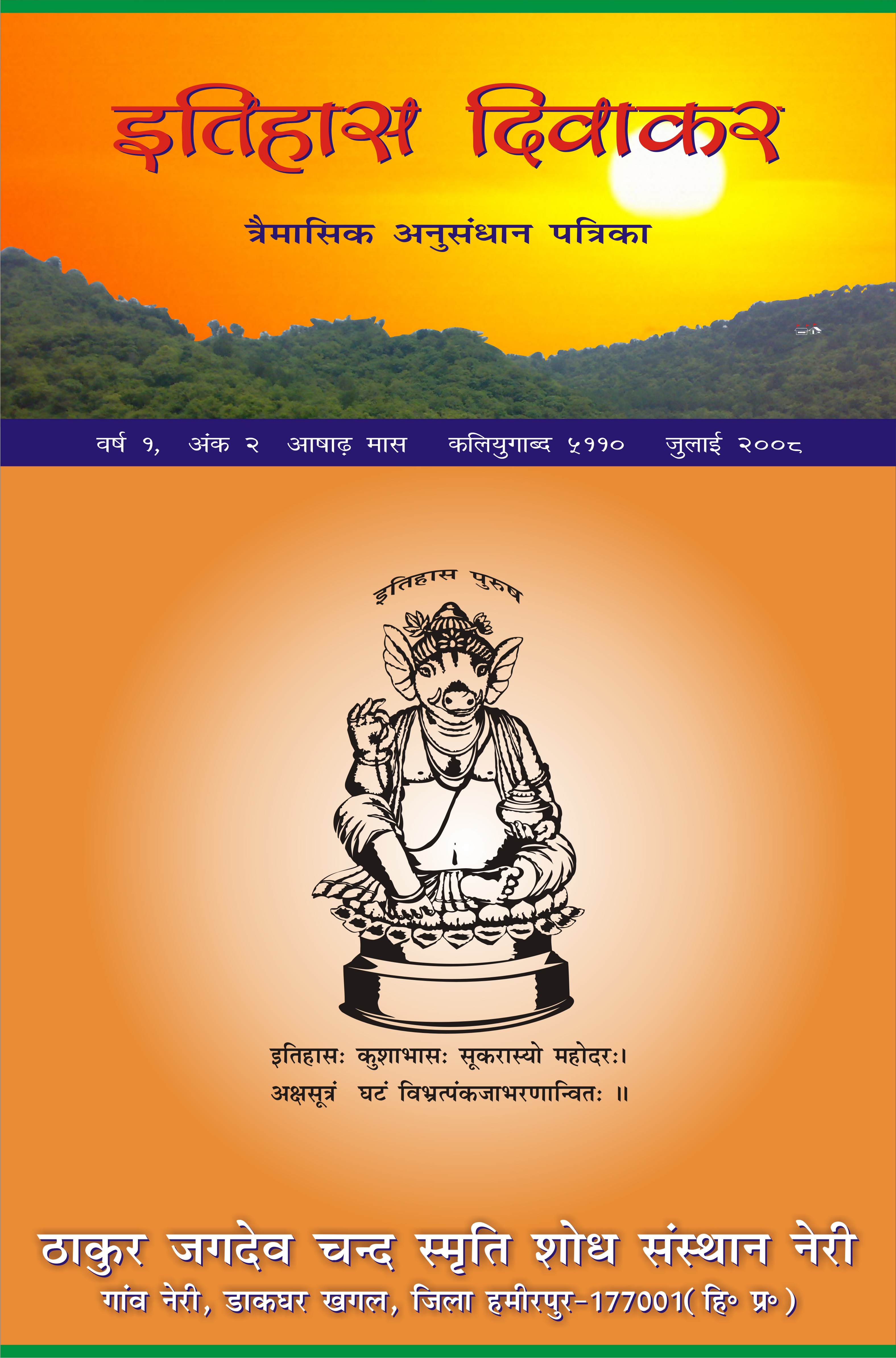
A certain intellectual community holds a view regarding the past that thinking about it is a sign of backwardness. What is the point of digging up buried corpses? Such thinking can only belong to those who wear the cloak of intellectuality on a superficial basis. No sensible person can deny the fact that time is a continuous flow. The past, present, and future are indivisible components of this flow. The past is our history. History contains accounts of many great achievements and also describes the mistakes that were made. Human society learns from the mistakes of history not to repeat them. The achievements of history provide society with energy, inspiration, and self-confidence. To contemplate the history of India in its proper perspective, it is essential to have knowledge of Indian chronology. This topic has been extensively illuminated in the article by Thakur Ram Singh. During this quarter, the date of Ashadh Purnima is July 18th. Ashadh Purnima is known as Vyas Purnima, marking the birth anniversary of Maharshi Krishna Dwaipayana Vedvyas. Maharshi Vyas is the foremost guru in the Indian knowledge tradition. Therefore, this Purnima is also famous as Guru Purnima. An insightful article titled 'Maharshi Vyas' by the eminent scholar of Indian history and culture, Dr. Vasudev Sharan Agrawal, introduces this celestial world-figure. A section named 'Samarth Darshan' has been initiated in honor and remembrance of the fourth birth centenary of the national saint Samarth Guru Ramdas. This time, under this section, we are presenting imitable verses from the composition 'Manache Shlok' by Samarth Guru Ramdas. Other important compositions are included under the 'Vividha' section. The magazine is reaching the readers in a different size from its inaugural issue. This size has been confirmed for the future. The past does not pass. The relevance of the past remains constant in the life of the nation, society, and humanity. With this in mind, we will always aspire for the creative cooperation of esteemed writers.
The Knowledge of Time (Kaal Gyan)
The Meaning, Origin, and Definition of Time
In Indian literature, 'Kaal' (Time) is a concept because it can be discussed and debated. According to grammar, this word is either enumerative or causative. It is formed by adding the 'dhañ' suffix to the root 'kal' in the sense of an action. The Vedic scholar Yaska, the etymologist, considers it to be derived from a root meaning motion. This clarifies that time is related to motion. Time itself moves and inspires everything else to move. Time and the universe move together, and this is where history begins. According to the great grammarian Maharshi Patanjali, time is that which causes the growth or decay of objects. In the 'Vakyapadiya', Bhartrihari has described it as 'vibhu', meaning omnipresent. In the book 'Vishwa ki Kaal Yatra' (The Time Journey of the Universe), it is written that when the cycle of creation began from the exploded cosmic substance of Hiranyagarbha, the first thing established was the 'Kalapurusha' (Time Personified), and after millions of years, when all the necessary means for human life were complete, humanity originated and the evolution of nature ceased.
Origin of Mahakal (The Great Time)
The time by which the creative and destructive time is measured is Mahakal. This time, being the form of the Supreme Lord, is eternal, beginningless, and endless.
The Concept of Time
Time is omnipresent. All creatures experience time. The power of time is effective over all animate and inanimate beings. Time is supreme. All are subject to the power of time. The grace of time is called life, and its wrath is death. Time is beyond beginning and end. Fire, air, and nature are all subject to time. Seeing the wondrous glory of time, the sage Bhrigu in the primordial age of history—the Devayuga—sang the following song about time: 'Time is boundless. The power of time is infinite. Time sees all. It has a thousand eyes. All are seated on the chariot of time. The wise ride this horse. It rides the foolish itself. These worlds revolve with the wheels of this wondrous chariot. There is nectar in the axle of this chariot, which is why it never stops or pauses. Time pushes the wheels of the world forward. Time is the first god. A full pitcher is placed on the head of time. This pitcher takes many forms. In this sun-like pitcher, one sees only time, enchanting youth, and dry old age in their many forms. That time is in the highest realm.'
Maharshi Vyas
Vyas is the Bhagirath of the river of Indian knowledge. Just as in a past age Bhagirath purified this divinely created country through his intense penance by bringing down the Ganga, similarly, Maharshi Vedvyas, in the primordial age of Indian folk literature, sat in unbroken meditation in Badrikashram in the Himalayas and first realized the threefold Ganga of spirituality, ethics, and mythology in his own soul, and then through literary practice, purified the Aryan literature of the country with it. It was as if Vedvyas brought the divine waters flowing on the high peaks of the knowledge-Himalayas down to the earth. He gave impetus to folk literature. The Saraswati, woven from the knowledge and characters of the ancestors, came to reside in the throats of the people.
Life Story
Despite the efforts of archaeologists, Vyas has not been fully placed within our historical timeline. Our Vyas emerged in an era somewhere between the 30th century BC and the 15th century BC. According to the Puranas, a tradition of twenty-eight Vyases is found, from Brahma to Krishna Dwaipayana. They were primarily narrators of the Puranas. Until well-reviewed editions of all the Puranas are prepared, the full value of this tradition cannot be assessed. Yes, the great sage Vyas, named Amitauja, the author of the excellent history named 'Jaya', who comes at the end of the twenty-eight Vyases, is certainly our long-familiar Puranic sage who moved between Badrikashram and Hastinapura on this earth during the Kurupandava era.
Introduction to Works
Vyas is considered the author of the Vedanta Sutras. The Vedanta Sutras are also called the Bhikshu Sutras. It is known from Panini's Ashtadhyayi that the author of the Bhikshu Sutras was Parasharya. Being the son of Parashara, Vyas's name was also Parasharya. Due to living in the Badri ashram, Vyas's second name was also Badarayana Muni, and for this reason, the Vedanta Sutras are sometimes called the Badarayana Sutras. The Mahabharata is, in the true sense, an encyclopedia of ancient India. In world literature, the Mahabharata is a colossal work. In comparison, the Iliad and Odyssey of Greece, or the ancient Eddas and Sagas of Iceland and Scandinavia, where the remaining oral tradition of Uttarakhand is preserved, fall far behind.
Samarth Darshan: Manache Shlok (Verses to the Mind)
Guru Samarth Ram Das was a nation-devoted saint who had attained the divine accomplishment of spiritual practice. He awakened the spirit of devotion to 'Shri Ram Jai Ram Jai Jai Ram' in the masses and ignited the power of national devotion in the languid society with the cry of 'Jai Jai Raghuveer Samarth'. With this power of national devotion, Chhatrapati Shivaji confronted the Mughal rulers and established a Hindu empire. Samarth Guru Ramdas wrote many books for the enlightenment of society, among which Dasbodh and Manache Shlok (i.e., Manobodh) are highly regarded.
Original: Ganadhish jo eesh sarva gunancha। Mularambh aarambh to nirgunacha। Namu Sharada mool chatvar vacha। Gamu panth aanant ya Raghavacha।।1।।
Translation: The Lord of Ganas, who is the master of all virtues, the beginning of the beginning, He is the formless one. We bow to Sharada, the source of the four forms of speech. Let us walk the infinite path of Raghava (Rama).।।1।।
The Rishi Tradition (Rishi Parampara)
With the utterance of the word 'Rishi', feelings of knowledge, devotion, penance, divine luster, truth, altruism, forgiveness, non-violence, etc., arise in our minds. When Vedic mantras, narratives, and other contexts are discussed, the names of Vedic Rishis come before us. It is natural to ask who these Rishis are and what their tradition is. These are some serious questions that are directly linked to the intellectual development of human creation in this universe. Before considering the Indian Rishi tradition, it is necessary for us to know the etymological meaning of the word 'Rishi'. The word 'Rishi' is derived from the root 'ṛṣ gatau' (to go, to see) with the Unadi suffix 'in'. Therefore, the etymological meaning of this word is 'seer of mantras'. The Rishis had a vision of the Veda mantras, which is why they are called 'ṛṣayo mantradraṣṭāraḥ' (Rishis are the seers of mantras).
Miscellaneous (Vividha)
The Unique Tradition of Deity Processions in Himachal
A unique tradition of deity processions is prevalent in Himachal Pradesh. All deities, after some interval, go on a 'devayatra' (deity's journey) with their devotees, accompanied by the resounding sound of musical instruments. Some deities go on a journey every year, while others embark on a journey with their entire retinue after three, five, seven, twelve, or twenty years. In Kullu, the departure of deities on a journey is called 'phera dena'. During the journey, the devotees accompanying the deity spend the night in temples of various villages, shrines, etc., and then proceed forward.
Guru Gobind Singh and the Battle of Nadaun
A battle fought in 1690 AD between the hill kings and Aurangzeb's army is described. A detailed account of this is available in the ninth chapter of the autobiographical poetic work 'Vichitra Natak' written by Guru Gobind Singh. This battle holds special significance in relation to Nadaun, District Hamirpur, because on one hand, the Mughal army was defeated, and on the other, the nine days spent by Guru Gobind Singh and his assistance to the hill kings is its second major point. The background of the battle was that Aurangzeb was engrossed in the conquest of South India. At the same time, 22 kings, including those of Kotkhai, Nadaun, and Guler Jaswan, stopped paying taxes.
Path of the Goal: Activities of the Research Institute
Three-Day National Symposium
A three-day national symposium on the topic 'Creation Theory in Folk Tradition' was organized by the Thakur Jagdev Chand Smriti Shodh Sansthan, Hamirpur, Neri, District Hamirpur (H.P.) in the research institute premises on May 10, 11, and 12, 2008, corresponding to Vaishakh Shukla 5, 7, 8 of Kaliyugabda 5110.