Itihas Divakar - January-April 2018
Editorial
One who sees the people directly becomes all-seeing.
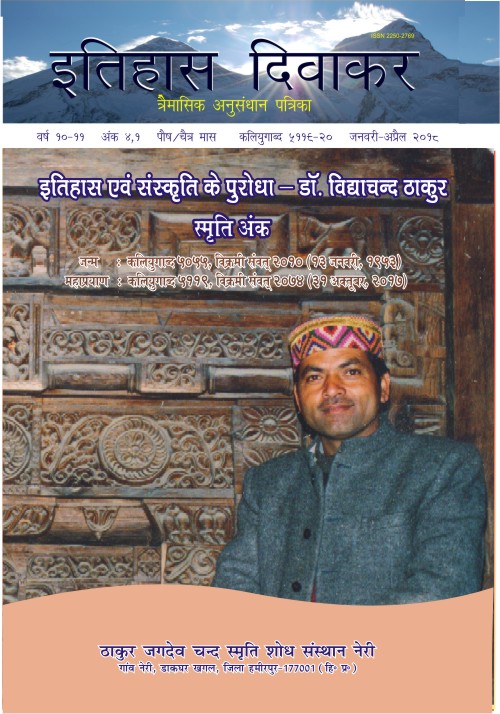
The person who directly perceives the essence of the people is the one who can attain omniscience. The contemplation and reflection of Dr. Vidyachand Thakur are seen within this motto. Thakur ji followed the environment in which he was raised throughout his life. He was a devotee of 'Shabdabrahman' (the ultimate reality in the form of sound). He was a knowledgeable scholar of folk tradition, folk language, folk art, folk culture, folk literature, history, and scriptures, and beyond that, he was a pioneer and thinker of national consciousness. It would not be an exaggeration to say that he was a great proponent of the protection, promotion, and development of folk culture.
Dr. Vidyachand was born on January 19, 1953, in the village of Khoda Aage, district Kullu, to the late Shri Uchhabu Ram and Smt. Lotami Devi. He was brilliant in his studies from childhood. After completing his primary education from the village school, he pursued his graduation from the Government College, Kullu. After his post-graduation in Sanskrit from Himachal Pradesh University, Shimla, he received his Ph.D. for his thesis "Sanskrit-derived words of Kulluvi: A linguistic study." During his Ph.D., he was appointed as the District Language Officer in the Department of Language and Culture, Himachal Pradesh, in Chamba district. After this, he served as a language officer in Mandi, Sirmaur, Solan, Bilaspur, and Hamirpur districts.
History should be a source of inspiration for the national psyche. He considered the Indian system of time calculation a matter of scientific and national pride. His devotion to dharma was so extensive that he considered dharma the backbone of India. He used to say that dharma is our identity; dharma and spirituality are our everything.
Dr. Vidyachand Thakur was the director of the ideological wing of the Thakur Jagdev Chand Smriti Shodh Sansthan, Neri, and the editor of the Itihas Divakar magazine. Many national and international seminars were organized under his guidance. The story of the research institute's construction, its direction, narratives from Vivekananda's literature, Indian culture, creation myths in folk tradition, and the Lok Gatha Digdarshika were important books published under his guidance.
This special issue contains memoirs of scholars who had a very close relationship with Thakur ji. They have brought out Thakur ji's life in their own ways through their memoirs.
Memoir: A Devotee of Folk Life: Vidyachand Thakur
Chetram Garg
Dr. Vidyachand Thakur was a devotee of folk life. Folk life itself expresses the culture and thought of a nation. The resilience that India maintained while enduring various storms was a result of the power of its people. Thakur ji used to say that if we have to choose between folk tradition and scriptures, the folk tradition gets the first preference. It is a repository of folk knowledge. This was his path of devotion until his last breath. He shaped many scholars with his own hands and engaged them in the devotion of words. In that series come Dr. Surat Thakur, Deepak Sharma, Thakur Sita Ram, Dr. Rakesh Sharma, Dr. Om Prakash Sharma, Shri Ramesh Jasrotia, Dr. Vivek Sharma, and other scholars. This is a long chain. He had the opportunity to exchange ideas with writers and thinkers from India and abroad. He came in contact with many foreign scholars from France, Russia, Germany, and the philosopher Prof. Shrinivas Mishra of India. Once introduced to Thakur ji, scholars would become his favorites. Foreign scholars would stay at his home for many days.
Thakur Vidyachand ji was born in Kaliyugabda 4054, Vikrami Samvat 2010 (January 13, 1953) in a farmer's house in 'Khoda Aage', Kullu district, Himachal Pradesh, to the revered mother Smt. Lotami Devi and father Shri Uchhabu Ram. Uchhabu Ram had two children in total: a daughter, Kali Devi, and a son, Thakur Vidyachand. Vidya Chand was about 8 years old when the shadow of his revered father was lifted from his head. Thakur Vidyachand received special affection from his mother, Lotami Devi. Vidya Chand was sharp-witted in his studies from the beginning. It is said that he always stood first in his class. After completing his education, he was appointed to the post of District Language Officer in the Language, Art, and Culture Department of Himachal Pradesh.