Editorial: The Luminous Path of Thakur Ramsingh Ji's Power of Action
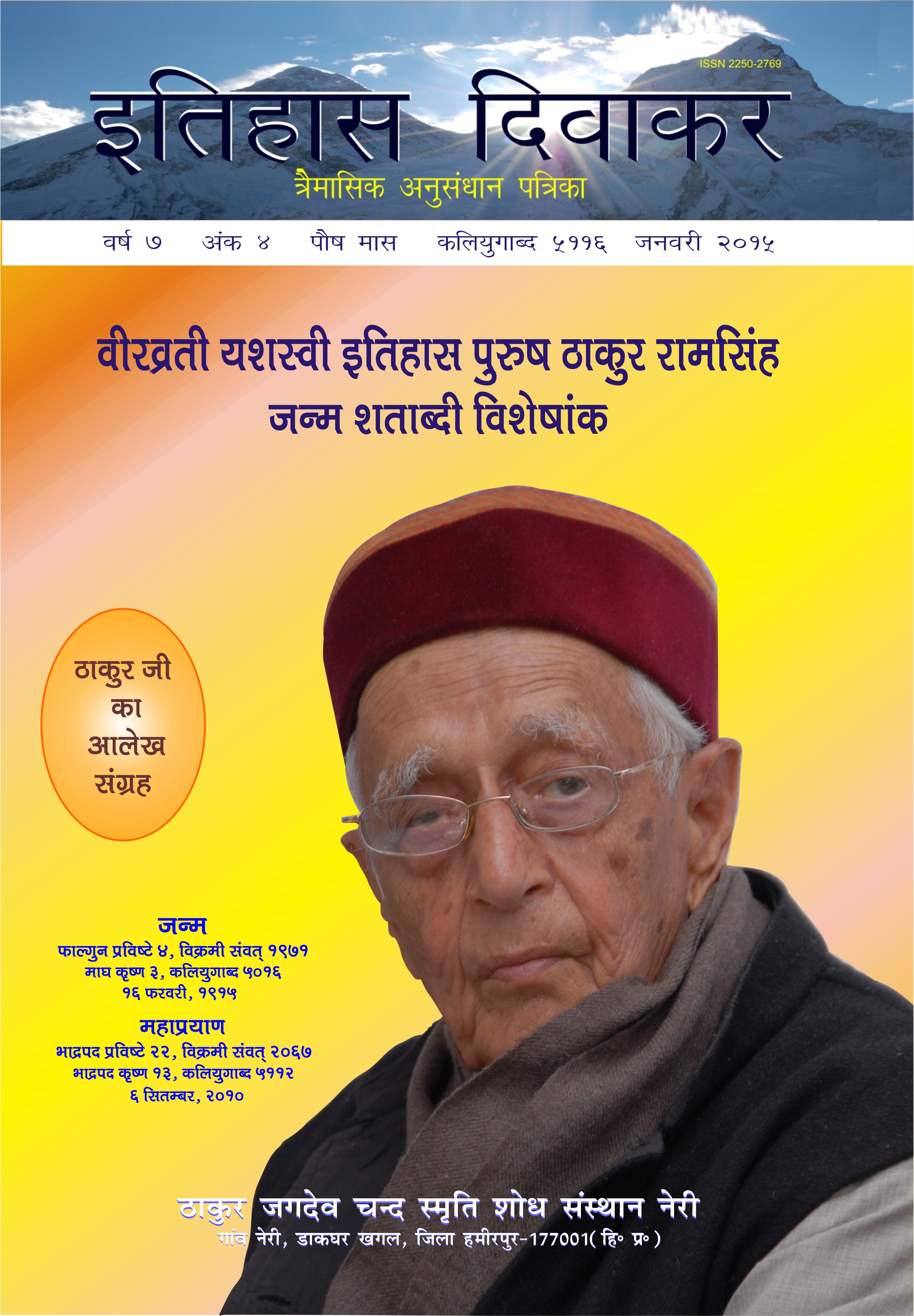
In God's ordinance, one who is born is certain to die. Lord Krishna states this principle in the Gita, that the flow of birth and death can never be stopped. One who is born will surely die, and those who die are surely born again. A special aspect of this cycle of coming and going is that some people establish such legacies in their lives that they become immortal even after death. Such an immortal figure is the nationalist thinker and historian, the late Thakur Ramsingh Ji, whose path of action will forever illuminate human society and the nation's path.
The heroic and successful man of history, Thakur Ram Singh Ji, was born a hundred years ago on the 4th day of the month of Falgun in Vikrami Samvat 1971, which corresponds to Magh Shukla Tritiya, Kaliyugabd 4015, and February 16, 1915, in the village of Jhandvi, Hamirpur district of present-day Himachal Pradesh, to mother Smt. Niyatu and father Shri Bhag Singh.
Bringing to light the glorious history of India with true facts was the ultimate goal of Thakur Ramsingh Ji. For this, he continuously traveled throughout the country. With the aim of achieving his goal, he, for his entire life up to the age of 95, with full confidence, embodied the sage's message of 'Charaiveti! Charaiveti!' (Keep moving!), sometimes moving here, sometimes there! He never tired! But after inspiring countless scholars with an indomitable will to achieve the goal, he expanded his glorious resolve and passed away from this world on September 6, 2010, corresponding to Kaliyugabd 5112, Vikrami Samvat 2067, Bhadrapada, 22nd day of the solar month, Krishna Trayodashi, merging into the five elements and becoming one with the absolute.
From childhood, the revered Thakur Ram Singh Ji's intellect was sharp and accomplished. In 1941, he was a student of M.A. (History) at F.C. College in Lahore. During that time, in September 1941, he became a Swayamsevak of the Rashtriya Swayamsevak Sangh. In 1942, he secured the first position in the final examination of M.A. at F.C. College. The principal of the college offered him the post of a lecturer in history, but he did not accept the post and became a pracharak (full-time worker) of the Rashtriya Swayamsevak Sangh to nurture patriotism.
The Concept of Time
In Indian literature, 'Kaal' (Time) is a concept because it can be discussed and debated. According to grammar, this word is either numerical or inspirational. It is formed by adding the 'dhañ' suffix to the root 'kal' in the sense of being.
The Vedic scholar Yaska, the author of Nirukta, considers it to be derived from a root meaning motion. This makes it clear that Kaal is related to motion. Kaal itself moves and inspires everything to move. Kaal and the universe move together, and this is where history begins.
According to the great grammarian Maharshi Patanjali, Kaal is that which causes the growth or decay of objects, meaning that by which objects grow or are destroyed. That is Kaal. In the 'Vakyapadiya', Bhartrihari has called it 'Vishu'. Vishu means all-pervading. In the book 'Vishwa Ki Kaal Yatra', it is written that when the cycle of creation began from the explosion of the Hiranyagarbha (cosmic egg), the form of Kaal was first established, and after lakhs of years, when all the necessary means for human life were complete, humanity came into being, and the evolution of nature ceased.
The time by which the preserver and destroyer aspects of creation are measured is Mahakal (Great Time). This Kaal, being a form of the Supreme Lord, is without beginning and without end. Kaal is all-pervading. All beings experience Kaal. The power of Kaal is effective over all animate and inanimate beings. Kaal is supreme. Everything is under the authority of Kaal. The grace of Kaal is called 'Aayu' (life span), and its wrath is 'Mrityu' (death). Kaal is beyond beginning and end. Fire, air, and nature—all other powers are subject to Kaal.