Itihas Divakar
Editorial: The Glory of Om
The glory of Om is immense. The word Om is Parbrahma (the ultimate reality) and Naad Brahma (the primordial sound). It is an eternal, omnipresent, and indestructible element. The rhythm of creation and dissolution of the universe is managed and executed under its will and command. In the scriptures, this word 'Brahma' has been explained in many forms, which reveals its boundless, transcendent glory.
Om is made up of the combination of three sounds: A, U, M. Upon uttering Om, the life force (prana tattva) immediately becomes dynamic with ease. That is why this word 'Brahma' is called 'Pranava'. Pranava is the designator of God - Tasya vachakah pranavah. While interpreting this yoga sutra of Maharishi Patanjali, Swami Vivekananda has called Om a natural designative sound. Swamiji says - Om (A U M) is the sound that is the foundation of all other sounds. Its first letter 'A' is the root of all sounds - it is like the key to all sounds. It is pronounced without touching any part of the tongue or palate. 'M' is the last sound in the sound series, its pronunciation requires closing both lips, and 'U' seems to roll from the root of the tongue to the middle boundary of the mouth's central sound base. In this way, the entire process of sound production is revealed through the word Om. Therefore, it is the natural designative sound, the mother of all different sounds. All the types of words that can be pronounced - all the types of words that we have the potential to pronounce, Om is the symbol of them all. All the different religious sentiments in India, this Omkar is their center. All the different religious sentiments of the Veda are dependent on this Omkar.
Vivekanandamritam: Pranava is the Illuminator of God
Author: Swami Vivekananda
It is true that all knowledge is inherent within us, but it needs to be awakened by another piece of knowledge. Although the power of knowing is present within us, we still have to awaken it. According to the yogis, awakening knowledge in this way, i.e., the manifestation of knowledge, can only happen with the help of another piece of knowledge. An unconscious, inanimate object can never cause the development of knowledge—only through the power of knowledge does knowledge develop. The knowledge that is within us needs the presence of knowledgeable people to awaken it. This is why the need for these gurus has always persisted. The world has never been without these teachers. Without their help, no knowledge can be attained. God is the Guru of all gurus because no matter how advanced these gurus were, whether they were deities or celestial beings, they were all bound and limited by time; but God is not bound by time.
Scrutiny: Timeless and Prosperous Indian History
History is not a fossil; it is alive. The present has a deep connection with history. The prosperity of any nation and its culture depends on its past history. The unique glimpse of cultural beauty is impossible without a meaningful understanding of history. The historical heritage of India is its cultural wealth. There is a considerable difference in the Eastern and Western perspectives on such history. It can be called partial and holistic, respectively. Whatever it may be, to understand and know history, having a sense of history is absolutely essential. In ancient times, history was understood by both the words 'Itihas' and 'Purana'. This means, iti-ha-asa, which translates to 'it happened thus.' The word history has also been explained in the Vedas.
Vedas and Vedanta
Author: Dr. Harishchandra Verma
To understand the nature of Vedanta, knowledge of the Vedas and Vedic literature is essential. All the historians of the world accept the fact that the Vedas are the most ancient texts in the world. Among Western scholars, Jacobi has considered the composition period of the Rigveda to be more ancient than other scholars. He believes that the Rigveda was composed around 3000 B.C. But now, based on many evidences, the period of the composition of the Vedas and the beginning of Vedic culture has reached up to ten thousand years B.C. Keeping in mind the depth of knowledge, the Vedas have been considered to be created by an invisible entity or the Supreme Soul. Because they were not created by humans, they have been called 'Apaurusheya' (not of human origin).
Ancient Chronicle: The Penance Place of the Demon Jalandhar - Jalandhar Peeth
Author: Dr. Ved Prakash Agni
The history of the Trigarta region has undoubtedly been a history of a holistic life-view, which is why it is completely imbued with symbolic, spiritual, and divine elements. It is not easy to grasp its essence without removing or understanding the fog of mystery surrounding them. Although this path is old, it is fraught with the risk and labor of excavating layers of archaeology buried under the mound of time, layer by layer. Here, only a few of its aspects will be considered. The Trigarta region has been a significant area for Vedic literature and faith. The Jalandhar Mahapeeth, existing within it, holds a glorious place in the history of Indian culture.
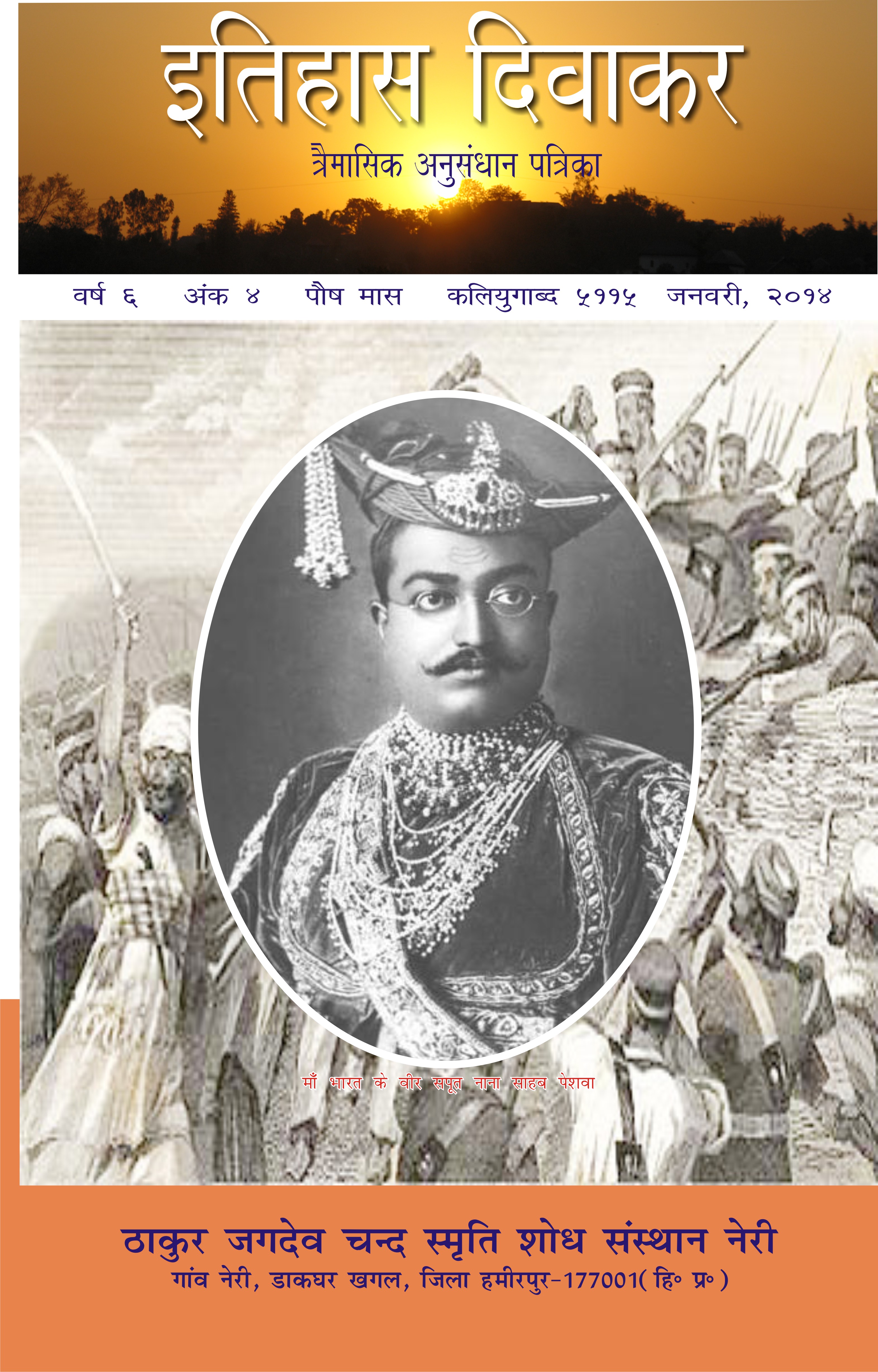
Revolutionary Hero: Brave Son of Mother India, Nana Saheb Peshwa
Author: Vinod Kumar Lakhanpal
In 1857, the common people of India fought the first war of independence against the heretical British with the great objective of making their beloved religion and country completely independent and fearless. This war of independence was labeled as a 'mutiny' or 'sepoy rebellion' not only by British historians but also by their Indian sycophants who viewed it from their perspective. It is true that the first war of independence was fought in the name of the last Mughal emperor, Bahadur Shah Zafar. But in reality, its true and leading figures included Nana Saheb Peshwa, Maharani Laxmi Bai, Tantya Tope, and Azimullah Khan.
Creation Narrative: Description of Creation in Guru Granth Sahib
Author: Prof. Ganeshdatt Bhardwaj
The Guru Granth Sahib is a sacred historical collection of the teachings of Sikh Gurus, devotees, and bards. While discussing the creation, Guru Nanak Dev Ji has also shed special light on the state of matter before creation. In his words — When there was no sign of creation. .... For countless ages, there was great darkness. There was neither earth nor sky. There was only the infinite command of the Lord. There was neither day nor night. There was neither moon nor sun. There was only a void. The Vedas and Puranas were non-existent.
Creation - Vedic and Worldly Context
Author: Dr. Om Datt Saroch
As beautiful and wonderful as this visible world is, the history of its creation process is equally mysterious. Since the dawn of human consciousness, man has been striving to know and explore the secrets of this wonderful creation. The beginning and foundation of human thought have been this creation and its creator, the Supreme Lord. In this context, there is a long tradition of Indian thought, which is prevalent in the Vedic Samhitas, Brahmana texts, Aranyakas, Upanishads, Puranas, Smritis, as well as in folk tales, folk songs, and folk culture.