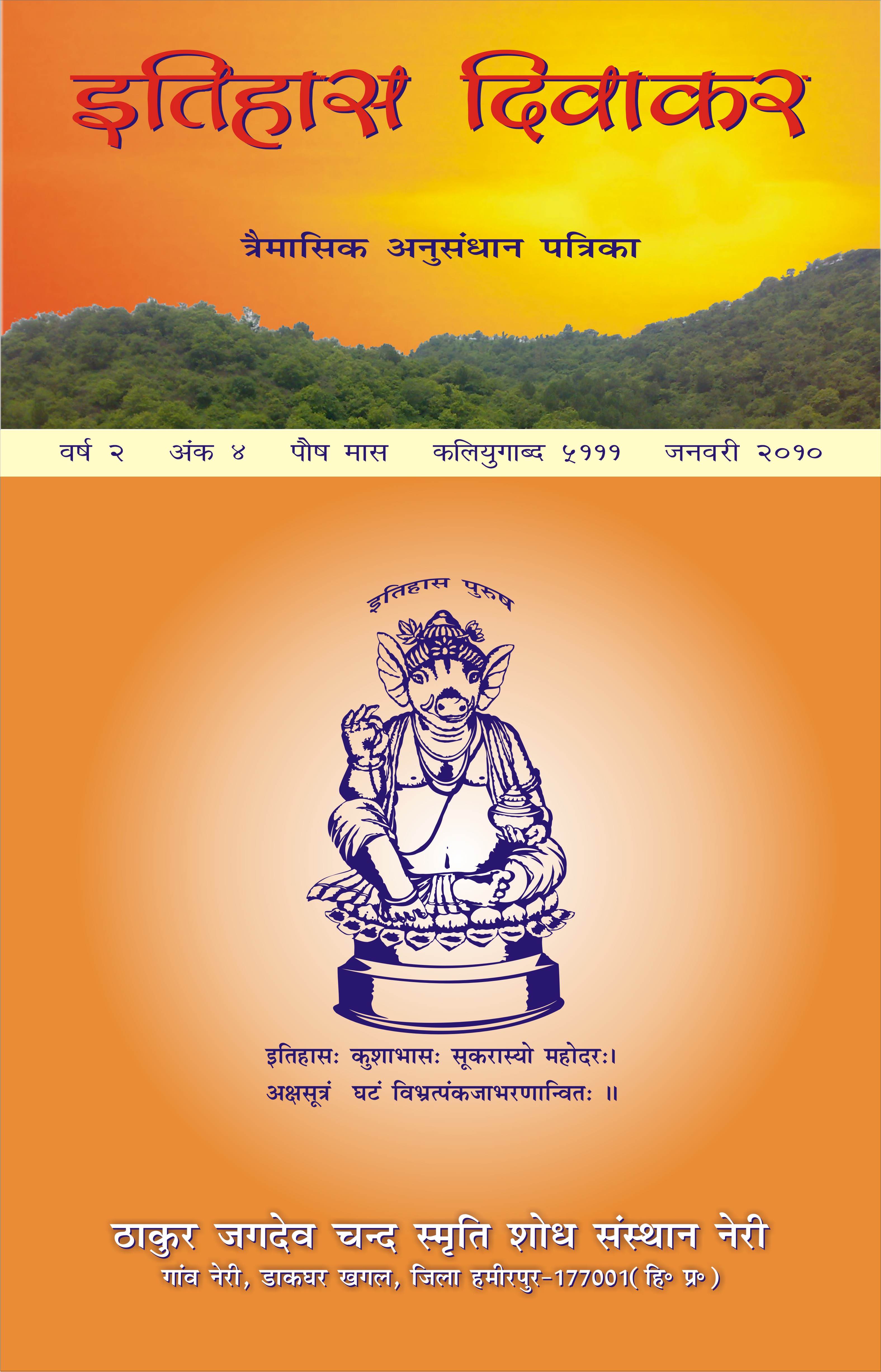
Itihas Divakar - January 2010
Editorial: Svasti Bhavate Sagave Savatsaya
According to the Kashikavritti commentary by Acharya Katyayana on Maharishi Panini's grammar treatise Ashtadhyayi, in the common parlance of that time, this blessing was given: 'Svasti bhavate sagave savatsaya,' meaning 'May your life be auspicious with cows and calves.' The term 'govatsa' here is used to mean the entire cattle wealth, including heifers, calves, and bulls. This context has been cited by the eminent scholar of Indian culture, Dr. Vasudev Sharan Agrawal, while discussing cows, bulls, etc., in his book on Panini-era India. An article related to this is included in the present issue of Itihas Divakar. The unique effort of the Vishwa Mangal Go-Gram Yatra organized this year gives this context special relevance.
The glory of the cow is universal. That is why the cow has been called the mother of the world – 'Gavo vishvasya matarah'. The infinite great qualities of the cow have been described in Indian scriptures. There is also a deep faith in the Indian public consciousness towards the cow and its progeny. Today, due to blind imitation of the West and the web of illusion, this faith of ours has weakened. Far from a ban on cow slaughter, shameless arguments are made in its favor. Due to society's ignorance about the multifaceted importance of the cow and its progeny, the cattle are wandering as orphans. In such a situation, many challenges have arisen for nature and humanity. The Vishwa Mangal Go-Gram Yatra is a meaningful public awareness campaign to face these challenges.
The Historical Root Cause of the Partition of India
Author: Th. Ram Singh
In the 8th century AD, Islam entered Hindustan as an aggressor and declared jihad against Hindu society to Islamize the entire country. At that time, from a political perspective, there was no emperor in Hindustan to unite Hindu society. The country was divided into about 500 small Hindu kingdoms. Consequently, a 1000-year-long Hindu-Muslim great war began. This conflict started from the western border of Hindustan, from Hindukush-Tashkent and Yarkand. Day and night, battles were being fought in every village, every city. The Hindus were losing on every front, and the Muslims were winning on every front.
This situation continued until the 16th century, but in the 17th century, a miraculous change occurred in the history of Hindustan - the Hindus were winning on every front, and the Muslims were losing on every front. The reason for this was that from the 14th to the 16th century, a great awakening of Hindu power took place throughout the country through the Bhakti movement.
In South India, Shivaji Maharaj fought 255 wars against the foreign Mughals and, by stepping on their chests, built a Hindu empire 350 miles long and 150 miles wide. Shivaji's coronation took place in 1675. In it, the establishment of the Hindu empire was announced. It was also Shivaji's earlier declaration that the border of Hindustan is from Mansarovar in the north to Kanyakumari in the south. I will make it independent.
The "Trisutri Yojana" - Hindu, Hindustan, and Hindu Rashtra
Until the struggle of 1857, the word 'Hindu' was respected all over the world, and our identity was Hindu. By fighting the 1000-year great war against foreign Muslim invaders in the name of Hindu, we uprooted their foreign Muslim Mughal empire. To eliminate this national identity of ours, the British made a three-pronged plan (Trisutri Yojana) after 1857. Its first formula was the De-Hindulisation of The Hindus, which means to de-Hinduize the Hindus and make them communal. The second formula was the De-nationalisation of The Hindus, meaning to denationalize the Hindus. The third and final formula was the De-socialisation of The Hindu, meaning to disintegrate Hindu society.
The Spread of Indian Culture in Southeast Asia
Author: Dr. Kuldeep Chand Agnihotri
The region of Southeast Asia is located between India and China. Countries from Burma to Thailand, Malaysia, Singapore, Laos, Vietnam, Cambodia, and other associated nations are included in this region. Due to its location between India and China, the promotion, dissemination, and influence of Indian and Chinese culture are reflected everywhere in these countries. Therefore, in history, this region is also known as Indochina. A very large number of Indians and Chinese are settled throughout this region.
In Southeast Asia itself is the world's largest temple, Angkor Wat, which is spread over about five hundred acres. Such large and magnificent temples of Mahatma Buddha stand in Siam (Thailand), Laos, and Vietnam that their beauty is captivating. In some islands of Indonesia, the Hindu way of life is prevalent in the traditional manner, and the beauty of the temples there is a sight to behold.