Itihas Diwakar
Quarterly Research Journal
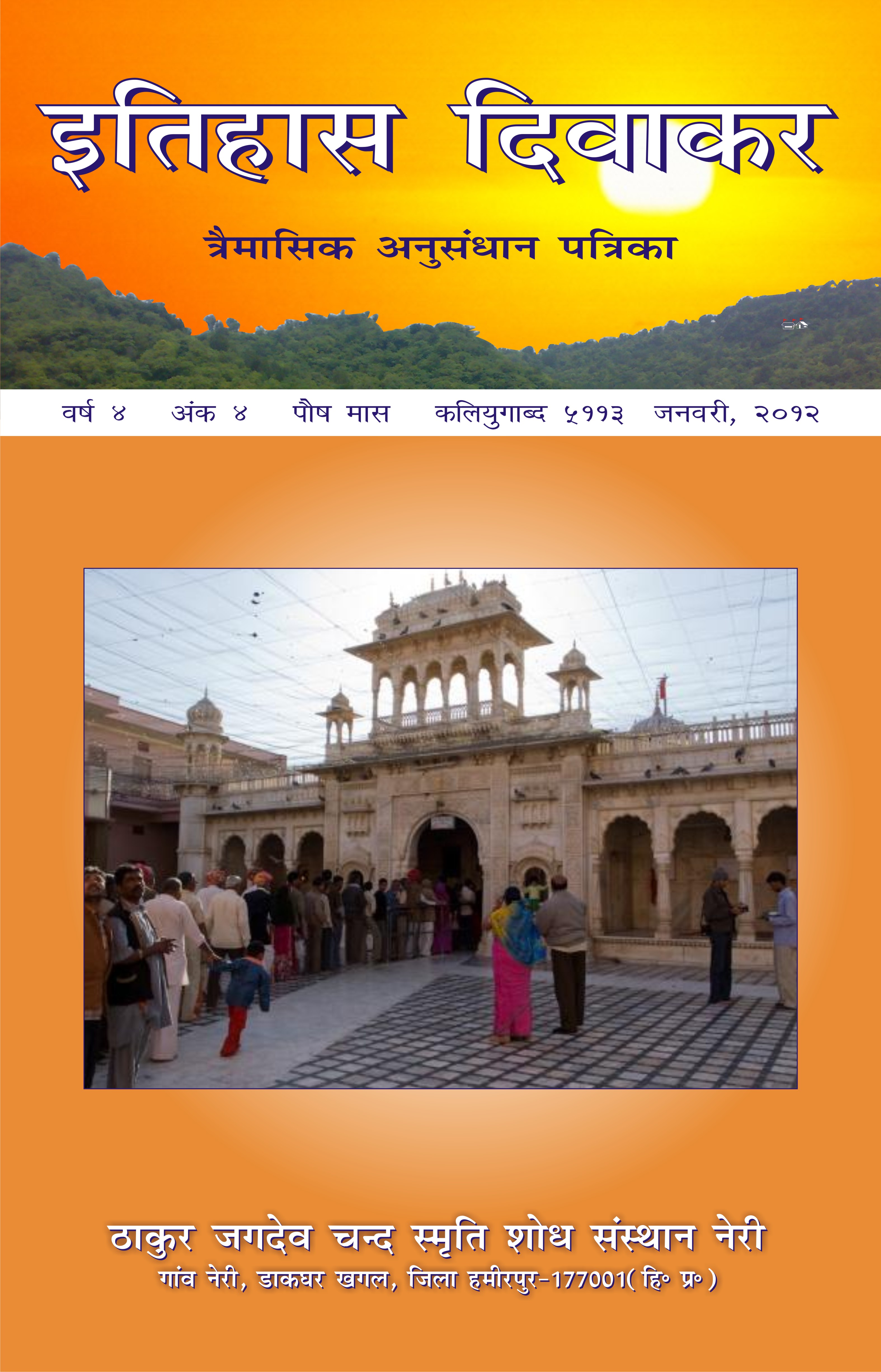
Year 4, Issue 4, Paush Maas, Kaliyugabd 5113, January 2012
Table of Contents
- Editorial
- History Perspective
- Historical Knowledge of Ancient Aryans - Prof. Ramdev
- Review
- Ancient Religious and Social System of the Spiti Tribal Community - Chering Dorje
- Mamleshwar Mahadev Temple, Mamel - Dr. Bhag Chand Chauhan
- Place Account
- Patan and Siddhpur in Gujarat - Kaushik Modi
- National Icon
- Saint Valluvar - Rajendra Singh Gaur
- Festivals
- This is How Lohri is Celebrated in Chamba - Ramesh Jasrotia
- Travelogue
- Two Days in Bikaner - Chet Ram Garg
- Activities
Editorial: Gita's Karmayoga
The historical war of Mahabharata took place in the final phase of the twenty-eighth Dvapara Yuga of the Vaivasvata Manvantara, which has been described in detail by Maharishi Vedavyasa in the Mahabharata text. In this historical text, from the twenty-fifth to the forty-second chapter of the Bhishma Parva, Lord Krishna gave the divine message of Karmayoga to Arjuna in the middle of the battlefield of Kurukshetra. This narrative of the teachings described in eighteen chapters is called the Shrimad Bhagavad Gita, which is famously known in its concise form as the Gita. In the teachings of the Gita, Lord Krishna, using Arjuna as a medium, guided the human community standing in a state of indecision about their duties. Shri Krishna says that a man can never remain without performing actions. Therefore, one should continuously perform actions with a sense of duty, free from attachment. Through this selfless action (Nishkama Karmayoga), man attains the ultimate goal.
If the people who lead the nation and society were to adopt the beneficial path of the Gita in their lives, it would be easy to get rid of any kind of corruption and misconduct prevalent in society. In this context, the Gita offers practical guidance:
Yadyadācharati śreṣṭhastattadevetaro janaḥ |
Sa yatpramāṇaṁ kurute lokastadanuvartate ||
Meaning, whatever actions the great and leading people of society perform, ordinary people follow them. The Hon'ble Court, on December 28, 2011, rejected the said petition, drawing the attention of the world community to the universal utility and importance of the Gita.
In reality, through the study and practice of the Shrimad Bhagavad Gita, the current atmosphere of despair will transform into an atmosphere of hope, and the Karmayoga of the Gita will create a bright future for the world.
History Perspective: Historical Knowledge of Ancient Aryans
Prof. Ramdev
Among the several primary means of crossing the ocean of sorrow, historical knowledge is one. For many centuries, our boat has been faltering in the vortex of this terrible ocean. Our ancestors who skillfully navigated this boat have passed on to the other world, but the lazy ones did not learn the method of navigating this boat from them.
It is a natural thing that when a man is engrossed in the thought of accomplishing a great task, he seeks to know the work style and wants to find a person who has achieved success in performing such a task or who has made a full effort for the desired achievement even in the state of failure.
History
History is the name of that knowledge, by observing which we get complete knowledge of the chronicles of the ancestors of any caste, that is, their progress and decline, their efforts and slackness, their errors and efficiency, and their joys and sorrows.
History of Bharatvarsha
It is the account of the progress and decline of the Aryan race, its efforts and slackness, its errors and efficiency, and at different times the sorrows caused by the foolishness and selfishness of its leaders, and at other times the happiness caused by wisdom and self-sacrifice. It is certain that when we, the people of India, read the history of India, we will be inspired by contemplating the great deeds of our ancestors, our national pride will be aroused, and by seeing the mistakes of many of our ancestors, we will walk on the path of progress with definite steps.
Review: Ancient Religious and Social System of the Spiti Tribal Community
Chering Dorje
Until the seventh century AD, the Spiti region was part of a vast kingdom called Zhangzhung. The Zhangzhung kingdom was a vast state extending from western Tibet to Baltistan (Pakistan-occupied). Some areas of Himachal were also included in it. This kingdom had three administrative regions, which were called Go, Fugs, and Var.
The Nature of Ancient Bon Religion
The Bon religion is one of the oldest religions in the world. We can compare it with the ancient Iranian religion of Zoroastrianism (fire worship) and the Israeli religion of Judaism. The founder of the Bon religion was Mahatma Shen-rab-miwo. It is said that he came to the Zhangzhung country from a region called Tagzig and propagated his doctrine in the local Zhangzhung language. Afterwards, he also went to Tibet. In Tibet too, he propagated his doctrine not in the Tibetan language, but in the Zhangzhung language. This makes it clear that there was a vast area where people understood the Zhangzhung language.