Itihas Diwakar - April 2011
Editorial: Nav Samvatsar and National Pride
The Kaliyugabd 5112-13, corresponding to AD 2011-12, is the birth centenary year of the visionary of Yug Nirman Yojna and founder of the Gayatri Pariwar, promoter of Indian culture, Vedmurti Taponishtha Yug Vibhuti Pt. Shriram Sharma 'Acharya'. Chaitra Shukla Pratipada, being the start date of the year, is called Varsha Pratipada. The tradition of celebrating this festival with great enthusiasm throughout India has been ongoing. Now, under the influence of Western culture, the noise of the Christian New Year on the night of December 31st is heard, causing our ancient traditions to fade. This is empowering anti-national forces that harm national pride. Therefore, there is a strong need for nationalist forces to become vigilant and active to strengthen the foundational elements that protect the nation. In light of this, it is imperative to make intensive and vibrant efforts to bring superior cultural values into the behavior of the national consciousness. Only then will the prosperous national concepts become strong, and national pride will always remain radiant.
Scientific Perspective of Nav Samvatsar
Dr. Om Kumar Sharma
Man is the most contemplative being in the world. In the Indian Vedic scriptures, human birth is considered superior even to celestial birth. It is through the inventions and creations of man that humanity chooses its life path. Even concerning the present Nav Samvatsar (New Year), when we consider it from an intellectual perspective, many new facts and mysteries are revealed. The term 'Navvarsh' means a new year. In all provinces of India, significant differences and absences are often seen in various festivals. It is a world-renowned and universally known fact that the sages of India have bestowed the invaluable asset of time knowledge upon humanity. In this article, we will shed some light on the Indian time calculation and the scientific authenticity of the Nav Samvatsar. The worship of the primordial energy of the universe also begins on Chaitra Shukla Pratipada. Another strong proof of this is that the spring season (Vasant Ritu) also begins to reach its peak on Chaitra Shukla Pratipada. This leads to a clear communication of new life force in every particle of nature. In contrast, on January 1st, the severity of the winter season (Shishir Ritu) is predominant. Therefore, upon consideration from every aspect, the Indian Chaitra Shukla Pratipada, also called Varsha Pratipada, proves to be scientific, cultural, rational, and authentic.
Folk Tradition of the New Year in Kullu
Maulu Ram Thakur
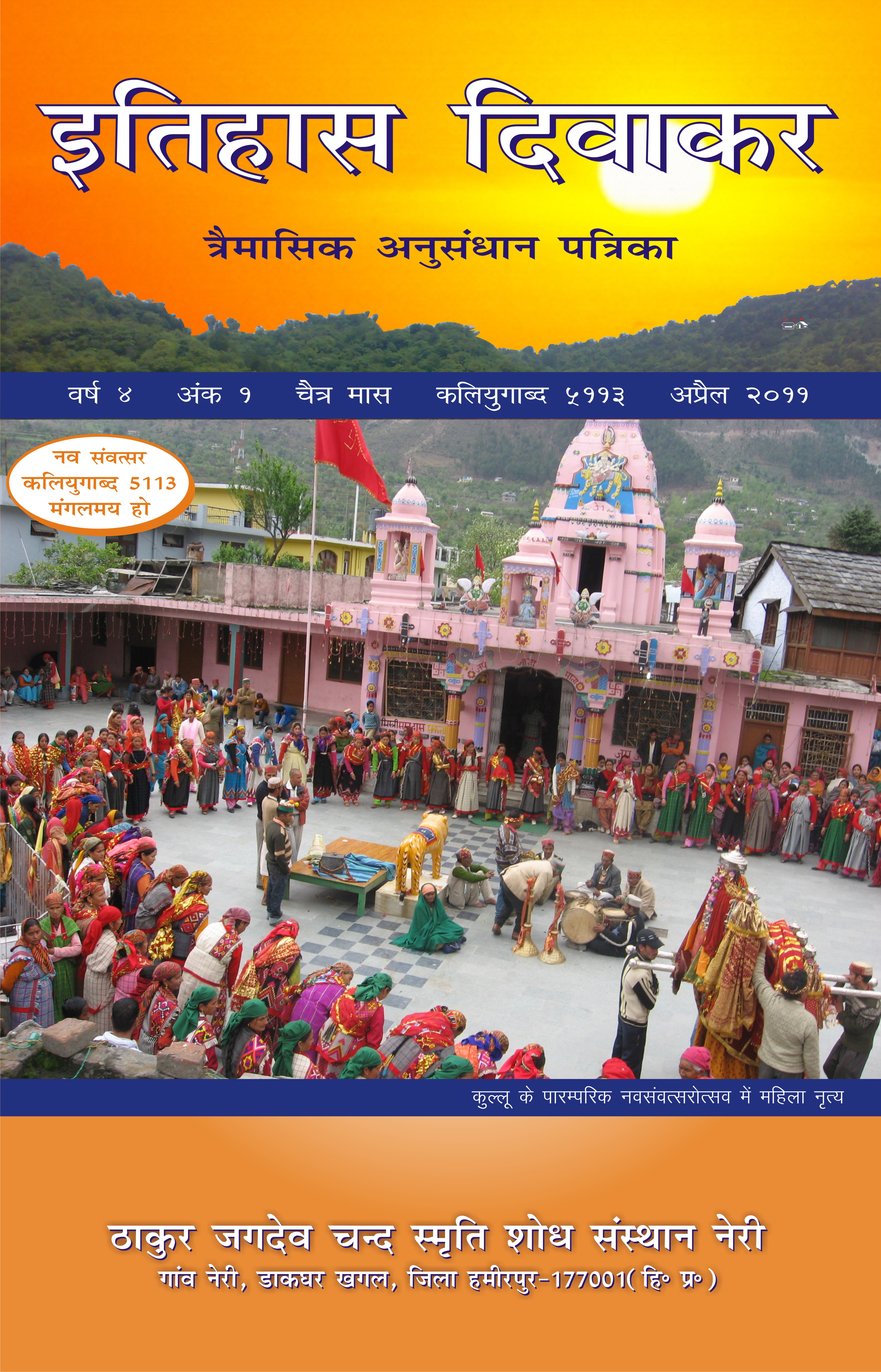
Among the festivals celebrated in Kullu, the New Year is known and recognized by the most names, and its folk tradition is very unique. It is known by several names such as 'Nuan Samat', 'Shudku Saza', 'Lehura Saza', 'Childa Saza', etc. There is a rich tradition of celebrating this festival on the day of Chaitra Shukla Pratipada throughout the Kullu district. Shudku means secretly, and Saza means Sankranti (transmigration of the sun). It is a custom to celebrate it in a peaceful atmosphere and with a peace-loving nature. After the morning meal, every family eagerly and impatiently awaits the family Brahmin. He visits every house on that day and recites the New Year's almanac (Panchang). The New Year is a special day for the worship of the family deity and the village deity. They are prayed to for a joyful completion of the new year. Fairs are held in the villages.
The Relevance of Sanskrit in the Context of Culture
Dr. Ramakant Sharma Angiras
This is an investigation into the diagnosis of a problem that has arisen in the context of contemporary Indian society, stemming from growing material prosperity on one hand and the decay of traditionally received life values on the other. The inner life of mankind constitutes the culture of a society. Therefore, the internal measures required for the health of a culture are all spiritual measures. In this 'samudra-manthan' (churning of the ocean), old and new traditions will have to become the Mandara mountain, and Sanskrit the churning rope, Vasuki. Sanskrit must become the churning rope because it is only Sanskrit that can authoritatively testify to how much and what kind of scrutiny of universal events and activities man has done and still needs to do.
Nation as a Cultural Unit
Pt. Shriram Sharma 'Acharya'
In India, the 'Rashtra' (nation) has always been a cultural term, not a political one. In Western countries, the nation is understood in the forms of 'Nation or State'. In India, the nation is an object of worship, an ideal. Despite hundreds of states, different forms of worship, various languages, and diverse attires, India has remained 'one nation'. Our sages accepted the natural diversity of the world with great ease but succeeded in developing and establishing culturally unifying principles by focusing on the refined consciousness stable in the human heart. This sentiment-filled cultural consciousness is what creates that timeless nation called 'Bharat'.
Innate Patriot: Dr. Hedgewar
Chandrashekhar Parmanand Minshikar
The name of the Rashtriya Swayamsevak Sangh has spread not only in India but all over the world today. Dr. Hedgewar was born on Chaitra Shuddha Pratipada, Kaliyugabd 4991, i.e., April 1, 1889, into a poor Vedic family in Nagpur. The active patriotism that manifested in Dr. Hedgewar's childhood remained an unbroken part of his entire life. From the experiences he gained in the freedom movement, many questions began to circle his mind. He started to feel that another path should be sought. He envisioned the future path, and the idea of establishing the Sangh became firm in his mind.
Rani Lakshmibai of Jhansi
Vasudev Sharma
It was India's good fortune that a gem as radiant as Lakshmibai appeared on this land. Whenever the Indian freedom struggle is discussed, the name of the Queen of Jhansi will be paramount. She was born in Kashi in Kaliyugabd 4937 to her father Moropant and mother Bhagirathi. In Kaliyugabd 4950, at the age of 13, she was married to King Gangadhar Rao of Jhansi. After the king's death, the British government refused to recognize Damodar Rao as his son. The queen declared, 'I will not give up my Jhansi.' Lakshmibai remained engaged in her struggle for independence and played a significant role in the great revolt of 1857.
Mythological Methods of Naming
Shri Ram Shankar Bhattacharya
How any pilgrimage site, river, city, mountain, and district is named is a subject worthy of study. In this context, we will present evidence from the Puranas for the reasons behind the naming of geographical features. There are various types, such as - naming based on a specific object, naming based on a specific event, naming based on a specific quality, naming after a ruler or founder, naming based on the place of origin, naming that proclaims importance, and naming a place after a person. This article analyzes all these methods with mythological examples.