Itihas Divakar
Editorial: Chintan Bhumi (Land of Contemplation)
History is a witness that the deeds of great men rarely come before society during their own lifetime. Thakur Ramsingh ji was no exception to this. When Thakur Ramsingh was born 104 years ago in Jhandvi village of Hamirpur district in Himachal Pradesh, it could hardly have been imagined that this boy named Ramsingh would give the right direction to the history of India, which had been distorted by the tyranny and malicious mentality of foreign invaders. Thakur Ramsingh understood the tradition of Indian history and made successful efforts to establish it. He became the first national president of the Akhil Bharatiya Itihas Sankalan Yojana in 1992. In this capacity, presenting the true evidence of history, he said – Aryans are the original inhabitants of India. The history of India is 1.97 billion years old. The Indian calendar is the oldest and most scientific calendar in the world. The history of India is not one of defeat but of continuous struggle. India is the mother of world civilization.
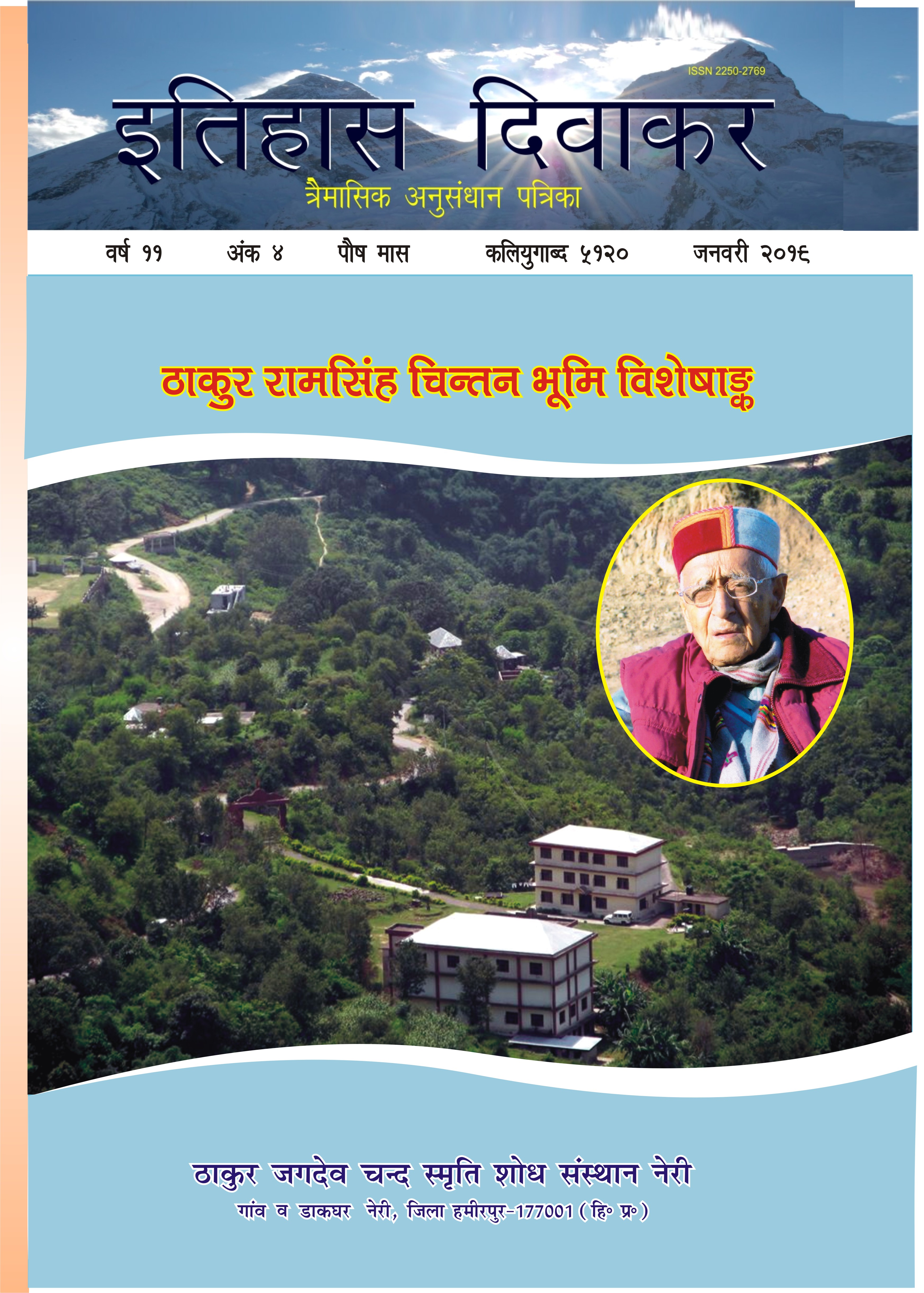
Thakur Ramsingh worked to awaken the dormant Indian scholars with his ideas. At the same time, he attacked the communist ideology that was deceiving its own society and religion for its own selfish interests. In the last decade of his life, he established this history research institute for permanent research work on history in Neri village of Hamirpur district. It has completed about 12 years of its development journey. Two special issues of the Itihas Divakar magazine have been published on Thakur Ramsingh before. The first special issue was "Itihas Purush Amar Vibhuti Thakur Ramsingh Smriti Shraddhanjali Visheshank" and the second was "Veervrati Yashasvi Itihas Purush Thakur Ramsingh Janma Shatabdi Visheshank". This third special issue will prove to be a milestone in taking his life's work in a research-oriented direction. The editorial board expects feedback from discerning readers on the material published in this issue.
The Land of Contemplation of the Man of History, Thakur Ramsingh
Dr. Om Prakash Sharma
A great thinker first establishes the great principles of thought in his stream of thought in the form of a seed. The seed established in the form of thought sprouts. A shoot emerges from the sprouted seed. In that shoot, the branches and sub-branches of thought slowly blossom and flourish, and in the end, that seed takes the form of a great tree of thought. The great thinker Thakur Ramsingh ji also established a word-seed called 'Bharatbodh' in his stream of thought. That seed today is radiating its splendor all around, having blossomed and flourished in various branches and sub-branches of thought like the Mahakal principle, creation and national new year, Indian history consciousness, points of history writing, and the historical importance of the Sankalp Path.
Mahakal Principle
Thakur Ramsingh ji was deeply hurt by the accusation from the Western world, in which Western thinkers kept trying to prove that India's history is devoid of chronology. He said that this thought of the Western world was refuted with evidence. On the basis of strong evidence from Vedic principles, he presented glorious proof of 1.97 billion years of Indian history to the world. He understood the side of the Western theorists from where the misconception spread that Indian thinkers did not know how to write chronological history. Thakur Ramsingh ji made it clear in his theory that the chronological history of India is not four to five thousand years old, but it starts from the original point of 1.97 billion years ago.
Two Pioneers of History from Himachal Pradesh: Thakur Ramsingh and Bipin Chandra Sood
Dr. Kuldeep Chand Agnihotri
Himachal Pradesh gave India two historians in the last century who can be specially mentioned. The first is Hon. Thakur Ramsingh and the second is Bipin Chandra Sood. Both were from the Kangra district of Himachal Pradesh. Thakur Ramsingh was born on February 16, 1915, in Jhandvi village (this village is now in Hamirpur district) and Bipin Chandra Sood was born 13 years later on May 27, 1928, in Garli Paragpur, and he passed away in August 2014 at the age of 86.
Until their education in Lahore, the paths of both were almost the same. Two young men from villages nestled in the mountain ranges of Himachal Pradesh were pursuing knowledge in Lahore. It is another matter that this pursuit of knowledge of Thakur Ram Singh from Jhandvi drew him towards the Rashtriya Swayamsevak Sangh, and the same pursuit took Bipin Chandra Sood from Garli Paragpur to the feet of Karl Marx.
Due to his active participation in the Rashtriya Swayamsevak Sangh, he chose a different path for himself. About thirteen years later, another young man from Himachal, Bipin Chandra Sood, also reached Lahore following the same path. He completed his studies at Forman Christian College in Lahore, but while living in Lahore, he became associated with communist ideology. In those days, Lahore had become a center of activities for the Rashtriya Swayamsevak Sangh, Congress, communist groups, Arya Samaj, Muslim and Christian organizations and a symbol of the activism of the Sapt Sindhu or North-Western India.