Itihas Divakar - January 2016
Editorial: Centenary Remembrance of Thakur Ramsingh Ji
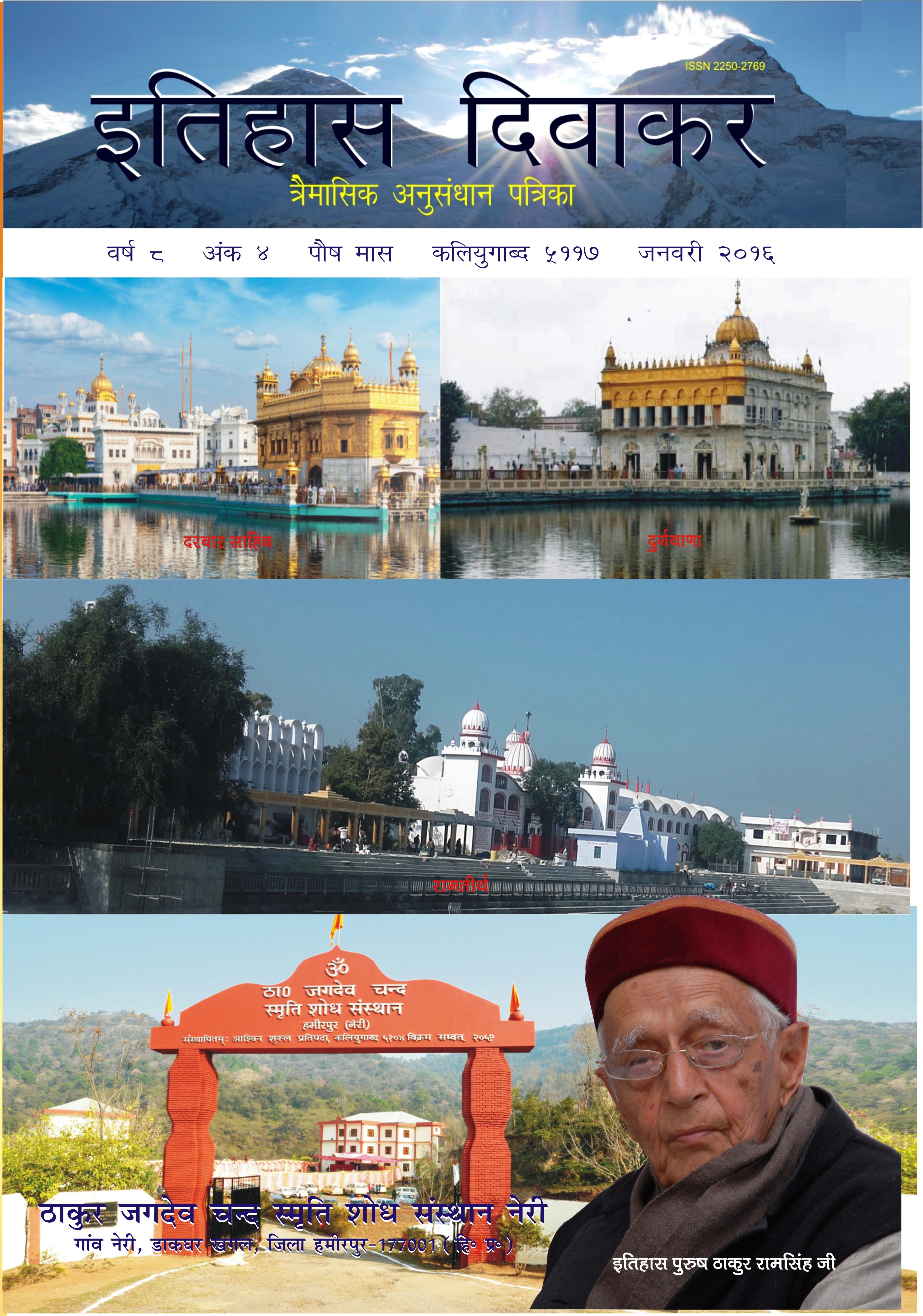
The heroic and successful man of history, the late Ramsingh ji was born on February 16, 1915, corresponding to the 4th Pravishte of the solar month of Phalgun in the year 5016 of the Kaliyuga era and Vikrami Samvat 1971. On the 4th Pravishte of the month of Phalgun in the year 5116 of the Kaliyuga era, Vikrami Samvat 2072, the birth centenary program of the revered Thakur ji was inaugurated on the premises of the Thakur Jagdev Chand Smriti Research Institute, Neri. Subsequently, these programs were organized at various places throughout the year, and the birth centenary programs will continue in the coming year as well.
On the occasion of the birth centenary, articles based on the inspiring memories of Thakur ji are being published in every issue of Itihas Divakar. In this issue, under the centenary remembrance, an article by the learned writer Shri Krishnanand Sagar, who had the privilege of Thakur ji's company, titled 'Thakur Ramsingh Ji in the context of the Partition of India' is included.
Centenary Remembrance: Thakur Ramsingh Ji in the context of the Partition of India
Krishnanand Sagar
It was the year 1941. In the library of Punjab University in Lahore, an M.A. (History) student was reading a newspaper. In the newspaper, there was a statement by Gandhiji. "Muslims are aggressive by nature and Hindus are cowards." Reading this angered the student and he muttered in anger, "Gandhi has lost his mind, calling Hindus cowards." Nearby, another student was also reading a newspaper; he said, "I agree with what you just said." They introduced each other. The muttering student was Thakur Ramsingh, and the one who agreed with him was Balraj Madhok.
The pain that Thakur ji's heart felt after reading Gandhiji's statement, "Hindus are cowards by nature," and the anger that erupted from his mouth, was not only pacified after coming to the Sangh Shakha but also found a definite direction – India is a Hindu nation, and the responsibility to free it from foreign rule also lies with the Hindu society. Therefore, organizing the Hindus and building the spirit of valor in them is the primary duty. After finding this direction, he became deeply involved in the Sangh's work.
Review: The Soul of Indian Culture-Civilization: Saraswati River
Ramsharan Yuyutsu
The word 'Sanskriti' is derived from the Sanskrit language by adding the prefix 'Sam' to the root 'Kri' and applying the suffix 'Ktin'. Its literal meaning is 'sanskar - to refine or adorn.' Therefore, that which refines every aspect of our lives is culture.
Haryanvi culture is not a separate entity, distinct from Indian culture. But when we look at the people-welfare-oriented form of Indian culture, we find that this element has developed a lot here, in the region of Haryana. In other words, the cultural heritage of public welfare of the people of Haryana is very old.
The introduction to Indian culture comes from the hymns of the Rigveda. The ideas described in them are the pillars on which Hindu civilization stands. The Rigvedic hymns are the main sources of information about the religion, social organization, economic and social customs, and moral ideals of the ancient Aryans. The two main foundations of this Indian culture are the land of Bharatvarsha and the Vedic literature.
Agriculture View: Agriculture in the Vedic Economy
Padmashri Dr. Kapildev Dwivedi
The main basis of the Vedic economy was agriculture. The grain produced from agriculture was the main means of livelihood. Therefore, special attention was given to the quality of agriculture in the Vedic period. Human life depends on food. The main means of obtaining food is agriculture; hence, agriculture is the basis of life for all humans. With the origin of creation, the problem of food arose. To solve this, the science of agriculture was invented. It is known from the Rigveda and Atharvaveda that poets (intelligent, far-sighted) and scholars (dhir) adopted the work of agriculture. Agriculture was a work of pride.
The Atharvaveda states that the main problem of human life is food. Life depends on agriculture and food for humans. Therefore, to solve this problem, it is necessary to increase agricultural yield and prepare improved varieties of its supporting elements like seeds, etc. In the Yajurveda, four main duties of the king are mentioned. Among them, improving agriculture has been described as the first duty. The four duties of the king are: 1. To improve agriculture, 2. To ensure water welfare, 3. To strengthen the economy, 4. To provide happiness and comfort to the people and nourish them.