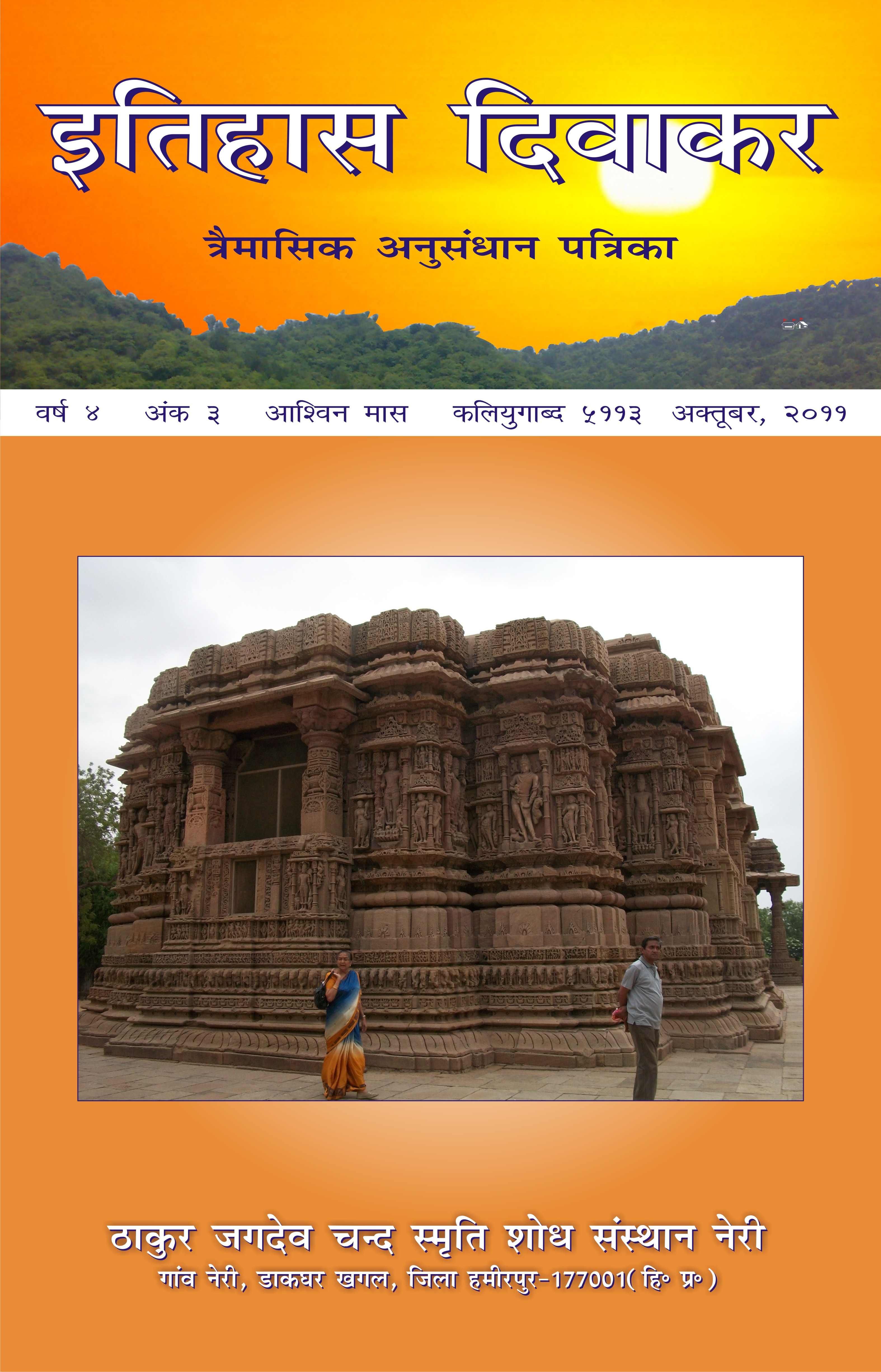
Itihas Divakar - October 2011
Editorial: Victory to Mother India
Great philosopher and eminent national thinker, the most revered Madhavrao Sadashivrao Guru Golwalkar ji, had said in one of his speeches - when a person or society suffers from self-forgetfulness, they lose all their knowledge, art, power, etc. When the opportunity to cross the ocean came, Hanuman ji sat quietly on one side. He had forgotten his strength. When Jamvant awakened him, he became colossal and ready for flight. A similar thing happened to Arjuna, "Who am I and what is my duty?" He had forgotten this. Lord Krishna gave him self-knowledge, only then could he fight and show his valor.
In recent times, Swami Ramdev and Anna Hazare ji have awakened the power of the nation of India. In their high and noble campaign for the eradication of black money and corruption and for a strong Jan Lokpal Bill, even though the ruling system adopted grossly undemocratic tactics, the empowered national power that emerged from self-forgetfulness forced the government to bow down. Anna Hazare, with the sacred national aspiration, gave the call with the chants of Bharat Mata Ki Jai, Vande Mataram, Inquilab Zindabad, which made the whole country rise as one. This sent the message of the national poet Ramdhari Singh Dinkar's poetry to the rulers–
When the people, in their wrath, raise their brows,
Make way, listen to the rumbling sound of time's chariot,
Vacate the throne, for the people are coming.
This is the result that the main demands of Anna Hazare's proposed Jan Lokpal Bill were accepted by consensus in the Parliament and sent to the Parliamentary Standing Committee. In this historic victory of people's power, the chant of Bharat Mata Ki Jai has been realized. Pure thought, pure conduct, a spotless life, sacrifice, and drinking the poison of insult for a good cause like Lord Nilkanth Shankar – adopting these five principles, the revolutionary national saint Anna Hazare has shown to be necessary for achieving the goal. If these fundamental eternal principles, enlightened by Anna, nurtured by the sage tradition of India, become prevalent on the practical ground of national life, then the proclamation of Bharat Mata Ki Jai will expand throughout the world with the feeling of welfare of Satyam Shivam Sundaram (Truth, Goodness, Beauty).
The Naming of the Country India
Dr. Vasudev Sharan Agrawal
According to the Vayu Purana, the name of our country is Bharatvarsha, and the people living in it are called Bharati Praja. The geographical extent of Bharatvarsha is said to be north of the sea and south of the Himalayas.
Uttaraṁ yatsamudrasya himavaddakṣiṇaṁ ca yat।
Varṣaṁ yadbharataṁ nāma yatreyaṁ bhāratī prajā ।। (Vayu. 45-75)
In another verse of the same Purana, the land stretching from Kanyakumari to the source of the Ganga in the Himalayas is considered part of Bharatvarsha – Āyato hyākumārikādāgaṅgāprabhavāñca vai।45/81.
Near the confluence of the two seas named Mahodadhi in the east and Ratnakar in the west, is Kanyakumari, where the virgin goddess Parvati, engaged in penance, remains engrossed day and night in the meditation of Lord Shankar, who is in a state of samadhi on the pedestal of the deodar trees at the source of the Ganga in the Himalayas. A very beautiful concept of a continuously flowing electric power in the north-south points of the country has been portrayed through this metaphor of Shiva and Parvati. The land of the country is not just a collection of earthly atoms; it is pervaded by a conscious life force that is alert like a coiled serpent (Kundalini).
Madhyadesh-Aryavart
In Manu's Dharmashastra and Patanjali's Mahabhashya, the names Madhyadesh and Aryavart are also found. The name Bharat is not used there. The tradition of the names Madhyadesh and Aryavart continued in classical Sanskrit and poetic literature. But the use of these two names was not for the entire country but was famous for Northern India, especially for the extensive boundaries of the Ganga-Yamuna Doab. In Manu, great reverence for Madhyadesh is expressed. Madhyadesh was the ideal and heart of the earth for human character. Even in the golden age of the Gupta period, Madhyadesh was famous not only in Bharatvarsha but also in all four directions. The inhabitants of the Doab in Nepal and Tibet were proudly called 'Madhyadeshiya' or 'Madhesiya'.
Sindhu-Hindu
Another stream of the country's nomenclature is the Rigvedic word 'Sindhu'. In the Rigveda, the word Sindhu is used for that great river which is the most prominent feature of the geography of northwestern India. The Panchandiya region on this side of the Sindhu is within the borders of Bharatvarsha, and even the bank on the other side of the Sindhu, from where water flows down into the Sindhu and which includes rivers like Kubha (Kabul river), Suvastu (Swat Panjkora), Gomati (Gomal), Krumu (Kurram), was always considered a part of Indian geographical expanse. The ancient geography of Afghanistan (Ashvakayan, Gandhar), Badakhshan, and Pamir (Kamboj) is in a way entirely a gift of Indian culture, and the oldest pre-Paninian literature of Bharatvarsha has a close connection with that geography.
The Oral Tradition of Our Country
Dr. Vidya Niwas Mishra
Before I start talking about the oral tradition, let me clarify that not every oral communication is an oral tradition. Filtered from countless oral communications and distinguished by a sense of ethnicity, the speech that constantly simmers in the cauldron of creation is the oral tradition. I am considered a man of the oral tradition. Some people, the very serious ones, hold a disdainful view of the oral tradition; they believe that a matter becomes serious only by being written and published. Speaking diminishes it.
Oral communication keeps the world running, but in the culture where the scale of oral tradition is heavier, some of its unique features are created on their own. One is that in that culture, the value of a word is somewhat higher; 'pran jahin par vachan na jai' (one may lose one's life, but not one's word). Secondly, the refinement of language becomes a life value. The more melodious and effective a person's speech is, the more respect they receive.
Thirdly, due to the oral tradition, the continuity of the culture is maintained. The reason why the distance between generations has become so great is the disrespect for the oral tradition. In our country, oral communication has been more active by skipping a generation; maternal and paternal grandparents would tell stories to their grandchildren, sing lullabies, and answer every question of the children, while parents barely had any conversation. Therefore, the gap between the past and the future was insignificant on its own; the experience of old age, combined with childlike curiosity, created enthusiasm in the life of an elder, and on the other hand, it filled the child with self-confidence.