History Divakar - July 2016
Table of Contents
- Editorial
- In Memoriam
- Yug-Yugeen Trigarta: National Seminar - Inaugural Speech by Prof. Madhok
- We Are All Travelers of the Same Path - Th. Ram Singh
- Great in All Things - Prof. Balraj Madhok
- The Intimacy Between Thakur Ji and Madhok Ji - Vishwanath Shekhadi
- Hindu, Hindu Dharma, and Hindutva - Prof. Balraj Madhok
- Analysis
- The Scientific Basis of Puranic History - Dr. Thakur Prasad Verma
- Alexander was not a Contemporary of Chandragupta Maurya - Kunj Bihari Jalan
Editorial: The Word Hindu is a National Identifier
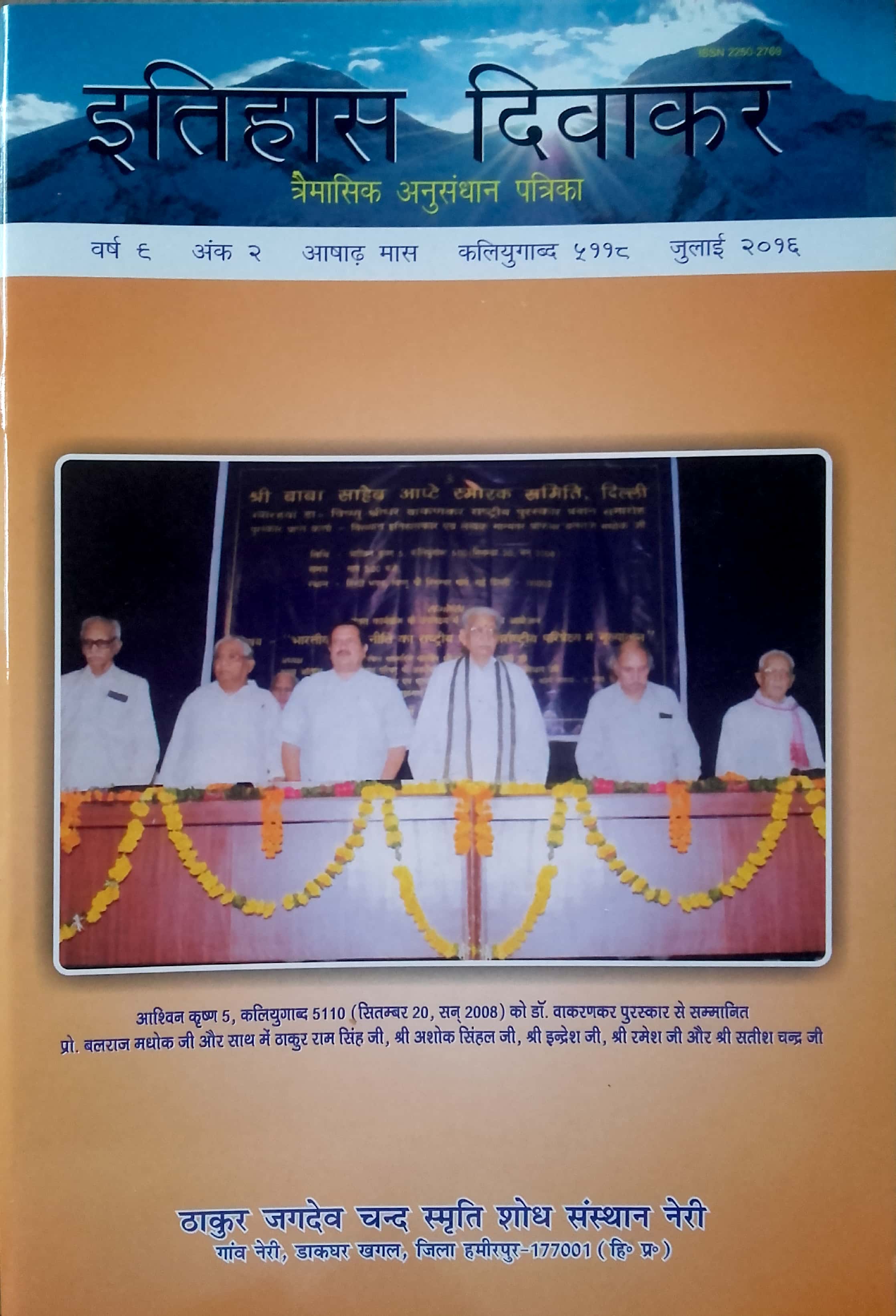
Prof. Balraj Madhok holds a distinguished place among the sons of India who dedicated their lives to the service of the nation. On Vaishakh Krishna 10, Kaliyugabda 5118, corresponding to May 2, 2016, Prof. Madhok passed away at the age of 96. There was a very close relationship between the revered founder of the Neri Research Institute, Thakur Ram Singh, and Prof. Madhok. At the request of Thakur Ji, he delivered the inaugural speech at the Yug Yugeen Trigart national seminar held at the famous historical site of Nagarkot, Kangra in Himachal Pradesh. That historically significant speech is published in this issue of Itihas Divakar.
Prof. Madhok was a nationalist historian of a high order. His historical article 'Hindu, Hindu Dharma and Hindutva' is presented in this issue. His view is clear that the origin of the word Hindu is geographical and its meaning is nationalistic. For many centuries, our ancestors fought against foreigners under this name and made Hindustan famous as a Hindu country. For this reason, Hindutva became a symbol of Hindustan's nationalism. It is necessary that Hindutva be reflected in the national life of independent India. Hindu is not a religion (mazhab), it is Dharma. Dharma means that code of conduct which provides specificity and stability to man and human society.
Yug-Yugeen Trigarta: National Seminar - Inaugural Speech by Prof. Madhok
The present in which we live has its roots in the past. Our history has a place in shaping our current mindset. Therefore, history is important. In our country, history has always been given importance. Knowledge of history was considered essential for kings. The British understood its importance. That's why they kept 2-3 papers on history in the ICS, which they called their Steel Frame. Knowledge of history is of special importance for ruling. But unfortunately, we did not pay attention to history. After independence, we did not try to know our history. Due to a lack of knowledge of history, we have made many mistakes. We made a mistake regarding China, a mistake regarding Kashmir, a mistake regarding Pakistan, and the mistakes that are still happening, their main reason is also the lack of knowledge of history. We have not learned anything from our history. Therefore, paying special attention to the history of our country, writing it, and learning the right lessons from it from a national perspective is the greatest need of today.
Hindu, Hindu Dharma, and Hindutva - by Prof. Balraj Madhok
The people of Bharat or Hindustan or India have been known by the name Hindu since very ancient times. This name is derived from Sindhu. The Sindhu river is a major geographical landmark of this country. This vast river, flowing like an ocean upon entering India from the west, has been a distinct identity of our country. It was on the banks of this great river and its tributary Saraswati that the great Aryan culture and way of life developed, which later spread throughout the country from the Sindhu to the Brahmaputra and from the Himalayas to Kanyakumari. This region was the original home and native land of the Vedic Aryans. From here they expanded to the countries of the east and west.
In the Rigveda, the oldest scripture of the Aryans and the original source of Indian culture and knowledge, this region is called Saptasindhavah (the region of seven rivers) and 'Brahmavarta' (from where the Supreme Being initiated the cycle of creation). The people of the brotherly country Iran pronounced the Sanskrit 'S' as 'H'. Therefore, they called Saptasindhavah as Haptahindavah. The word 'Haptahindavah' is clearly mentioned in the ancient religious book of the Iranians (Parsis), the Zend Avesta. In this way, long before the advent of Christianity and Islam in the world, this country of the Sindhu river had been given the name of Sindhustan or Hindustan. Its people came to be identified by the name Hindu.
The Scientific Basis of Puranic History - by Dr. Thakur Prasad Verma
The Puranas are priceless treasures of India's civilization and culture. They not only contain the origin of the history of India but also of the world, and all those things and conduct that can be beneficial for all of humanity are contained in them. The Puranas are historical texts. Therefore, changes and additions have been made in them from time to time according to the needs of society.
But in reality, as is clear from the name, the Puranas were originally conceived as a source to keep a record of old events happening in the world. They have been considered even more ancient than the Vedas. Whatever the case, the main subject of the Puranas has been considered history, and their five characteristics have been described: Sarga, Pratisarga, Manvantara, Vamsha, and Vamshanucharita. The first two are related to the science of creation, but Manvantaras are a part of Earth's history and are linked to astronomical events. Therefore, despite its connection with astronomy, it is linked to the solar system and the life of the Earth.