Itihas Divakar - April 2016
Editorial: The Glory of Barley
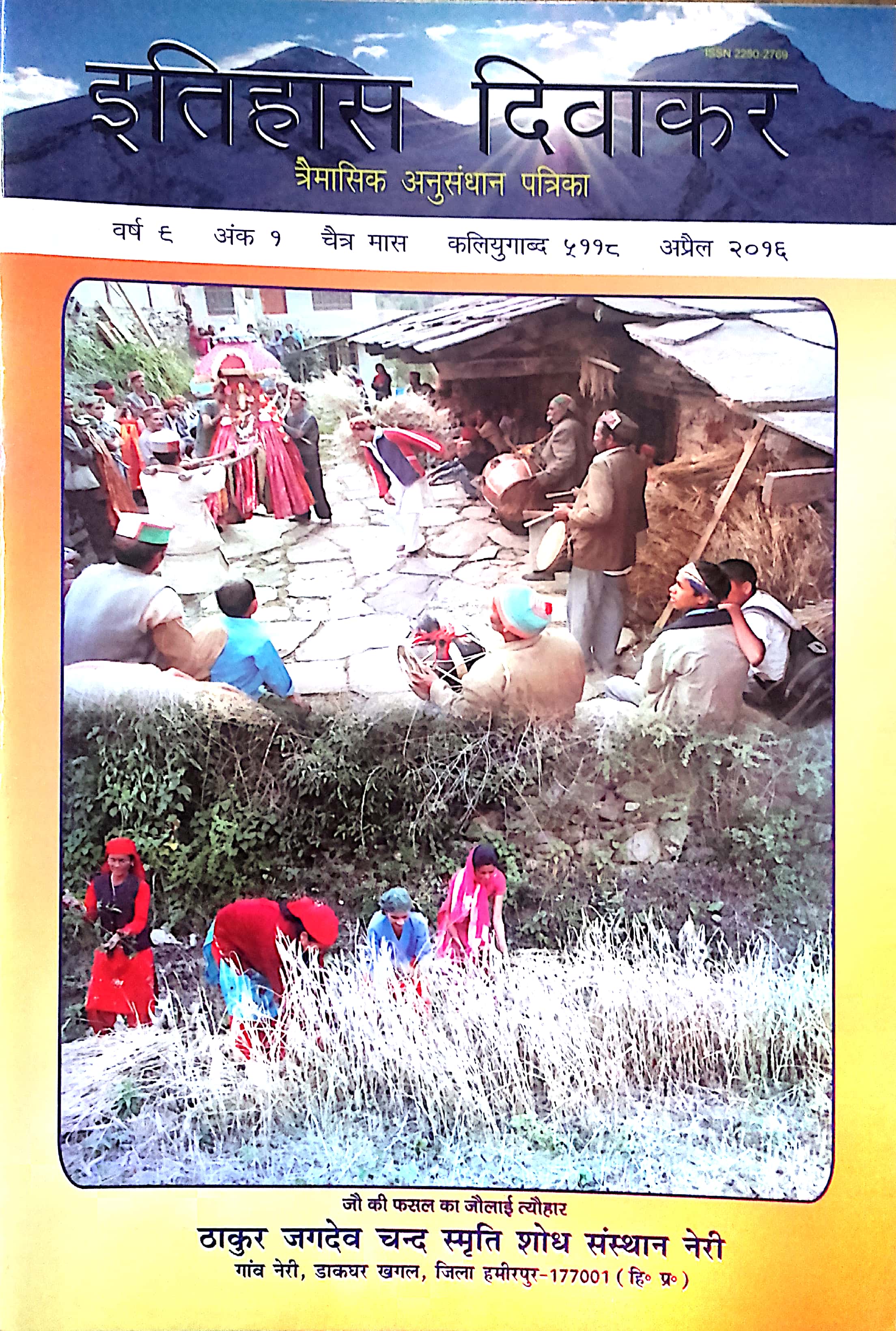
Barahar is a panchayat in the Kullu district of Himachal Pradesh. Hukam Ram was the eldest son of the Numberdar (village headman) of Barahar. After his father's death, the eldest son was supposed to become the Numberdar, but due to his carefree nature, he did not take the position, which his younger brother had to assume. He himself was fond of wandering and chatting. Recalling his words today, it is realized that there is complete truth in what he said. Barley (Yava) is predominant among grains even in the Vedas. For example, in the Rigveda, it is mentioned that hunger can be overcome with barley. In Indian tradition, barley sprouts are grown for the worship of Goddess Bhagwati during Navratri, especially the Chaitra Navratri which begins with the new year, and the Ashwin Navratri. In Himachal Pradesh, these sprouts are called 'Jaura' or 'Loong'. Barley is the first crop to be ready on the occasion of the new year. In this connection, the 'Salahar' festival is celebrated in the month of Vaishakh in some areas of Kullu and Mandi districts. Thus, the glory of barley is prevalent everywhere in scriptures and folk tradition.
Chaitra Sankranti and the New Year
Author: Dr. Surat Thakur
In line with Indian tradition, the new year in Himachal Pradesh is also considered to begin in the month of Chaitra. With the arrival of Chaitra, a new vitality flows through every living and non-living thing. New shoots appear on trees and plants. Every creature finds relief from the shivering cold of the winter season. In most regions of Himachal Pradesh, sweets and clothes are distributed as New Year gifts to relatives and friends upon the arrival of Chaitra. Eating 'Gudani' made of jaggery on Chaitra Sankranti is considered auspicious. According to tradition, it is not considered auspicious to say the name of the month of Chaitra aloud; instead, it is considered auspicious to hear it from traditional singers who sing folk songs of this month.
The New Year: This day is celebrated as a holy day not only in Himachal but in the entire Hindu society. On Chaitra Shukla Pratipada, Brahma Ji initiated creation, and this is the day the new era (Samvatsar) begins. Here it is called by names like 'Naua Saja', 'Gudla Saja', 'Kanaua Saja'. There is a tradition of eating something sweet before dawn. It is a popular belief that the way this day passes, the entire year will be spent. After sunrise, the family priest goes to the homes of his patrons and recites the 'patri' (almanac) detailing the events of the coming year.
The Jau-Lai Festival of the Barley Crop in the New Year
Author: Tobdan
At one time, barley was sown as a major crop throughout Himachal Pradesh. Barley has been an important element of our food. It is nutritious. After roasting barley, 'sattu' is made from it, from which different dishes can be prepared. The importance of barley in our ancient culture can be estimated from the fact that many traditions related to it are still alive and their place is very important. Since Himachal Pradesh is a hilly region and it gets very cold in winter, it is difficult to get fresh flowers these days. The tradition of using barley saplings as flowers has been prevalent throughout the state since ancient times. In Lahoul, it is called 'Yavrag' and in Kullu, in old times, it was known as 'Jaure'.
Modernity and Scientific Nature of Ancient Time Calculation
Author: Dr. Murli Manohar Joshi
The importance of the Srimad Bhagavatam in Indian mythological literature is well-known. In this text, certain philosophical and scientific concepts are interwoven with other stories with such skill that one has to bow before the genius of Vyasa. One such important concept is 'Kala' (Time). In the Srimad Bhagavata Purana, philosophical and scientific discussions on this subject have been presented in detail at many places.
In the eighth chapter of the second canto of the Srimad Bhagavatam, King Parikshit asks various questions to Shukadeva Muni. He asks how many Mahakalpas and their intermediate Kalpas are there? How is the past, future, and present time estimated? And how can the 'Anvi' (subtle) and 'Brihat' (great) motions of time be known? In this chapter, Maitreya tells Vidura that 'Kala' (Time), which pervades the 'Parmanu' (atomic) state of matter, is 'Atyant Sukshma' (extremely subtle time) which experiences all states of creation from beginning to dissolution, and that is the supremely great time.