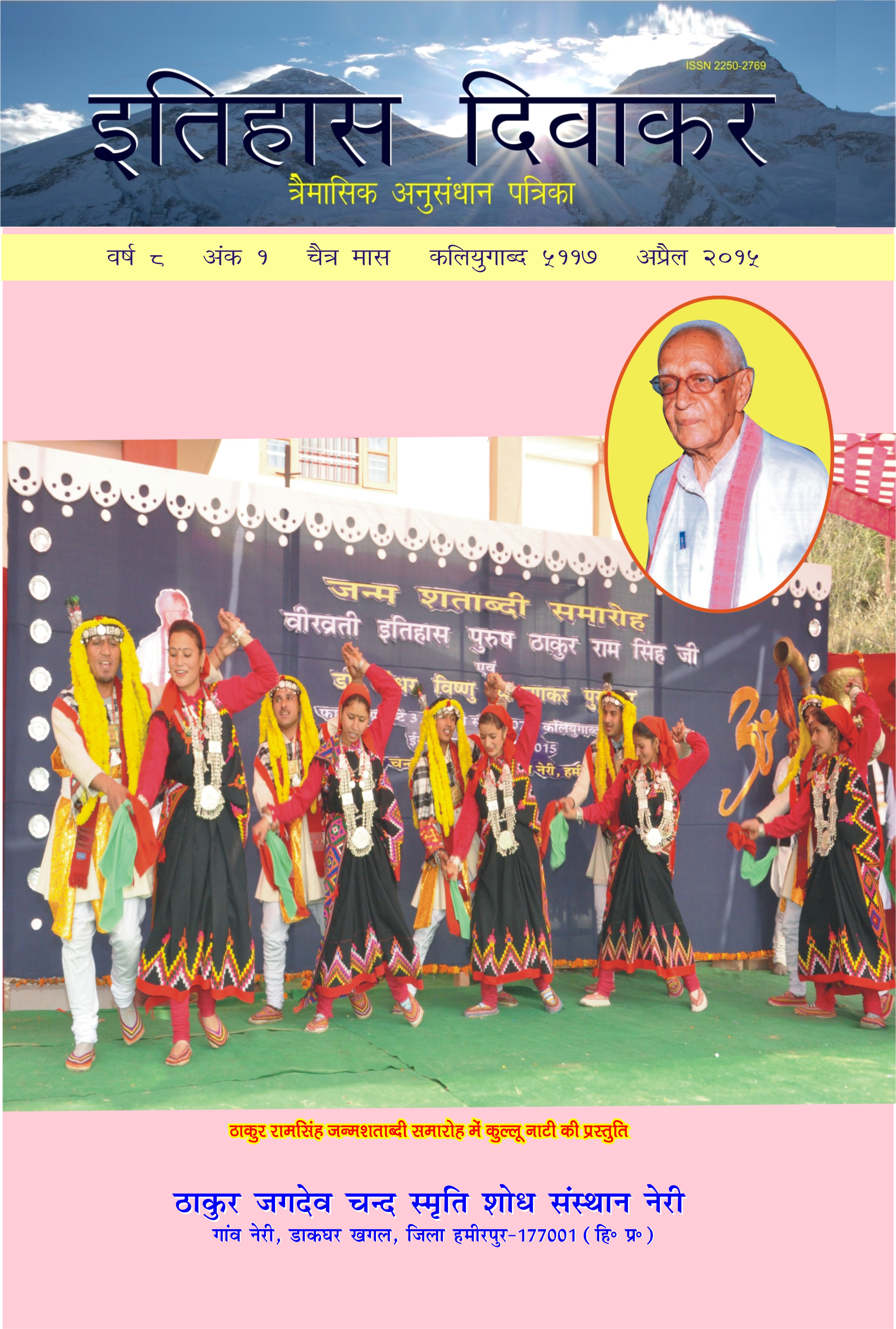
Itihas Divakar: April 2015
Editorial: Understanding All Aspects of History
May the new year Kaliyugabd 5117, Vikrami Samvat 2072, and Shaka Samvat 1937 be auspicious for all. Our new year begins on Chaitra Shukla Pratipada. Being the first day of the new year, Chaitra Shukla Pratipada is also known as Varsha Pratipada. Varsha Pratipada reminds India of its glorious tradition, and from this understanding, the path for the present and future is paved in the light of India's history and culture. It is important to note here that we should not only glorify the achievements of history but also keep in mind the history that describes the mistakes of our past. The consequences of these mistakes make us aware not to repeat them. In this very awareness lie the bright possibilities for the present and future of the nation, society, and human life.
The inspiring statement by the most revered Sarsanghchalak, Dr. Mohanrao Bhagwat, is noteworthy: as long as the people of the country do not recognize themselves, various problems will continue to surround us. Today, we blame each other for the country's problems, but this will not achieve anything. First, we must recognize ourselves; only then can we take the country forward, and only then will the nation's destiny rise. Our Sangh's programs are not for power demonstration but for self-reflection. These programs are for self-realization so that we can recognize our capabilities and use them in the nation's interest. Indeed, for self-reflection and proper assessment of our capabilities, it is essential to understand all the good and bad aspects of history.
The Slaying of Vritrasura with Dadhichi's Bone-Vajra
Baba Saheb Apte
The weapon that Indra used to kill his enemy is called 'Vajra' in our Puranic texts. However, the Vajra that Indra used to kill Vritrasura was not his own; it was a special kind of Vajra prepared for that very purpose, as the famous description goes. The material of Indra's usual Vajra is not described anywhere. But the special Vajra made to kill Vritrasura was made from the bones of a sage named Dadhichi. No other weapon could be used to kill Vritrasura. Indra was told that the only way to kill Vritrasura was to use a Vajra made from Dadhichi's bones. When Indra went to the sage and stated his purpose, the sage gave up his life with great joy through yoga. Subsequently, Indra killed Vritrasura with the Vajra made from his bones. This is a very strange story.
Is this literally true?
This event is mentioned directly or indirectly in many texts, from the most ancient Vedas to the later Puranas, so there is no doubt about the historicity of this event. But even more surprising is that, apart from this one instance, there is no mention of such a use of bone in the vast Sanskrit literature. The description of weapons is found in many places, but they were made of iron and other metals, as has been stated clearly or implicitly.
The Mythological Geography of India
Dr. Om Datt Saroch
The Puranas are the main source of knowledge about Indian religion, philosophy, art, culture, and history. The vision of India's ancient knowledge tradition is found in the Puranas. A detailed description of India's ancient form, geography, and history is found in the Puranas. The vision of an undivided India (Akhand Bharat) is seen from a geographical perspective in the Puranas. According to the Puranas, there are fourteen realms (lokas) in this universe. Six realms are above the Earth, and seven are below. Bhu-loka (the earthly realm) is in the middle of the universe. These fourteen realms are: Bhu-loka, Bhuvah-loka, Svah-loka, Tapah-loka, Jan-loka, Mahah-loka, and Satya-loka, which are above the Earth. The seven realms below the Earth are: Atala, Vitala, Nitala, Gabhastiman, Mahatala, Sutala, and Patala. Among these fourteen realms, Bhu-loka is the Earth where we live. The geography of Bhu-loka includes a detailed description of its islands, continents, regions, mountains, forests, rivers, and countries in various Puranas. The description of the terrestrial sphere has been made considering Bharat Varsha (India) as the central point.
India's Perspective on History
Gunjan Agrawal
What is history? What is the purpose of teaching history? What should be the perspective towards history? What was the tradition of history writing in ancient India? Why rewrite Indian history? – These are some questions that are troubling not only the intellectuals in Indian society but also the country's politicians; and the common person of the country is also curiously watching the ongoing tussle in history. Our belief is that history is the lifeblood of any nation. The knowledge of the national soul and the actions of the national body depend on it. It is the foundation of civilization and a primary component of culture. The contribution of history in building the future is indispensable. Therefore, if history is neglected, the decline of the nation is inevitable.