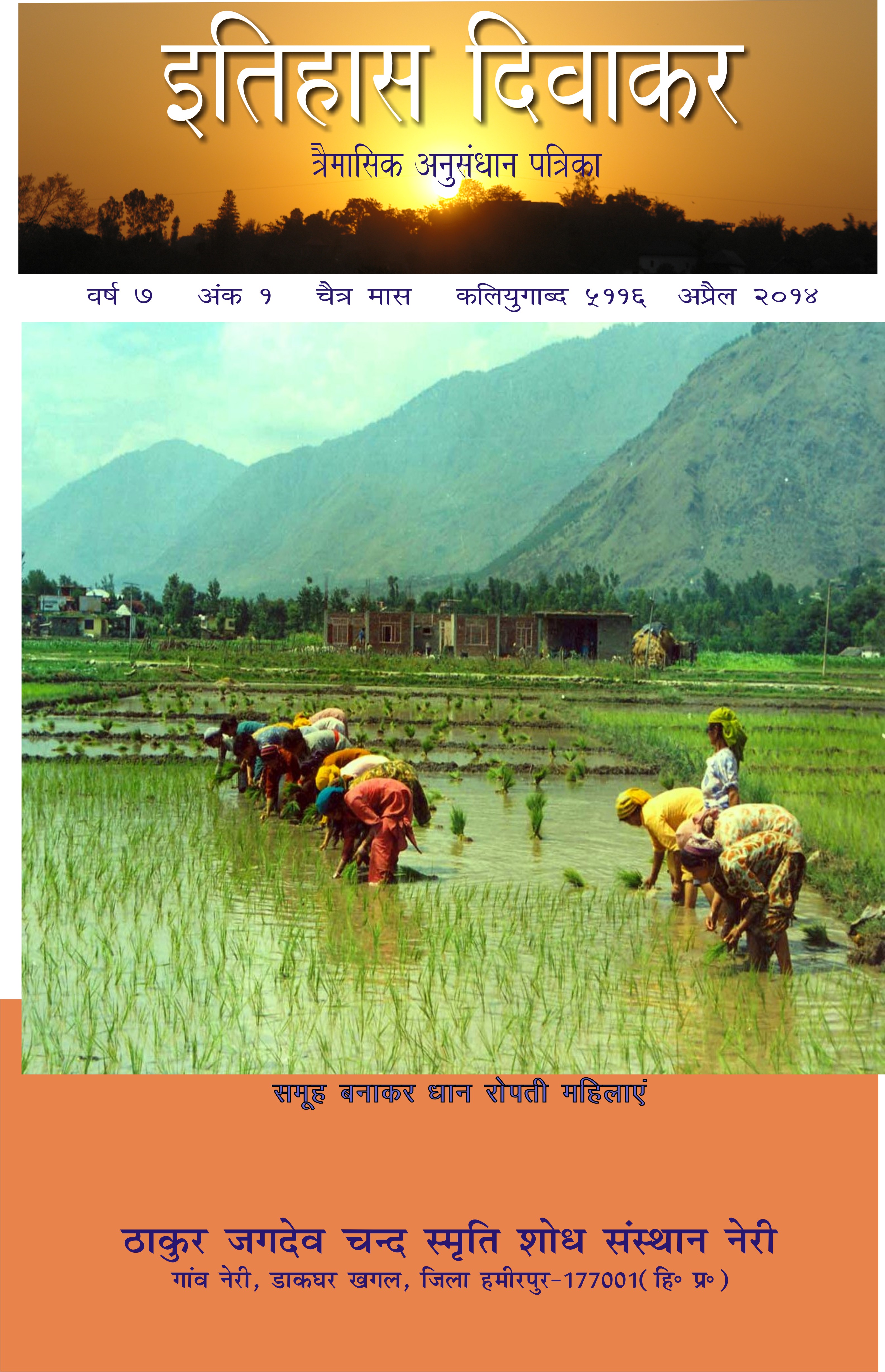
Editorial: Agriculture is the Sustenance of Life
May the new year Kaliyugabda 5116, Vikrami Samvat 2071, and Shaka Samvat 1936 be filled with happiness and prosperity in every way!
The importance of agriculture is timeless and universal. India has been renowned as an agrarian country since ancient times, and the thoughts of sages and the practice of agriculture are the fundamental flow of India's cultural stream. In the Rigveda, the priceless heritage of human society and the Indian nation and the most ancient scripture of world literature, the importance of agriculture has been stated as: 'Engage in agriculture and become prosperous with honor - Krishimit krishasva vitte ramasva bahumanyamanah'.
Krishi Parashar is a unique work in the field of agricultural science, composed by Maharishi Parashar. Maharishi Parashar says that agriculture provides wealth and sharp intellect to man, and the life of the living world is based on agriculture – Krishirdhanya Krishirmedhya Jantunam Jivanam Krishi.
Agriculture can never be neglected for life. In this context, it is said in Krishi Parashar that even if one wears gold ornaments on the neck, ears, and hands, a person still has to fast in the absence of food – Kanthe karne cha haste cha suvarna vidyate yadi. Upavasastathapi syadannabhavena dehinah.
Agriculture is a science with diverse characteristics in different regions. The study of these brings to light many aspects of social life's history, culture, and social thought and behavior. That is why the article by the experienced and renowned scholar of Himachal Pradesh, Shri Maulu Ram Thakur, 'Agricultural Professional Terminology of Kullu,' is being included in this issue. It is humbly expected that authors will provide similar material under the agriculture section in Itihas Divakar in the future.
Universal Scientific Time Calculation
Narendra Sahgal
According to the visionary sages and ancient astronomers of the all-encompassing and all-embracing Indian culture, the first human appeared on Earth on the day of Chaitra Shukla Pratipada. Therefore, this day is important and venerable not only for Indians but for all of humanity. This day heralds the auspicious arrival of the new year for the entire cosmos.
Among the approximately seventy time calculation systems prevalent in the world, the Indian time calculation is the only scientific one whose connection is with the proven principle of time that pervades all of humanity. The rest of the time calculations are based on specific regions and communities. Scholars of the Western world have been saying that the age of human creation is only seven to eight thousand years, but now after new research has come to light, Western scholars have also supported the statement of ancient Indian astronomers that human creation is two billion years old.
Nature-Based Time Calculation
According to Indian philosophy of life, the first human, in the form of the creator Brahma, emerged on the Sumeru mountain from a completely submerged Earth, 1 billion, 97 crore, 29 lakh, 49 thousand, and 15 years ago on a Sunday morning of Chaitra Shukla Pratipada.
The Indian time calculation is based on the laws of nature. The 12 months, based on constellations and scientifically sound—Chaitra, Vaishakh, Jyeshtha, Ashadha, Shravana, Bhadrapada, Ashwin, Kartik, Margashirsha, Pausha, Magha, and Phalguna—make up a year. Similarly, the planet-based naming of the seven days of the week—Sunday, Monday, Tuesday, Wednesday, Thursday, Friday, and Saturday—was also done by Brahma himself on the basis of science.
Core Elements of Indian National Thought
Dr. Satish Chandra Mittal
Nation, nationality, or nationalism are well-known words in the history of the world. While its concept is ancient in Indian thought, its contemplation in the Western world is a product of the 18th and 19th centuries. The basis of one is fundamentally cultural, the other's political. Naturally, the course of development and concept of both has been different.
To understand it in the historical context of India, it will be necessary to know its meaning, nature, scope, and its essential elements. There are many questions related to this. What is nationality or nationalism? Is this an ancient concept or a modern idea? What has been its form in different countries, in different times? Is this an emotional expression, a hindrance to current global thinking?
The Meaning of Nationalism
Western thinkers and Indian scholars have from time to time expressed the meaning and sentiment of the idea of nationalism or nationality. The concepts of nationalism in modern India are mainly influenced by Western thought. The 'Encyclopedia Britannica' states, 'Nationality is a state of mind in which an individual feels supreme loyalty towards his nation.' The famous British scholar Hans Kohn (1891-1971) clarified this by writing, 'Nationality is an idea, a thought-force that fills the human mind and heart with new ideas and emotions and inspires them to organize their consciousness and bring about change in their actions.'