Editorial
The Backbone of India
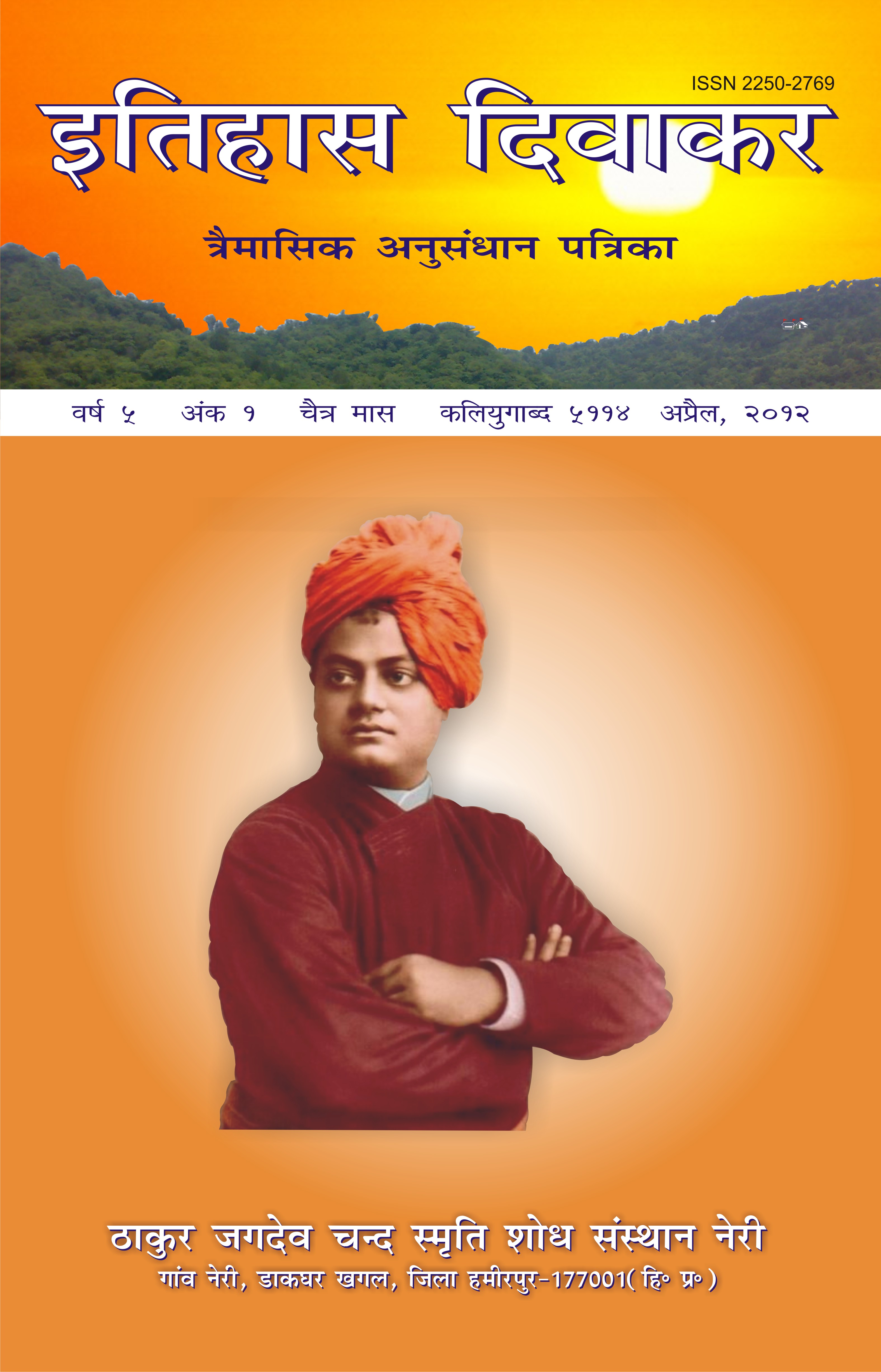
Endless greetings for Navasamvatsar Kaliyugabda 5114, Vikrami Samvat 2069, and Shaka Samvat 1934. In the Indian Sanatana tradition, the holy festival of the New Year is recognized nationwide on the day of Chaitra Shukla Pratipada. This day is connected to the religion and spirituality of India. The noble path of India's religion and spirituality – 'ā no bhadrāḥ kratavo yantu viśvataḥ' (Rigveda 1/89/1), meaning – 'Let noble thoughts come to us from all sides', is a Vedic message beneficial not only for the nation of India but for the entire world community. Swami Vivekananda re-established the impression of the philosophy of India's sages' religion and spirituality very deeply in Western society. Swami Vivekananda was born to father Vishwanath Dutt and mother Bhuvaneshwari Devi on Magha Krishna Saptami, Kaliyugabda, 4964, corresponding to January 12, 1863, in Calcutta. His parents named him Narendranath, who became famous worldwide as Swami Vivekananda after receiving divine knowledge from Swami Ramakrishna Paramahamsa. On September 11, 1893, while addressing the World Parliament of Religions in Chicago, America, as a representative of Hinduism, when Swamiji began with 'Sisters and Brothers of America', the entire audience was mesmerized. After unfurling the flag of India's religion and spirituality in foreign lands, when Swami Vivekananda reached the shores of India at Pamban town via Jaffna, he said in his reception ceremony there that he has traveled Western countries and has had much contact with different nations. He felt that every nation must have a specific ideal. This ideal is the backbone of the nation's life. India's backbone is not politics, nor is it military power, nor is it commercial supremacy, nor is it mechanical power. India's backbone is Dharma (religion).
Vivekanandamritam
Dharmabhoomi Bharat (The Land of Dharma, India)
Swami Vivekananda
'Whenever there is a decline of righteousness and a rise of unrighteousness, then I manifest myself.' These words are from the holy Gita, the words of the eternal Lord. This sentence is the root mantra of the principles of the eternal rise and fall of the spiritual power-flow in the world. These changes are repeatedly manifested in the world in new rhythms, and although, like other great changes, they affect every minute object in their field of action, their power is found to be more manifest in favorable places. Just as in the collective form, the primitive state is the equilibrium of the three gunas, and all the struggles that occur to break this equilibrium and regain it are what we call the manifestation of nature – this world – and the activity of the world and objects will continue in this manner until the original equilibrium is attained. Similarly, it seems that as long as humanity exists in its present form on this earth, disparity and its eternal companion, the effort to achieve equilibrium, will both continue side by side. As a result, specificity will continue to be created everywhere in the world, from different races and sub-races to individuals.
Navasamvatsar
Nav-Samvatsar Month and Day System
Dr. Gaurinath Rastogi
The prevailing Nav-Samvatsar (New Year) in India is not just indicative of the arrival of the new year for Indians, but for the entire human creation. It is said that 'chaitra māse jagad brahmā sasarja prathame'hani, śukla pakṣe samagraṁ tu tadā sūryodaye sati.' In simple words, it was in the Shukla Paksha (bright fortnight) of the month of Chaitra that Lord Brahma structured the creation, creating the sun, moon, earth, constellations, etc., and started time calculation based on their motion. Before the creation of the sun, deep darkness of Amavasya (new moon) was spread across the three worlds. With the advent of the sun, light began on earth. The entire process of this creation and time calculation was done by Brahmaji in harmony with nature. Fifteen days after the darkness of Amavasya was dispelled, on the full moon day when the Chitra Nakshatra was present, the month was named Chaitra.
Nav-Samvatsar in Kullu
Om Prakash 'Shastri'
On the first day of the Chaitra Shukla Paksha, the new year, or Nav Samvatsar, begins in India. This new year is called 'Naunh Sanvat' in the Kullu region of Himachal Pradesh. Based on this Naunh Sanvat, the dates of fairs, festivals, and celebrations for the entire year are decided. In reality, this Naunh Sanvat is a festival celebrated in a peaceful atmosphere. According to popular belief, the way this day begins is how the entire year will pass. Therefore, on this day, no such food should be consumed that might create an atmosphere of fighting, quarreling, or any unpleasantness for the whole year.
Review
The Rewriting of History
Baba Saheb Apte
The history of India that has been written so far has been written mainly by foreign authors. In it, the tendency to portray our past in its true form is not visible. There can be several reasons for this. The ignorance and prejudice of the authors are a major obstacle, but the most potent reason has been the cunning conspiracy of the British to defame India in the world and to create a feeling of inferiority among the conquered. For this reason, notions were created such as, 'Being a hot country, the people here cannot work hard, their intellect can only write philosophy or poetry,' and in their confirmation, it was then said that 'The Aryans came and settled in India from outside.'
A Critical Study of the Sankalp-Paath
Dr. Om Dat Saroch
Our culture is action-oriented. The Upanishads, while inspiring continuous action, wish for an age of a hundred years, saying – 'Kurvanneveha karmāṇi jijīviṣāmaḥ śataṁ samāḥ'. During the Mahabharata war, when Arjuna, overcome by attachment, was turning away from the battle, Shri Krishna made him understand the importance of karma and, by imparting the knowledge of Karma Yoga, engaged him in the act of war. The Veda is the primordial knowledge of the world. There are two main streams of Vedic knowledge – Jnanakanda and Karmakanda. Jnanakanda includes philosophical contemplation, the glory of the Supreme Being, and various hymns to deities. Karmakanda includes rituals like yajnas and worship.
The Era of Maharaj Shri Agra and His Descendants
Om Prakash Garg 'Madhup'
An ancient saying goes, 'As the king, so the subjects.' This principle must have been before the learned people in history writing since ancient times, which is why almost all historical texts in the world are written keeping in mind the royal class and their system of governance. In the tradition of India, the rightful holder of the title of king is a Kshatriya. In the Puranas and Smritis, etc., if it became necessary to write about other kings due to circumstances, only a brief mention was made, or an attempt was made to present them as Kshatriyas as well.
Revolutionary
Satyagrahi Revolutionary - Shobha Ram
Roop Sharma
Mandi was a famous state in Himachal Pradesh before independence. The year 1909 AD holds a special place in the history of Mandi state. This was the historic year when the throne of the then-ruler Raja Bhawani Sen began to shake. A young man named Shobha Ram, demonstrating his wisdom, gathered the पीड़ित people into an organized group in the Paddal ground of Mandi and performed a unique feat. For about eight days, the administration in Mandi state was in the hands of Shobha Ram instead of the king. At that time, this saying became popular among the people— 'Raj Bhawani Sen ra, Hukam Shobha Ram ra' (The kingdom belongs to Bhawani Sen, but the orders are of Shobha Ram).
Place Chronicle
The Glorious Ujjayini
Lalit Sharma
In the heart of India, Madhya Pradesh, the mythological and cultural city of Mahakalpuri, or Ujjayini, has the distinction of being the capital of the ancient and era-founding hero Vikramaditya and of enshrining the timeless Mahakaleshwar Shiva in its lap, making it the central point of the entire ancient world. From the Vedas to the great epics and all Puranic texts, the glory of this ancient and glorious city has been sung. Lord Shri Krishna received his education in the ashram of Guru Sandipani here and then gave the world the knowledge of the Gita.
Travelogue
A Glimpse of Kinnaur Kailash
Birbal Sharma
The public considers the marvelous rock formations standing on the mountain peaks of Himachal Pradesh as Shiva's Kailash. Every year, thousands of people undertake the difficult and risky journey to these Kailashes, which are symbols of religious faith. In 1999, during a journey to Shrikhand in July, when our group of fellow travelers from Mandi-Kullu set out from Bagi Pul-Jao-Singhad, we could not proceed up the Dandadhar due to continuous rain and had to turn back.
Activities
97th Birth Anniversary of the Late Thakur Ram Singh Ji
On Phalgun Pravishte 4, Kaliyugabda 5113, Krishna Paksha 9/10, corresponding to February 16, 2012, the 97th birth anniversary of the late Thakur Ram Singh Ji, the founder and national historian of the Thakur Jagdev Chand Smriti Shodh Sansthan, was celebrated at the research institute in Neri, District Hamirpur (Himachal Pradesh). On this occasion, scholars from different parts of the country and the local public offered their heartfelt tributes to the revered Thakur Ram Singh Ji. Prof. Prem Kumar Dhumal, Chief Minister of Himachal Pradesh, was the chief guest of the ceremony, and O. Nyamdavaa, former ambassador of Mongolia to India, was present as a special guest at the ceremony.