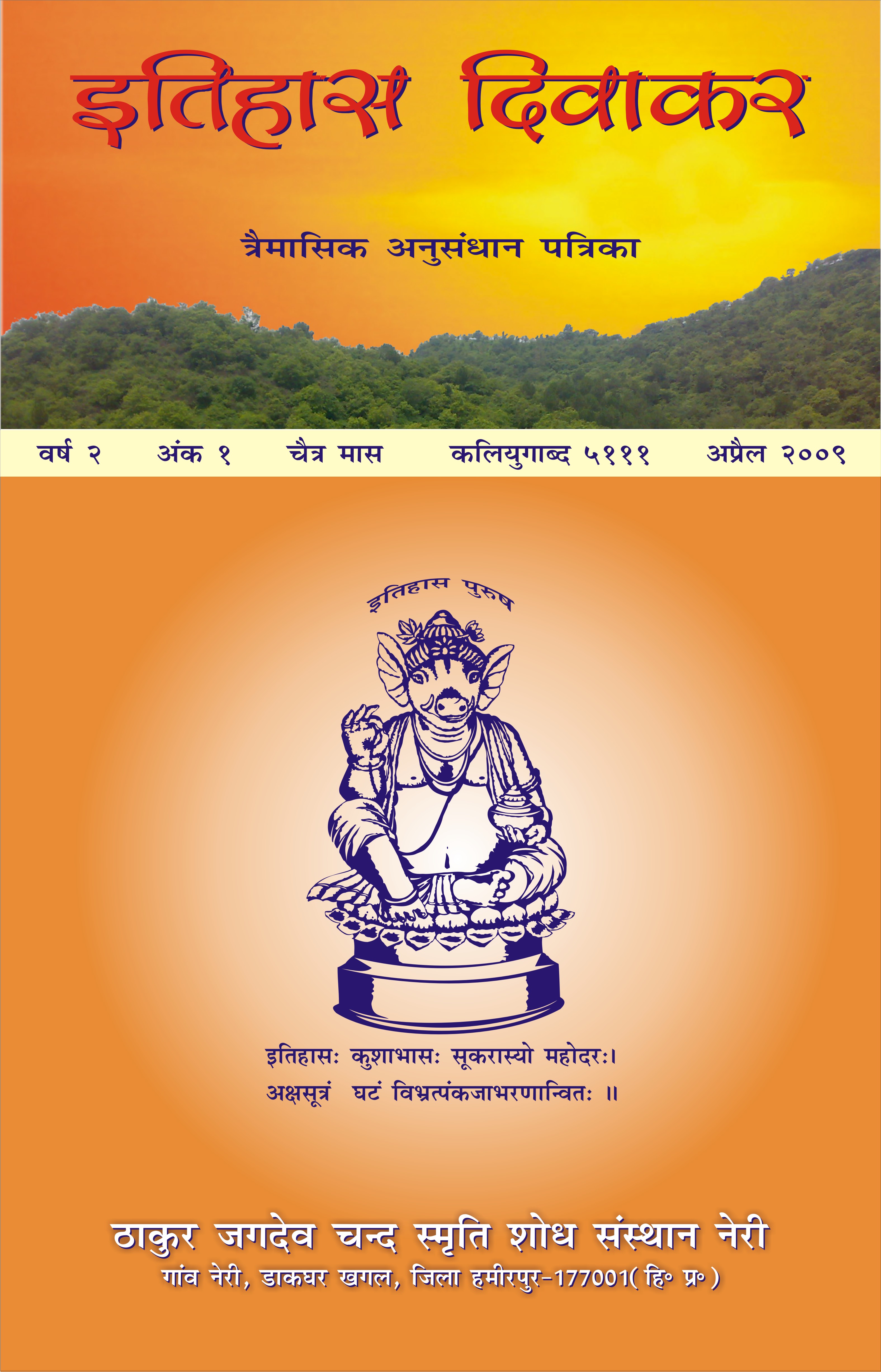
Itihas Diwakar - April 2009
Editorial: New Samvatsar: Kaliyugabd 5111
In India, according to tradition, many eras (Samvats) are prevalent within a one-year period, among which Vikrami and Shaka Samvat are the most famous. Vikrami Samvat holds a prestigious place in northern and central India, while Shaka Samvat is widely used in western and southern India. The promoter of Vikrami Samvat is considered to be the justice-loving ruler of Ujjain, Maharaja Vikramaditya, and the Shaka Samvat was established by the brave and mighty king Shalivahana of Pratisthanpur, Saurashtra. One thing was common between these two rulers: first, Maharaja Vikramaditya defeated the foreign invading Shakas and expelled them from India, and later, when their activities somehow increased again, 135 years after the Vikrami Samvat, King Shalivahana completely defeated the Shakas and liberated the country. After freeing the country from foreign enemies and taking it to the pinnacle of power and prosperity, the Vikrami Samvat started in 3044 of the Kaliyugabd, and 3179 years later, the Shalivahana Shaka Samvat began. Today, due to official recognition, the Christian era is often used in general work, but every religious act, vow, festival, and all rites from birth to death of the society connected with India's eternal tradition are determined based on the lunar dates or solar entries of the Vikrami and Shaka Samvat. In addition to these two and other prevalent eras in the country, in recent years, with the rise of national sentiment, Indian society has once again become aware of its ancient scientific era, the Kaliyugabd. It is also known as Kali Samvat or Yugabd because this era expresses the time period of Kali Yuga; therefore, for clarity, it is appropriate to call it Kaliyugabd.
The use of Vikrami, Shaka, etc., eras, which developed on the rich ground of India's history and culture, certainly reflects our national pride, but we must also be aware that all these eras, being related to a specific person or a particular event in a timeline, cannot be the fundamental scientific basis for time calculation. In reality, time calculation is directly related to time, and therefore, only the calculation connected to time can be considered scientific time calculation.
Let every citizen of the nation greet the New Year, which is a symbol of the nation's glorious tradition, with all their heart, and on this sacred occasion, wish for the well-being of the entire creation. Our prayer at the feet of God is:
Sarve Bhavantu Sukhinah, Sarve Santu Niramayah।
Sarve Bhadrani Pashyantu, Ma Kaschid Dukhbhag Bhavet।
Meaning, may all beings be full of happiness and peace, may all be free from disease and ailments, may no sorrow come to anyone's share, and may all see and follow the path of welfare.
National Great Festival: Varsh Pratipada
• Th. Ram Singh
Varsh Pratipada falls every year on the first day of the bright fortnight (Shukla Paksha) of the month of Chaitra. In every home in our country, the festival of Varsh Pratipada is celebrated with great enthusiasm and devotion. That is why this sacred day has gained the importance of a national great festival. It is mentioned in the famous astrological text Hemadri that the creator Brahma began the creation on Chaitra Shukla Pratipada. A similar reference is found in the Brahma Purana: Chaitra masi jagad brahma sasarja prathame'hni. Shuklapakshe samagram tu tada suryodaye sati. Meaning, Lord Brahma created the universe on the first day of the bright fortnight of the month of Chaitra, at sunrise.
Later, some events of national importance became associated with this day, which gave this festival immense faith and recognition in society. For example, in the Satya Yuga, to save the world, Lord Vishnu took his first incarnation in the form of a fish (Matsya) on this very day.
Example of Iran
On the first day of the year 2001, January 1st, some Muslims in Iran organized a New Year's Day celebration. For this crime, the government there sentenced them to fifty lashes each. All the men and women who participated in the ceremony had to suffer this punishment. The government's stance was that January 1st is the New Year's Day for Christians—not for Muslims. Is this incident, published in newspapers, not a lesson for us? Therefore, we, the citizens of India, can experience self-respect by celebrating our own Indian New Year on Chaitra Shukla Pratipada instead of January 1st. We should understand the importance of our Samvatsar like Iran does.
Vikrami Samvat and Shak Samvat
• Rajkumar Punj
In Indian time calculation, the duration of time is divided into Kalpa, Manvantara, Yuga, Samvatsar, etc. Any person in Hindu society, whether they live in a village or a city, is educated or uneducated, may not know much about the long periods like Kalpa, but they are certainly aware of the four Yugas. They also know that at present, the time of Kaliyuga is ongoing among the four Yugas. The knowledge of Kaliyuga and the four Yugas in the public consciousness, under the time-based calculation, is a symbol of our rich tradition and scientificity of timekeeping. The classical tradition tells us that in the year 2009, on March 27, on the day of Chaitra Shukla Pratipada, when the new year based on Indian time calculation begins, from that day Kaliyugabd 5111 starts. Besides this, this day is the first day of the new year for many of India's eras, among which Vikrami Samvat and Shak Samvat are prominent. From the Varsh Pratipada of March 27, 2009, Vikrami Samvat 2066 and Shak Samvat 1931 begin.
Dr. Keshavrao Baliram Hedgewar
• Baba Saheb Apte
We have been celebrating the Varsh Pratipada festival in this country since the beginning. Varsh Pratipada is a day of inspiration and victory. Various aggressors came to our country from outside. We drove all of them away. History tells us that when the Greeks invaded our country, Chandragupta Maurya not only drove them out of the country's borders but also expanded the country's boundaries. Like the Greeks, the Shakas also invaded. But this invasion was different from that of the Greeks. The Shakas had spread their kingdom far inside the country. Vikramaditya completed the remaining work of assimilating the Shakas into his culture. That is why he is called 'Shakari Vikramaditya'. The day this work was completed was a day of victory for society. Therefore, a new year count of the Shak Samvat started from that day. Our society celebrated this day, 'Varsh Pratipada', as a festival. The Rashtriya Swayamsevak Sangh has also given Varsh Pratipada the status of a festival because the Sangh also wants to do this work.
The Secret of Emperor Prithviraj Chauhan's Defeat in the Second Battle of Tarain
• Sushri Charu Mittal
Two important epic texts—Prithviraj Raso and Prithviraj Vijay—have been written on the life of India's last Hindu emperor, Prithviraj Chauhan. In the educational institutions of Hindustan, it is taught about Prithviraj Chauhan that he had enmity with King Jaichand of Kannauj, and for this reason, Jaichand invited Muhammad Ghori to attack Prithviraj. Jaichand helped Muhammad Ghori to defeat Prithviraj Chauhan. This is why Prithviraj lost the second battle of Tarain. But this is not the reality. Prithviraj was the emperor of India. Jaichand was nothing before him. The reason for Prithviraj's defeat was not Muhammad Ghori either. Therefore, to know the secret of Prithviraj's defeat, it is necessary to know about Prithviraj.
Result of the War
Delhi came under the rule of the Muslims. Prithviraj's established security line (from Jammu to Gujarat) was broken, and as a result, within 100 years, the aggressive armies of Islam reached the Indian Ocean in the south. An insider brought down Lanka. Prithviraj was defeated due to the personal prestige and treason of Hamir Rai, not because of Muhammad Ghori or Jaichand. The terrible mistakes that have been made in Indian history, among them all, the most terrible mistake was made by Hamir Rai, who considered his personal prestige greater than his country and neglected the explanations of Chand Bardai for a month and the apology sought by Prithviraj.